
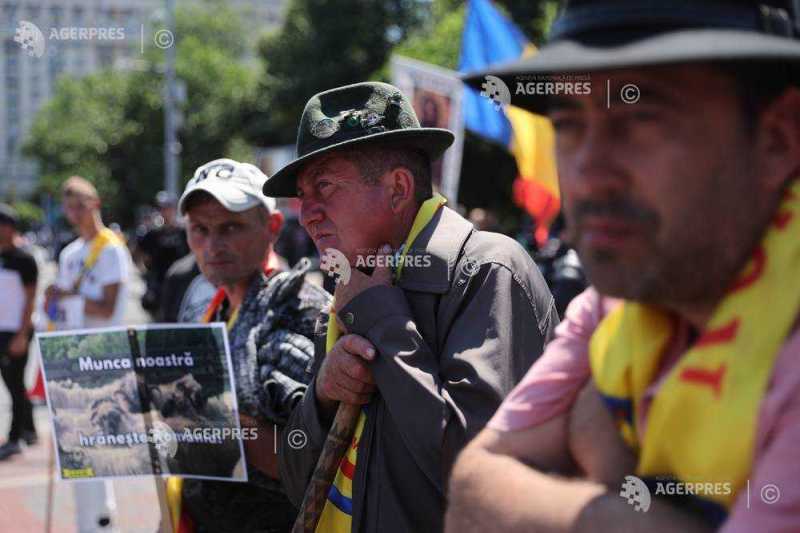
Several hundred shepherds are participating in a protest on Tuesday morning, for which mobilisation was organised on social media, with the shepherds moving from the car park in Victoriei Square, where they initially gathered, to the pavement in front of the Antipa Museum.
Protesters contacted by AGERPRES declined to comment.
The shepherds' main grievances concern the management of outbreaks of sheep plague or sheep pox and measures leading to the slaughtering of animals, as well as the ban on sheep and goat exports as a result of the PPR (Peste des Petits Ruminants - also known as sheep and goat plague).
They began gathering in the car park in Victoriei Square at 08:00.
The protest was organised through social media, with one of the initiators being Ionica Sterp (Shepherd Ionica).
On the other hand, the National Federation of Sheep and Goat Breeders in Romania (ROMOVIS) said in a release earlier this month that the sheep and goat sector is going through an extremely difficult period. Breeders have suffered significant losses as a result of restrictions affecting intra-EU trade and exports, while the problems raised by farmers are real and require concrete responses from the authorities.
The ROMOVIS said, however, at the time that it was not the organiser of the protest announced for Tuesday, 15 September, and had not been involved in its organisation or conduct, farmers' participation in the protest being an individual decision.
Separately, the Bucharest Gendarmerie announced that, together with the other relevant institutions, it will take measures to ensure public order and protect participants at the public gathering to be held on Tuesday in Victoriei Square in Bucharest, including setting up checkpoints for body and baggage checks.
The shepherds' dissatisfaction is mainly driven by the European Commission's decision in June to extend the ban on exports of sheep and goats from Romania to third countries until 31 December 2026, while also maintaining the ban on deliveries to European Union (EU) member states.
Interim Minister of Agriculture and Rural Development Tanczos Barna announced at the beginning of last week that, following discussions held in Brussels, concrete prospects had been identified for unblocking sheep and goat exports.
According to the National Veterinary Sanitary and Food Safety Authority (ANSVSA), the Action Plan submitted to the European Commission to unblock sheep and goat exports provides, among other measures, for the differentiated administration of 1.3 million vaccines obtained free of charge from the European body. AGERPRES (RO - writing by: George Banciulea; EN - writing by: Rodica State)
- Category: English
- Date: 2026-09-15 10:08:47
- Foto: RADU TUTA / AGERPRES PHOTO