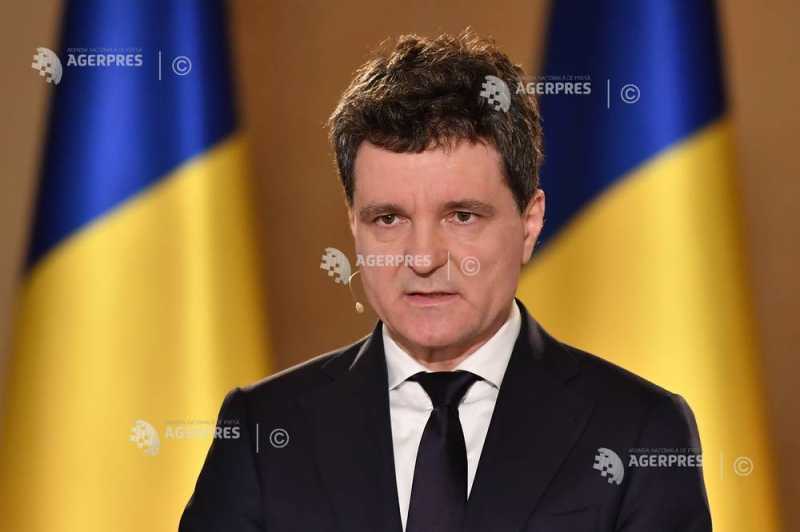


Romania has gone through a year of consolidation involving the most ambitious fiscal adjustment in the European Union (EU), moving from an economy based on debt-fuelled consumption to one based on investment and long-term development, interim Finance Minister Alexandru Nazare says.
In a post on his Facebook page, he provided an up-to-date economic assessment of Romania, 'the country that entered 2025 with the largest fiscal deficit in the EU'.
'In 2024, Romania recorded a budget deficit of 9.3% of GDP. No other EU country entered 2025 with a deficit of more than 6%, while the EU average was 3.1%,' the finance minister wrote on Monday.
In his view, this was the starting point for the fiscal consolidation Romania has undergone over the past year. According to the European Commission's forecast, Romania's annual deficit fell to 7.9% of GDP in 2025 and is estimated to reach 6.2% in 2026. For the second consecutive year, Romania is projected to record the largest deficit reduction in the EU.
'Today, just over a year since we changed the paradigm of public finances and following the first seven months of 2026, we have a clear picture of the direction in which we are heading. The budget deficit fell from 76.44 billion lei in the first seven months of 2025 to 48.08 billion lei in the first seven months of 2026. This means 28.36 billion lei less, a reduction of approximately 37%. This development is not accidental. Budget revenues increased by 11.2%, while total expenditure increased by only 2.9%. At the same time, personnel expenditure fell by more than 4 billion lei,' Nazare said.
He believes that, after a year of consolidation, Romania is no longer remotely in the position it was in at the beginning of 2025, when the accumulation of a deficit of more than 9% meant an economy dependent on borrowing to sustain a level of spending that state revenues could not cover.
'We have radically changed direction, but it is essential that we maintain the same trajectory. Reducing the deficit is essential to put public finances on a sustainable footing and reduce the pressure of debt on the economy,' the finance minister added.
According to Nazare, the government's gross financing requirement rose from 135 billion lei in 2021 to 278.5 billion lei in 2026. This includes both financing the new deficit and refinancing accumulated debt falling due. Public debt increased from 46.9% of GDP in 2020 to 59.6% at the end of 2025, exceeding 1.138 trillion lei.
Therefore, Nazare stressed, reducing the deficit is not a matter of choice and can no longer be postponed because 'today's deficits become tomorrow's debt and interest'.
'And the cost of this debt is very tangible: in the first seven months of 2026, interest expenditure increased by 26.5%, exceeding 40 billion lei. Every additional leu paid in interest is a leu that can no longer be used for schools, hospitals, roads or better public services,' the minister said.
Nevertheless, in this context of high pressure on public finances, the deficit adjustment was not achieved through cuts to investment, nor by sacrificing long-term development - on the contrary, investment continued to grow. This is one of the most important differences compared with a fiscal adjustment carried out solely by reducing expenditure, Nazare pointed out.
In the first seven months of 2026, investment reached 76.51 billion lei, 14.83 billion lei more than in the same period last year, while more than 71% of investment payments were linked to European funds and the National Recovery and Resilience Plan (PNRR). At the same time, payments for projects financed through European funds and the PNRR increased by 20.40 billion lei, or 60.08%, compared with the same period last year.
According to the same source, the policy pursued by the Ministry of Finance is aimed at reducing expenditure 'that puts a permanent burden on the budget' and protecting expenditure 'that develops Romania'.
'We have begun shifting the centre of gravity of the economy away from consumption and current expenditure financed through debt towards investment, production, infrastructure, business activity and jobs. Romania must continue to make a much deeper change than simply reducing the deficit. We must change the model of economic growth,' Alexandru Nazare said. AGERPRES (RO - writing by: Cristian Anghelache; EN - writing by: Cristina Zaharia)
- Category: English
- Date: 2026-09-07 11:35:57
- Foto: GRIGORE POPESCU / AGERPRES PHOTO