

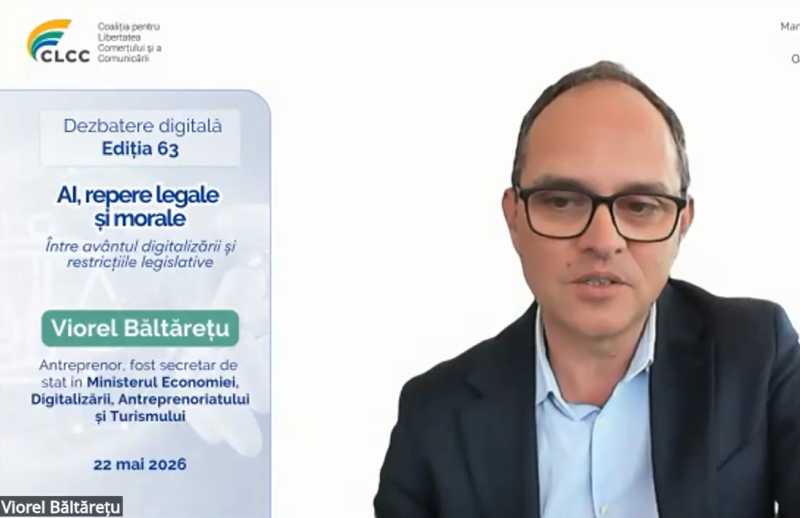
Only 5.2% of companies in Romania currently use technologies based on artificial intelligence (AI), compared to a European average of about 20%, while 66% of Romanian SMEs say they want to adopt such solutions, said Viorel Baltaretu, entrepreneur and former secretary of state in the Ministry of Economy, at a specialized debate on Friday.
'5.2% is the percentage of all companies in Romania that currently use AI technology. The European average is around 20%, and the countries where it is used the most, Estonia, for example, exceed the level of 40%. So, compared to the European average, we are currently about a quarter behind,' said Baltarețu, at the digital debate 'AI, legal and moral benchmarks. Between the boom of digitalization and legislative restrictions', organized by CLCC Coalition for Freedom of Trade and Communication.
According to him, another report shows that two-thirds (66%) of Romanian SMEs say they want to use AI and believe that this technology will transform the industry.
'We're talking about 66% who want to and 5% who do. That proves to me that it's not a problem of technology. It's a problem of courage and taking the first step,' said the entrepreneur.
In his opinion, the technology is already accessible and can be implemented at low cost, but many companies are still reluctant. 'After all, a subscription to ChatGPT, Claude or other simple AI tools, which means the basis of AI, costs somewhere around $20 per month. It's not the complexity. The technology exists, it's accessible and it works today. It's, unfortunately, the fear of the unknown. It's the feeling that AI is for others. Maybe for companies, for IT people, for people with big budgets. I think this fear is the most expensive thing that Romanian SMEs are paying for at the moment. And the reality is this: the world is not standing still,' explained Baltarețu.
In his opinion, Romanian companies risk losing ground to competitors from other European countries that are already using artificial intelligence to increase productivity. 'AI is no longer a competitive advantage at this point. In my opinion, AI is becoming a basic condition to stay in the game. Just like the internet was in 2000, just like the smartphone was in 2010. We have competitors, companies from Poland, the Czech Republic, Germany, that use AI and are obviously accumulating a productivity gap compared to Romanian companies every month,' he said.
Baltaretu stated that SMEs can use AI in areas such as marketing, customer relations, data analysis, legal activities or human resources, with low investment and rapid benefits in terms of productivity.
'The benefit for a smaller company, think about it, can be between 5 and 15 hours of work saved every week. That is between 20 and 60 hours per month. Return of investment in the first month, not in the first year, in the first month. It is an extraordinary leap from a productivity and efficiency perspective,' he said.
At the same time, the former secretary of state assessed that the Romanian state does not currently have a strategy regarding the adoption of AI in the SME sector, criticizing the way in which European regulations in the field were introduced. 'Unfortunately, the Romanian state did not have and does not currently have a strategy for the adoption of AI for SMEs. (...) We had debates about risks, about ethics and about algorithms, but what we did, from my point of view, was to regulate before educating. And this is a mistake that companies are paying for at the moment, not the state,' the entrepreneur argued.
On the other hand, Viorel Baltaretu recommended entrepreneurs to start testing AI tools without waiting for ideal conditions or complete regulations. 'AI will not take your business. But a competitor who uses AI, and you do not, can take your customers,' he warned.AGERPRES (RO - writing by: Nicoleta Banciulea, editing by: Mariana Nica;EN - writing by: Catalin Cristian Trandafir)
Only 5.2% of companies in Romania use AI, compared to European average of 20% (entrepreneur)
Autor: agerpres.ro
Timp de citire: 3 minute
Alte știri din categorie
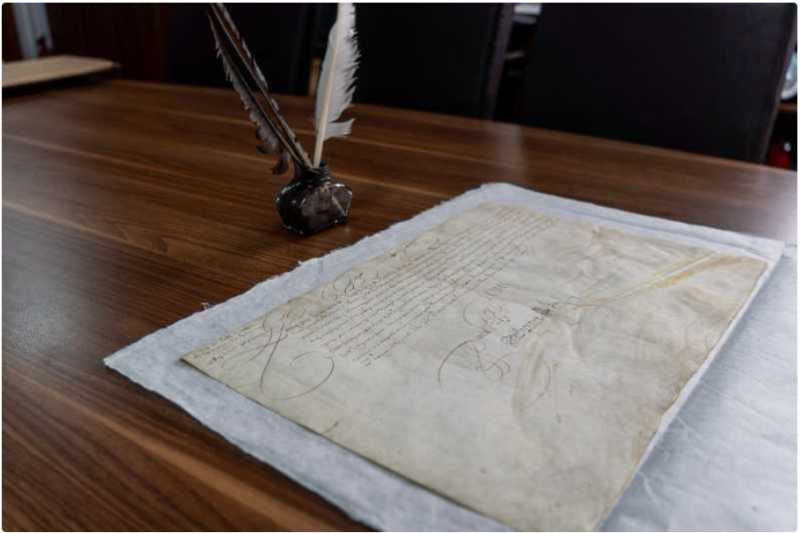
Rare parchment signed by French King Louis XIII enters Dambovita County Library's collection
A rare document signed by King Louis XIII of France has recently entered the collection of the 'Ion Heliade Radulescu' Dambovita County Library, an acquisition the institution considers one of its most valuable in recent years, head of the library's Public Relations Service Alexa
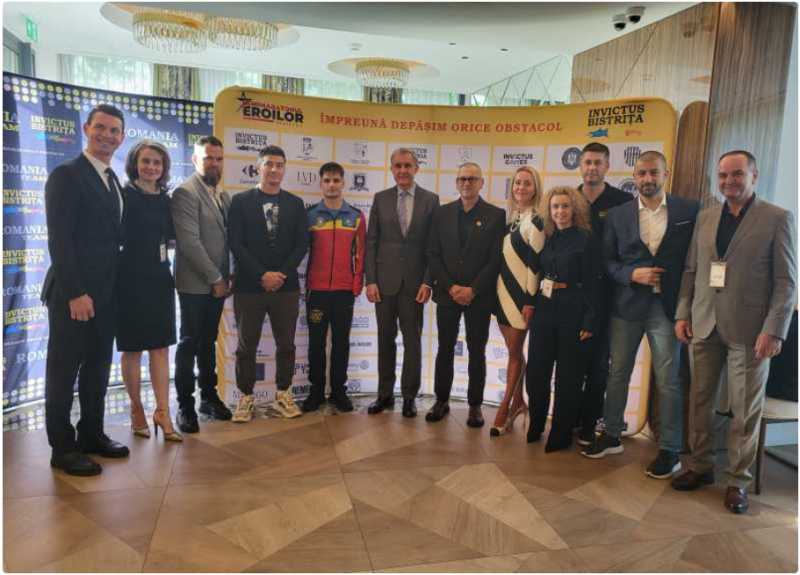
Prince Radu meets with organisers and sponsors of Invictus Heroes Half Marathon in Bistrita
Prince Radu took part on Friday evening, in Bistrita, in a meeting with the organisers and sponsors of the Invictus Heroes Half Marathon, now in its fourth edition and scheduled for 23 May. His Royal Highness said he felt 'lucky' to attend the event and believes that the thous

Long Night of Museums: Central University Library offers guided tours, spotlight on great boyar families
As part of the Long Night of Museums, the 'Carol I' Central University Library will open its doors to the public on Saturday from 19:00 to midnight, offering Romanian- and English-language guided tours and a journey into the history of Romania's great boyar families, the institut
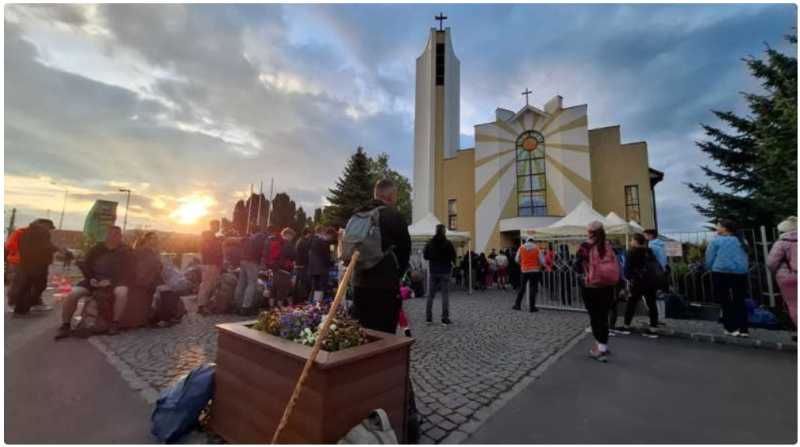
FEATURE STORY/Thousands of Romanian, foreign pilgrims travel the Way of Faith to Sumuleu Ciuc Pentecost gathering
Pilgrims from Romania and abroad are streaming into Miercurea-Ciuc ahead of Saturday's Sumuleu Ciuc Pentecost pilgrimage - considered the largest Catholic procession of its kind in Central and Eastern Europe. Many have been on the road for days, some for weeks, and describe the j
Botosani Tribunal rejects action against University of Bucharest regarding studies of President Nicusor Dan
The Botosani Tribunal rejected, on Friday, as unfounded, an action by former judge Lăcramioara Axinte, who asked the University of Bucharest to make public information regarding President Nicusor Dan's studies. The action against the University of Bucharest was opened in Febru
Nazare: EC's spring forecast shows that economy needs well-targeted investments and reforms to support recovery
The interim Minister of Finance, Alexandru Nazare, participates on Friday and Saturday in the informal meeting of the Economic and Financial Affairs Council (ECOFIN), where discussions will also take place regarding the importance of completing the negotiations on the revisi
Romanian Air Force pilot awarded after downing drone in Estonia
The Romanian Air Force pilot who shot down a drone that entered Estonian airspace was decorated by the leadership of the Ministry of National Defense with the 'Envoy for Peace' Emblem, 1st Class, during a working visit to the Siauliai Air Base in Lithuania, where the Carpathian V
Craiova International Shakespeare Festival 2026 opens with Japan-themed events
The International Shakespeare Festival, organised by the 'Marin Sorescu' National Theatre and the Shakespeare Foundation, opened on Thursday evening in Craiova with a series of events dedicated to Japan, marking the start of the 21- 31 May edition. Speaking at the official openin