
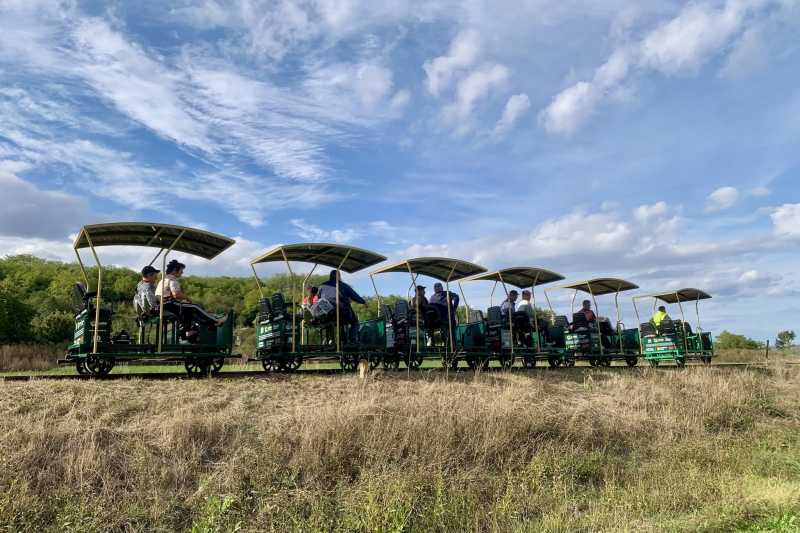
The Transylvanian Plain, an area often overlooked by traditional tourist routes focusing on mountains or medieval fortresses, has officially become the site of an unprecedented national first with the opening of VeloRail, Romania's first rail-cycle draisine circuit, a 12-kilometre route connecting the communes of Raciu, Sanmartinu de Campie and Craiesti.
The country's only such circuit has been developed on a narrow-gauge railway built in 1912 and abandoned for almost three decades, which was saved with great difficulty from scrap metal thieves. It has been brought back to life through a visionary project combining sport, railway nostalgia and ecotourism.
This unusual attraction represents a breath of fresh air for local tourism, particularly in the lowland area of Mures County, an aspect immediately highlighted by the Visit Mures Association.
'VeloRail - a new two-wheeled experience in the Transylvanian Plain! Romania's first rail-cycle draisine track has been created along the route of a more than 100-year-old narrow-gauge railway that is no longer in use. We are delighted that Mures County has gained a new and unusual tourist attraction!,' representatives of the Visit Mures Association said on Facebook.
However, the road to the launch of the six unusual vehicles, known as rail-cycle draisines, was a real battle of attrition against scrap metal thieves and neglect. While other sections of the old railway embankment were wiped from the landscape, the local community in Raciu and volunteer associations formed a protective shield around the tracks.
'What we are doing in Riciu could be a good example, first and foremost of how to stop the theft of disused railway lines, because just in our area, from Targu Mures, well, Cristesti, to Raciu, the entire narrow-gauge railway was stolen, including the track ballast, as they call it. So absolutely nothing remains there. Here, from Riciu - Sanmartin - Craiesti to Teaca, we managed to keep this line standing, even though they tried to come to us with lorries to take the railway away. We opposed them very strongly and today we can say that the results of the actions we took in previous years are now visible. We did not allow a symbol of the Plain to disappear!,' Raciu Mayor Ciprian Alin Belean told AGERPRES.
The railway's ultimate rescue came through a close partnership with the Mocanita Transylvania Association, an organisation that has taken the line under concession and has been trying for 11 years to bring heritage trains back to the historic route between Targu Mures and Lechinta, which was permanently closed in 1997.
Together, they entered a national project competition funded by Raiffeisen Bank, winning a grant of 60,000 euros in a fiercely contested competition involving hundreds of other initiatives.
The biggest technical challenge was the design and actual construction of the vehicles. With no precedent or specialist manufacturers in Romania, the organisers initially encountered repeated refusals from companies in the industry.
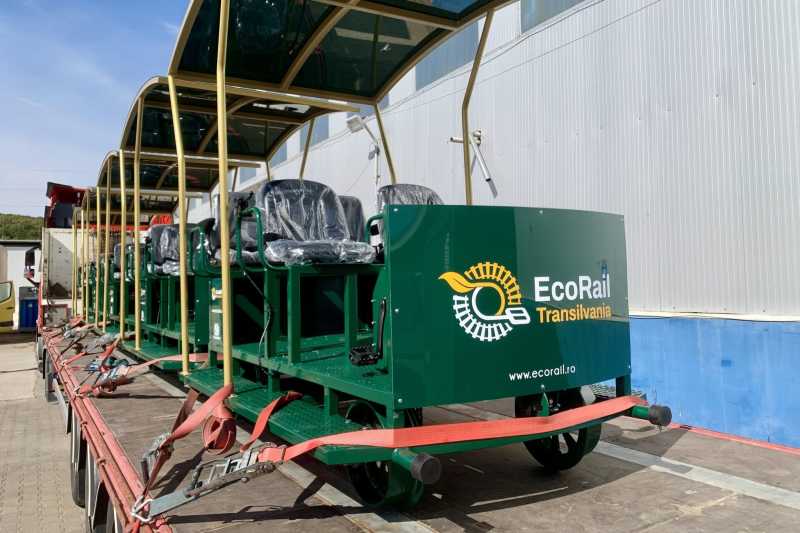
'It was difficult to build these rail-cycle draisines from the outset because we no longer have them in Romania. They were built from scratch, meaning we had a designer who worked for months designing every single component. Then we went to three or four companies and knocked on their doors. They did not want to take on such a project,' Mayor Ciprian Alin Belean brought to mind.
The solution came from a private company in Bistrita, which accepted the challenge of building the vehicles to precisely match the narrow-gauge railway.
'Basically, you cannot find rail-cycle draisines in a shop. You cannot simply go and say, I'm going to buy a rail bike, just as you would buy a bicycle or a motorbike. No. They have to be built to match the railway and they have to be very, very carefully designed,' Belean said.
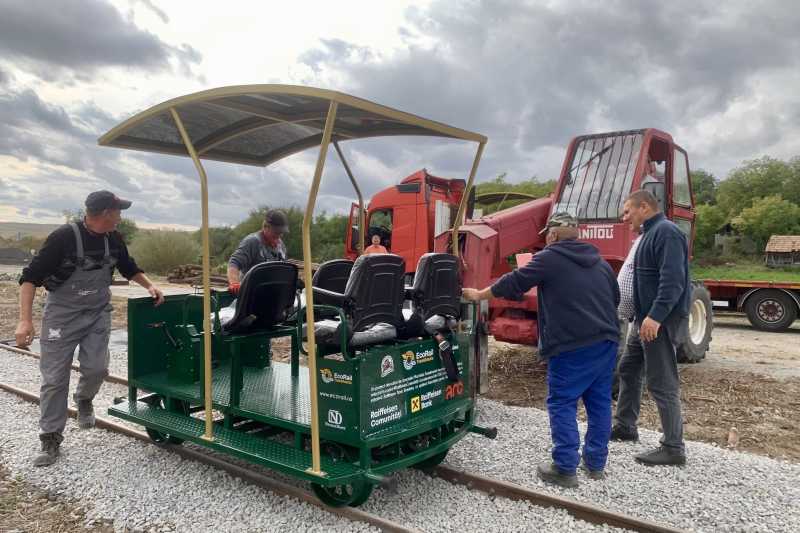
The result is an unusual hybrid vehicle, as Cristi Moldovan, president of the Mocanita Transilvaniei Association, explained.
'A rail-cycle draisine is a railway vehicle that you pedal. It has four seats. Two people pedal at the front and two people are passengers at the back. We like to say that it is first class at the back and second class when it comes to pedalling. This is how we want to showcase the railway built in 1912, allowing people to enjoy it in an environmentally friendly way while exercising at the same time,' Cristi Moldovan said.
A complete circuit takes between two and three hours, covering 6 kilometres in each direction. The route starts at the market in Raciu and ends at the old railway station in Sanmartinu de Campie, a historic building saved and restored by a private investor. There, tourists can stop for a break, a lemonade or a hot meal prepared at a local gastronomic establishment.
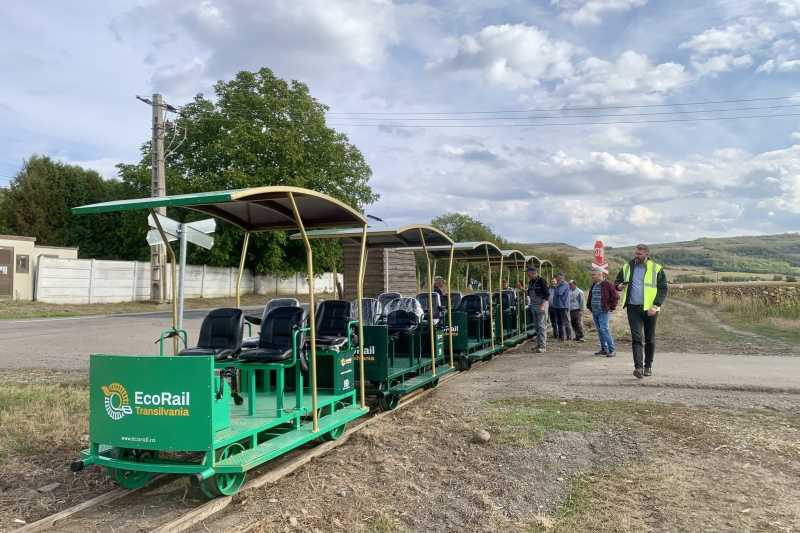
At Sunday's launch, on 27 September, access was completely free for local residents and volunteers, but in the future the project will operate on the basis of online bookings, with dedicated staff providing guidance.
The organisers hope that VeloRail - a concept that is extremely popular in countries such as France, which has 64 such routes, Switzerland, Austria and Germany - will dispel the myth that tourism cannot be developed in lowland areas.
'Someone once told me: 'Well, we cannot do tourism in the lowlands because we do not have mountains or the sea.' No! So, from my point of view, that approach is out of the question,' Raciu Mayor Ciprian Alin Belean stressed.
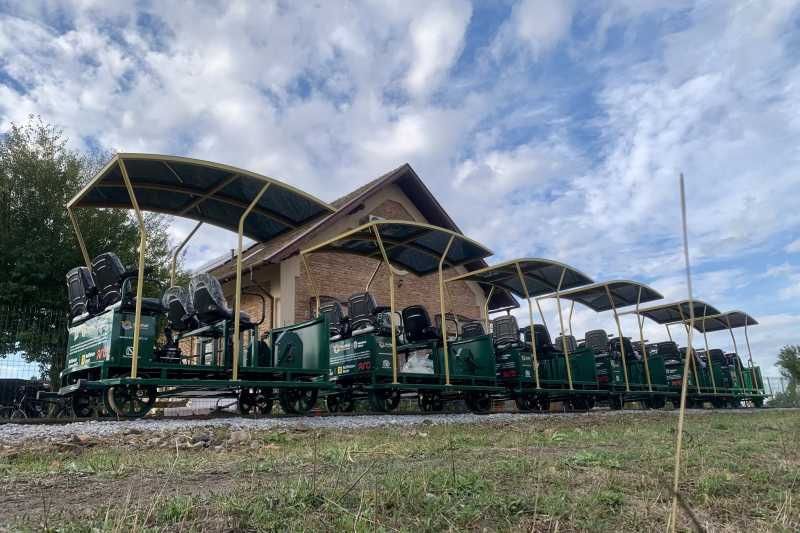
He is already planning a complex two- to three-day itinerary for visitors, which from next year will include the new Gheorghe Sincai Museum - the Romanian scholar Gheorghe Sincai was born in Raciu - as well as historic churches in the area and traditional local cuisine.
Through VeloRail, the community has not only managed to preserve its past but has also given local residents a chance to rediscover their own history, Cristi Moldovan pointed out.
'They have a dual purpose: one is to encourage people to pay attention to the railway and to keep it part of community life. It was very important when people used it to commute, but after being abandoned for 30 years, they had more or less forgotten its importance. Now, through these rail-cycle draisines, they have the opportunity to rediscover it,' the president of the Mocanita Transilvaniei Association added. AGERPRES (RO - writing by: Dorina Matis; EN - writing by: Adina Panaitescu)
Photo source: Asociatia Mocanita Transilvaniei / Facebook
Display count: 92- Category: English
- Date: 2026-09-29 11:12:02
- Foto: Asociatia Mocanita Transilvaniei / Facebook