
The European Commission on Wednesday approved the registration of Romania's 'Branza framantata de Teaca' as a Protected Geographical Indication (PGI), according to a statement by the EU executive.
'Branza framantata de Teaca' is a traditional kneaded cheese from Teaca, a village in northern Romania.
It is made from raw, unpasteurised cow's milk, which is coagulated, fermented, matured and salted, with the cheese then packed in a natural pig bladder.
The characteristics of this type of cheese cannot be faithfully reproduced outside this geographical and cultural context, as they rely on the ability of local producers to interpret and control each stage of the process through sight and touch. This expertise has been passed down from generation to generation and is a fundamental part of the community's identity, linking the product's name to the taste, texture and quality expected by consumers, the European Commission said.
The new designation joins more than 3,900 protected names already included in the eAmbrosia database.
According to a statement from Romania's Ministry of Agriculture and Rural Development, the name 'Branza framantata de Teaca' was granted protection under the Protected Geographical Indication quality scheme pursuant to Regulation (EU) 2024/1143 on geographical indications for wine, spirit drinks and agricultural products.
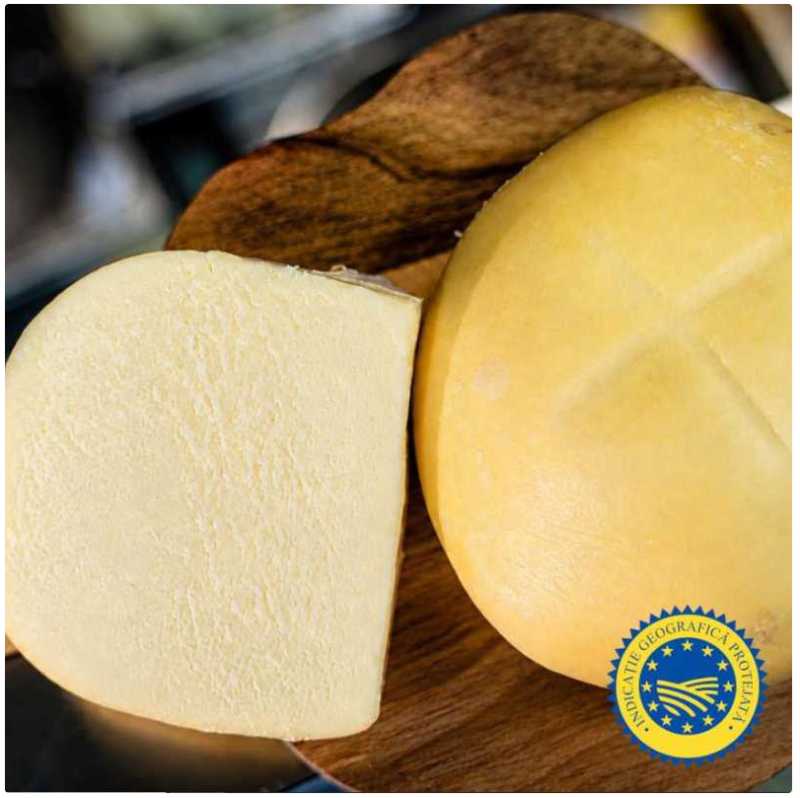
Branza framantata de Teaca has an irregular oval or round shape and weighs approximately 0.4 to 2 kilograms. The shape and weight of each piece are determined by the natural pig bladder in which the cheese is packed.
Production involves receiving the raw materials, filtering and preparing the milk for coagulation, coagulating the milk, processing and reheating the curd to achieve the required dehydration, forming and preparing the curd, producing and kneading the Branza framantata de Teaca, and filling and sewing the pig bladders. All stages of production take place within the defined geographical area of the village of Teaca, in Bistrita-Nasaud County.
The application to register Branza framantata de Teaca as a PGI is based on the product's reputation and on know-how handed down from generation to generation in Teaca, which influences its specific organoleptic characteristics.
'The characteristics of the product cannot be faithfully reproduced outside the geographical area because they depend on the ability of local producers to interpret and control each stage of the process through sensory means. This expertise has formed a core part of the community's identity, associating the product's name with the taste, texture and quality expected by consumers. Branza framantata de Teaca has been known since ancient times, with one piece of evidence being its presence at the famous Teaca fair. The existence of the Teaca fair is also documented in the German-language monograph written by Ilse Schliesleder-Fronius,' the Agriculture Ministry said.
The application for PGI protection was submitted to the Ministry of Agriculture and Rural Development by the applicant group, the Bistrita-Nasaud Cheesemakers' Association.
Under Regulation (EU) 2024/1143, the applicant group has an important role in helping safeguard the product's quality, reputation and authenticity on the market, including by taking action to prevent or counter commercial practices that harm or risk harming the image and value of the product.
Branza framantata de Teaca has become the 18th Romanian product recognised and registered at European level, joining Magiun de prune de Topoloveni (PGI), Salam de Sibiu (PGI), Novac afumat din Tara Barsei (PGI), Scrumbie afumata de Dunare (PGI), Telemea de Sibiu (PGI), Carnati de Plescoi (PGI), Cascaval de Saveni (PGI), Salata cu icre de stiuca de Tulcea (PGI), Telemea de Ibanesti (PDO), Salata traditionala cu icre de crap (TSG), Placinta dobrogeana (PGI), Pita de Pecica (PGI), Salinate de Turda (PGI), Sardeluta marinata fabricata potrivit traditiei din Romania (TSG), Carnati din topor din Valcea (PGI), Batog de Sturion (PGI) and Babic de Buzau (PGI).
Romania currently has another 11 applications being examined by the European Commission with a view to registration, two for PGI status and nine for Traditional Speciality Guaranteed (TSG) status. AGERPRES (RO - writing by: Nicoleta Gherasi; EN - writing by: Simona Iacob)
- Category: English
- Date: 2026-09-09 17:39:00
- Foto: Comisia Europeană în România / Facebook