
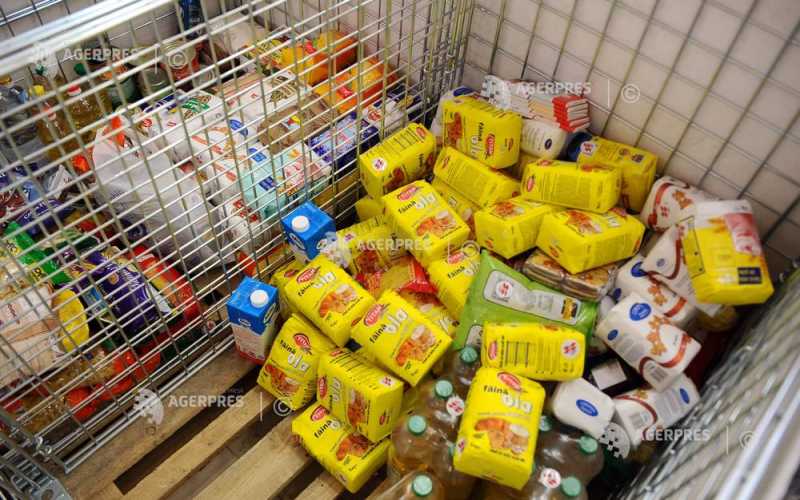
More than 3.45 million tonnes of food are thrown away every year, while more than 27% of Romania's population is at risk of poverty or social exclusion, according to the Federation of Food Banks in Romania (FBAR) data published on Wednesday.
'September is recognised globally as a month dedicated to raising awareness of and combating food waste, but for Romania, this autumn has a double significance. It marks ten years since the concept of a food bank was first implemented in our country through the establishment of the Bucharest Food Bank. This historic milestone is the ideal moment to examine a painful reality, but also to present the only structural, logistical and legal solution that has been operating continuously for a decade. In Romania, food waste continues to be a phenomenon of dramatic proportions. Every year, more than 3.45 million tonnes of food are thrown away. In direct contrast to this massive waste of resources, more than 27% of the country's population is at risk of poverty or social exclusion, with many Romanians facing major difficulties in securing their daily food,' the FBAR representatives said in a release sent to AGERPRES on Wednesday.
According to the federation, based on the Law No. 217/2016 on reducing food waste (amended by Law No. 49/2024), companies in the agri-food sector that have surplus stocks, products with cosmetic packaging defects or goods nearing their expiry date but still perfectly safe for consumption can currently transfer them free of charge to the Food Banks network. Companies thus benefit from full tax deductibility and VAT exemption.
'Once collected, the products are transported rapidly using a national fleet of 31 refrigerated vans, ensuring the cold chain is maintained for perishable foods (dairy products, meat, vegetables and fresh fruit). At the country's nine regional warehouses, covering a total area of more than 3,831 square metres, Food Banks teams sort, verify the traceability and record each product in accordance with the sanitary and veterinary regulations in force. The food is then distributed in an organised manner and free of charge to partner NGOs registered in the network, which turn it into hot meals or support packages for children at day centres, elderly people living alone or families going through critical periods,' the release mentioned.
According to official data, last year the network saved more than 10,000 tonnes of food from going to waste, which were turned into 20 million food portions and distributed, with the support of 183 donor companies, through 854 partner NGOs, helping 326,364 vulnerable people.
At the same time, in the first half of this year, the Food Banks had already redistributed 8,555 tonnes of food, of which 7,589 tonnes had been saved from going to waste. This activity resulted in 17.1 million food portions, providing monthly nutrition for an average of 298,030 vulnerable people, including 111,822 children under 18, through 910 partner NGOs.
Over its first decade of activity (2016 - June 2026), the Network collected more than 49,000 tonnes of products (of which more than 44,000 tonnes were food saved directly from going to waste). All these resources were turned into more than 96 million food portions distributed free of charge in communities.
The FBAR and the nine Regional Food Banks in Bucharest, Cluj, Roman, Brasov, Oradea, Timisoara, Constanta, Craiova and Galati form a national solidarity network and are members of the European Food Banks Federation (FEBA). AGERPRES (RO - writing by: Daniel Badea; EN - writing by: Rodica State)
- Category: English
- Date: 2026-09-09 12:29:31
- Foto: CRISTIAN NISTOR / AGERPRES PHOTO