

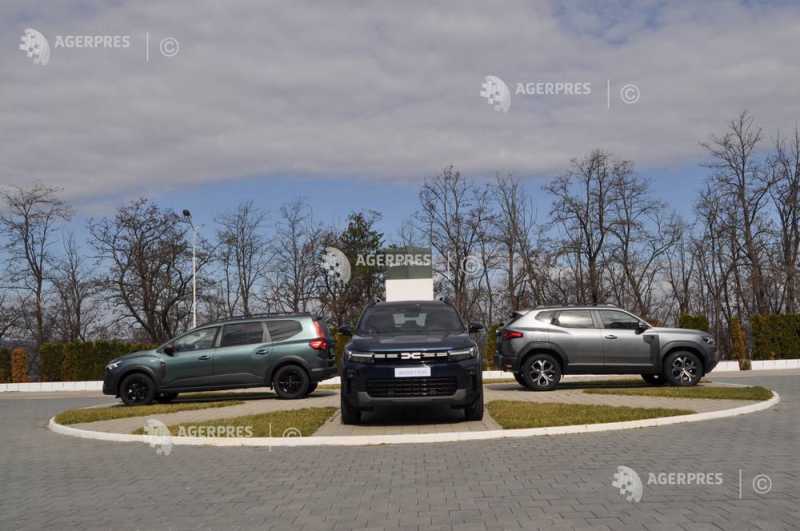
Dacia is not on the verge of closing its Mioveni plant, but Romania could gradually lose production volumes, versions of certain models and, most importantly, the allocation of the next-generation Duster, according to Dumitru Chisalita, president of the Intelligent Energy Association (AEI), in an analysis released on Wednesday.
The AEI has analysed the possibility of Dacia leaving Romania and the impact such a decision could have on Romanians.
'The main conclusion is a balanced one: Dacia is not on the verge of closing its Mioveni plant, but Romania could gradually lose production volumes, versions of certain models and, most importantly, the allocation of the next-generation Duster. This is the real danger,' Chisalita said.
According to him, any major company seeks to secure the most favourable conditions possible from the state in which it operates: lower taxes, cheaper energy, better infrastructure, state aid, greater flexibility in labour relations and more predictable regulations. In this negotiating process, one of the strongest forms of leverage is the threat of reducing investment or even leaving the country, a situation that applies to many companies operating in Romania.
'The statements made by Dacia-Renault representatives should also be viewed from this perspective. They do not automatically represent a decision to withdraw, but neither can they be ignored. The state's mistake would be either to panic and offer whatever is requested or to assume that Dacia can never leave. The correct response is to conduct its own independent and pragmatic analysis: how much is media pressure, how much is genuine economic dissatisfaction, how feasible would relocation be and what would the consequences be for Romania?,' the specialist said.
There is currently no official announcement concerning the closure of the Mioveni plant. The current-generation Duster entered production at the end of 2023, while the Bigster has been produced exclusively at Mioveni since 2025. The investments already made, existing equipment, local suppliers and the commercial success of the models make an immediate withdrawal unlikely, Chisalita believes.
Thus, the important question is not whether Dacia is leaving tomorrow, but whether the next Duster, the next platform and future technologies will still be produced in Romania.
The AEI analysis estimates a probability of around 55% for a scenario in which the current generation remains in production and its successor is produced at least partly in Romania. The negative scenario, involving production being split or the successor being moved elsewhere, has an estimated analytical probability of around 35%, while an accelerated withdrawal by 2028-2029 is estimated at around 10%. These figures are not Renault forecasts but indicative assessments of risk, the author of the analysis notes.
In his view, some of Dacia's arguments reflect genuine economic problems and these apply to the economy as a whole. Mioveni is facing rising labour costs, more expensive energy, changing taxation, incomplete infrastructure and a growing perception of economic risk. Romania is also at the lowest level of the investment-grade category, which could affect financing costs and investor confidence.
Compared with the Renault plant in Bursa, Türkiye, Mioveni is estimated to have a gross disadvantage of 318-378 euros per vehicle, mainly as a result of differences in labour and electricity costs. Gas and diesel make a much smaller contribution. For a car delivered to Germany, Romania's proximity to the European market reduces the net difference to approximately 200-250 euros per vehicle.
These figures are standardised estimates, not Renault's confidential costs, the analysis says. They nevertheless show that the problem exists, although it is not sufficient on its own to justify leaving Romania. The country retains important advantages: access to the European single market, proximity to customers, a mature supplier network, skilled workers, productivity, engineering capabilities and investments that have already been partially amortised.
In other words, Dacia representatives are not inventing all the problems, but are naturally using them to strengthen the company's position in negotiations with the state. The government should verify each claim rather than negotiate on the basis of public statements, Dumitru Chisalita recommends.
He says the decision on whether to leave or remain could be made during the critical period of 2027-2029. Decisions could then be made on the future platform, suppliers and the plant that will produce the successor to the current Duster. Physical closure could come as late as 2030-2031, but the industrial decision would be made two or three years earlier.
The signals that should be monitored are clear, according to the AEI: reduced investment at Mioveni; falling production volumes and the elimination of shifts; the transfer of dies or versions to Bursa; the selection of Turkish suppliers for the next generation; reduced research and engineering activities in Romania; the absence of a new model following the Bigster; and investment in electrification being directed exclusively towards other plants.
If such signals accumulate, the threat would cease to be merely a negotiating tactic and become a gradual withdrawal strategy, the specialist warns.
In a scenario of complete withdrawal, Romania could lose approximately 5-5.5 billion euros in gross exports annually, while the trade balance could deteriorate by 2.5-3.5 billion euros. The annual loss in direct and indirect value added and GDP is estimated at 2.5-4 billion euros. Between 55,000 and 90,000 jobs could become vulnerable, including employees at the plant, suppliers, transport operators and services dependent on the automotive industry.
A withdrawal by 2029 would be an abrupt shock. Suppliers would have little time to diversify, thousands of employees would enter the labour market simultaneously and Arges could face a severe regional recession. Between 2029 and 2035, the cumulative loss of GDP could reach 17-28 billion euros.
A withdrawal in 2031 would ultimately be no less serious, but it would give Romania an additional two years to attract other investments, retrain employees and convert suppliers to other activities. This period would only have value if it were used before the closure was announced.
For a family in Mioveni in which one member works for Dacia or a supplier, the company's departure could mean the immediate loss of the main source of income, estimated at 70,000-100,000 lei a year, difficulties in paying loans and bills, a drastic reduction in spending and potentially the need to leave the area in search of a new job. Property values could fall, small local businesses could lose customers and public services could deteriorate as a result of lower local revenues.
According to Chisalita, Romania should respond neither with unlimited subsidies nor with a hostile attitude towards the company. The government should request confidential, evidence-based talks with Renault regarding industrial allocations for 2027-2031 and commission an independent Mioveni-Bursa audit covering energy, labour, taxation, logistics and productivity.
Genuine problems should be addressed through fiscal predictability and reasonable transition periods; competitive long-term energy contracts; completion of road and rail infrastructure; support conditional on investment, production volumes and jobs; retaining the engineering centre in Romania; developing battery, hybrid component and power electronics production; diversifying suppliers that are excessively dependent on Dacia; and preparing a retraining and economic transition plan for Arges.
In conclusion, Dacia is not leaving tomorrow, but neither is it destined to remain in Romania forever. AGERPRES (RO - writing by: Cristian Anghelache; EN - writing by: Adina Panaitescu)
AEI:Dacia not closing Mioveni plant, but Romania could gradually lose production volumes (analysis)
Conţinutul website-ului www.agerpres.ro este destinat exclusiv informării publice. Toate informaţiile publicate pe acest site de către AGERPRES sunt protejate de dispoziţiile legale incidente. Sunt interzise copierea, reproducerea, recompilarea, modificarea, precum şi orice modalitate de exploatare a conţinutului acestui website. Informaţiile transmise pe www.agerpres.ro pot fi preluate, în conformitate cu legislaţia aplicabilă, în limita a 500 de semne. Detalii în secţiunea Condiţii de utilizare. Dacă sunteţi interesaţi de preluarea ştirilor AGERPRES, vă rugăm să contactaţi Direcţia Marketing - marketing@agerpres.ro.
Alte știri din categorie

President Dan says Foreign Ministry investigating Orlivka school case
President Nicusor Dan said on Friday that Romania's Foreign Ministry has opened an investigation into the case of the school in Orlivka, Odesa region, where a Year 1 class taught in Romanian was closed. Speaking at a news conference held after the Carpathian Integration Initiative 'Carpathian 8' Summit, he said that 'remarkable progress has bee

Bolojan: We will try, within our possibilities and depending on our electoral weight, to form a Government
President of the National Liberal Party (PNL) Ilie Bolojan said on Friday that, although Siegfried Muresan's nomination for prime minister came three months late, the party would deal with the situation 'responsibly' and seek to form a Government based on its electoral weight. 'Yesterday, about 30 minutes beforehand, I learned from the piece of

Siegfried Muresan: We will start work on a government programme; beginning of next week - discussion with MPs
Prime Minister-designate Siegfried Muresan announced on Friday that he was starting work on the government programme together with the National Liberal Party (PNL), Save Romania Union (USR) and the Hungarian Democratic Union of Romania (UDMR), mentioning that he would present the priorities at the beginning of next week and, based on these, would hold an "extremely tran

CCIR's Daraban: The diaspora is not a sentimental issue but a chapter in the national economy
The experience gained by Romanians in the diaspora in competitive markets must be transformed into investment, jobs and exports, believes Mihai Daraban, President of the Chamber of Commerce and Industry of Romania (CCIR). According to a press release from the organisation sent to AGERPRES, the institution is strengthening its partnership with ROUNIT - Reunited
European Commission approves ANSVSA's Action Plan to unblock sheep and goat exports
The Action Plan of the National Veterinary Sanitary and Food Safety Authority (ANSVSA) for unblocking exports of sheep and goats has been approved by the European Commission, allowing exports of carcasses and products to resume under the differentiated vaccination scheme. According to an ANSVSA release sent to AGERPRES on Friday, the approved solution protects
Health Insurance House launches project on cross-border exchange of medical images, laboratory results, discharge reports
The National Health Insurance House (CNAS) announced on Friday the launch of the European project 'Romanian Medical Images, Laboratory Results and Discharge Reports' (RO-MI-LR-DR), for the cross-border exchange of medical images, laboratory results and discharge reports. The project is funded through the EU4Health programme, with the European Health an
'Socola' Institute of Psychiatry in Iasi to hold new memory testing campaign at weekend
The 'Socola' Institute of Psychiatry in Iasi has announced that it will hold the third edition of its 'Memory Testing Campaign' on Saturday and Sunday, a campaign addressing people of all ages and aimed to identify individual risk factors that may predispose people to memory disorders, while also providing participants with specialist counselling.

'Brancusi and His Muses' exhibition opens at Art Safari
'Brancusi and His Muses', the largest exhibition dedicated to the great sculptor to be held in Romania during Brancusi Year, opened on Thursday evening at the Art Safari New Museum. Curator Doina Lemny said she wanted the initiative to be different, allowing the public to enter the artist's studio atmosphere. 'It is true that Brancusi's wor