
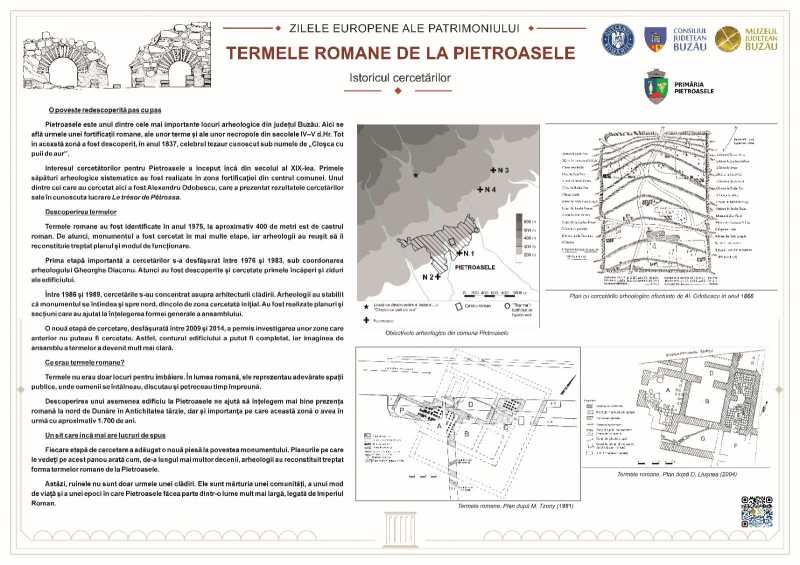
The Buzau County Museum is organising an exhibition at the Pietroasele Roman Baths to mark European Heritage Days, offering visitors an opportunity to discover how the thermal baths operated as well as to learn valuable information about the famous 'Closca cu puii de aur' (The hatching hen with the golden chicken) treasure.
The event, organised by the County Museum in partnership with the Buzau County Directorate for Culture and Pietroasele Town Hall, aims to highlight the fact that archaeological heritage should not only be researched and preserved but also explained and reintegrated into the life of the community.
'In this regard, we have created a documentary exhibition consisting of a series of themed panels through which the public can follow the history of research into the monument, the architecture and operation of the baths, the main archaeological discoveries as well as the project through which the site is to be restored and developed. The story begins with Pietroasele as a major landmark of Buzau archaeology, a site where the Roman fort and baths, settlements and necropolises dating from the 4th-5th centuries AD meet, as well as the place where the famous 'Closca cu puii de aur' treasure was discovered. The baths were identified in 1975, approximately 400 metres east of the Roman fort, and were researched in several stages between 1976 and 2014,' the County Museum said.
The same source said the exhibition explains, in accessible language, what the balneum at Pietroasele looked like and how it operated approximately 1,700 years ago.
'The building measured approximately 28 x 31 metres and comprised six rooms with different functions, four pools and two heating areas. Visitors will be able to discover the route from the apodyterium and tepidarium to the sudatorium, caldarium and frigidarium, as well as the ingenious hypocaust heating system, through which hot air circulated beneath the floor and through the walls,' representatives of the Buzau County Museum also said.
The entire site will be transformed into an open-air museum, with archaeological remains, visitor trails, landscaped areas and spaces for the public.
'A separate section is dedicated to the Legio XI Claudia and the 'signatures' left by Roman soldiers in clay. Research at the baths uncovered 27 fragments of stamped bricks and roof tiles, all bearing the insignia of this Roman military unit. The six types of stamps identified are important archaeological evidence for understanding the links between the Pietroasele complex and the Roman army,' the organisers said.
The exhibition will open in the park in the centre of Pietroasele on 11 September at 11:00 am and will be permanently accessible. AGERPRES (RO - writing by: Florin Zafiu; EN - writing by: Adina Panaitescu)
Photo source: Muzeul Județean Buzău/Facebook.com
Display count: 312- Category: English
- Date: 2026-09-08 12:01:02
- Foto: Facebook.com