
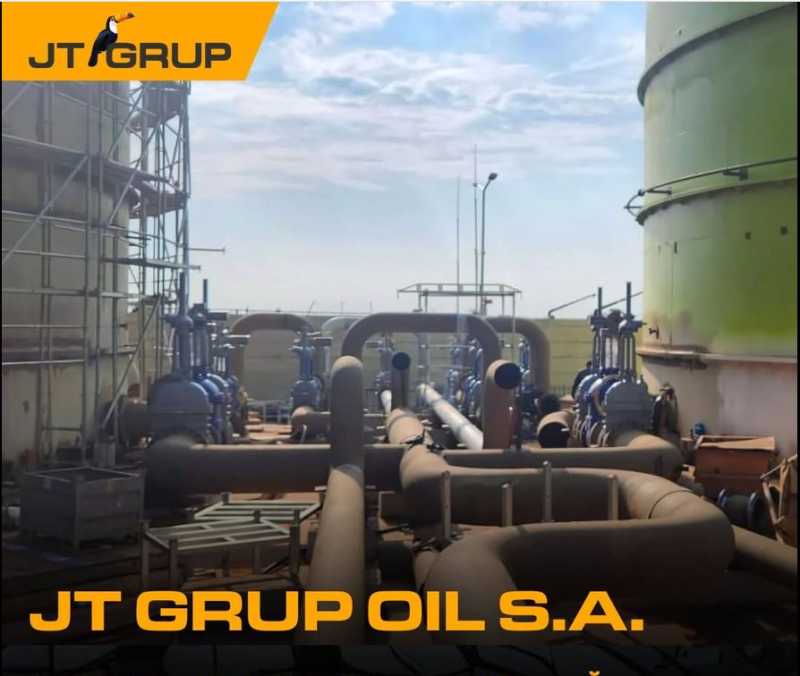
Romanian fuel distributor JT Grup Oil has completed a new private petroleum products terminal in the Port of Constanta following an investment of around 30 million euros, adding annual handling capacity of up to one million tonnes to the market.
JT Terminal has eight tanks with a total static storage capacity of 31,500 tonnes and is designed to handle up to one million tonnes of petroleum products annually through stock rotation, the company said in a statement on Thursday.
The infrastructure can handle barges with capacities ranging from 3,000 to 9,000 tonnes, simultaneously operate 16 railway wagons on two parallel tracks and process up to 100 road tankers a day.
According to the company, the terminal's location in the Black Sea port of Constanta, its access to the Danube-Black Sea corridor and its links between maritime and river transport and rail and road infrastructure provide a significant logistical advantage for Romania, the Republic of Moldova, Serbia and Ukraine.
'The terminal creates a new entry, storage and distribution point for petroleum products and contributes to strengthening the role of the Port of Constanta in logistics flows towards the Republic of Moldova, Serbia and Ukraine,' the company said.
JT Grup Oil said the terminal was designed to serve Romania as well as the Republic of Moldova, Serbia and Ukraine and support the development of new trade flows towards those markets.
'The completion of JT Terminal marks the conclusion of the most complex investment project JT Grup Oil has undertaken to date. We began this investment in response to a concrete market need - Romania needs additional capacity to import, store and distribute larger volumes of petroleum products,' company chairman and CEO Bogdan Aldea said.
'Today, this infrastructure exists, and the investment goes beyond developing a new business line for JT Grup Oil. The terminal adds import, storage and distribution capacity to the market and contributes to diversifying the infrastructure through which Romania can secure its petroleum product requirements,' he added.
Majority shareholder Jean Paul Tucan said the project was financed through Romanian private capital, bank financing and European funds.
'Beyond what JT Terminal means for the company's development, we have delivered infrastructure that provides the economy with a new gateway for petroleum products, capable of supporting supplies to Romania, the Republic of Moldova, Serbia and Ukraine,' Tucan said.
The company said the new infrastructure could help increase traded volumes, attract international partners and develop new commercial flows to the four markets. It said companies from the Republic of Moldova, Serbia and Ukraine had already expressed commercial interest in using the new logistics capacity during the project's development.
'We now have the infrastructure needed to handle volumes of up to one million tonnes annually and to develop partnerships with major international companies, as well as new trade flows through the Port of Constanta,' Aldea said.
JT Grup Oil is also developing a new bitumen terminal and a project at Dubova, at a strategic entry and exit point on Romania's border. The latter is expected to have an operating capacity of 20,000 tonnes per month and support cross-border petroleum product flows.
JT Grup Oil is a Romanian fuel distribution company listed on the Bucharest Stock Exchange. AGERPRES (RO - writing by: Oana Tilica; EN - writing by: Simona Iacob)
- Category: English
- Date: 2026-09-03 15:27:57
- Foto: JT Grup Oil / Facebook