
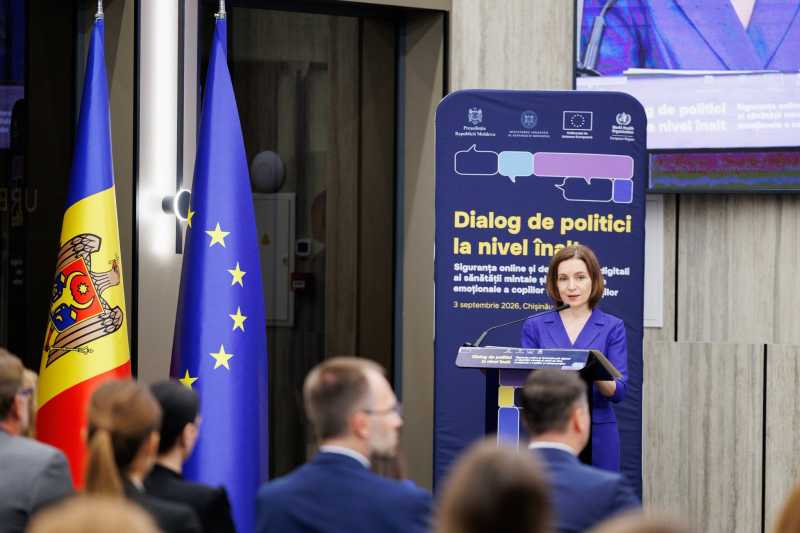
The challenges facing children and teenagers amid rapid digital developments, as well as solutions to protect them online, were in the focus of discussions on Thursday in Chisinau at an international conference on online safety and the impact of the digital environment on mental health. Among those attending were Moldovan President Maia Sandu and Mirabela Gradinaru, life partner of Romanian President Nicusor Dan, Moldpres reports.
Maia Sandu said the authorities' goal was simple: every child in Moldova should be able to grow up healthy, free and safe in a world where physical and digital realities increasingly overlap.
'At the beginning of this year, I announced children's safety and mental health in the digital age as a priority. (...) The digital environment opens extraordinary opportunities for them, but it also affects their attention, emotions, relationships and the way they see themselves,' Sandu said.
She called for children and young people to be supported in using technology intelligently, responsibly and in a balanced way, to think critically and to engage with new tools without becoming dependent on them.
'That is why we need a joint effort by families, schools, the healthcare system, authorities, civil society and the companies that operate digital platforms. We need practical support for parents and teachers, clear procedures for preventing and reporting incidents, and rapid and confidential access to assistance for children in difficulty. At the same time, protection must be built into the way platforms operate. And last but not least, we must listen to the voices of children and adolescents in order to understand their needs, fears and aspirations,' Sandu said.
Mirabela Gradinaru also underscored the role of authorities and families in protecting children in an ever-changing digital environment, noting that childhood now unfolds simultaneously in the physical and digital worlds, with the boundary between the two becoming increasingly blurred.

'We must work together to protect children in an ever-changing digital environment. And as the mother of two young children, this is an issue that concerns me every day. (...) If until now we spoke only about dangers in the physical world, today we have two worlds: the physical world and the digital world. And the difference between the two is almost nonexistent. At the same time, we are talking about the opportunities offered by the digital world: learning, creativity and belonging,' she said.
Gradinaru argued that online safety cannot be left solely to parents. Families need concrete support from institutions, schools, healthcare services and communities.
'A child can be with us in the same room, in the same hall, but at the same time very far away, because they are in a world that is becoming increasingly difficult for us to understand and control. (...) They no longer have doors they can close, because the outside world can reach our children through a screen. So what can we do? Support parents, because we cannot leave this responsibility solely on their shoulders. (...) A mother or father cannot simultaneously be a parent, teacher, psychologist and technology expert. It is unrealistic to expect every family to keep up on its own with risks and changes that even institutions and regulators fail to anticipate,' she said.
Gradinariu also called for digital literacy to be accompanied by mental health literacy, so that children can identify harmful content, unhealthy behaviours and situations in which the online environment affects their wellbeing.
Moldovan Health Minister Alexandru Gasnas said it was necessary to address online dangers and develop mechanisms to protect children and adolescents, while avoiding placing the entire responsibility on families.
'The fight is asymmetric, because these supercomputers are fighting for our attention, and that is the biggest problem (...),' the minister said.
Natasha Azzopardi Muscat, Director of Health Systems at the WHO Regional Office for Europe, said healthcare systems must be prepared to support people amid rapid technological change.
'One in seven children and one in five adolescents live with a mental health condition. We now see mental health as a public health issue. (...) There will be moments when people need support. And our health systems and health services must be capable of providing appropriate assistance for this rapidly changing epidemiological phenomenon, whether at primary healthcare level, where we still see a major gap in many countries, or through specialised services,' she said.
EU Ambassador to Moldova Iwona Piorko said every child needs age-appropriate digital services and strong online protection.
'When our children leave home, we ask simple questions: are they safe, do we know exactly where they are going, can they ask for help? Today, we need to ask the same questions about the digital world. Young people spend four to six hours a day in front of screens. Six hours every day means 20 years of their lives. At the same time, almost 60% of children already have experience with psychosocial problems online,' Piorko said.
She added that the EU would continue supporting Moldova in ensuring that children can benefit from the opportunities of the digital world without compromising their safety, rights, mental health or wellbeing.
The conference 'Online Safety and the Digital Determinants of Mental Health and Emotional Wellbeing of Children and Adolescents,' was organised by Moldova's Health Ministry and the WHO Regional Office for Europe, under the auspices of the Moldovan Presidency and with EU co-financing.
Experts from France, Belgium, Finland, Poland and the Czech Republic presented European experiences and solutions for creating a safer and healthier digital environment for children and adolescents. AGERPRES (RO - writing by: Gabriela Ionescu; EN - writing by: Simona Klodnischi)
- Category: English
- Date: 2026-09-03 18:41:31
- Foto: Maia Sandu / Facebook