
A real-time monitoring project for wild sturgeon and environmental parameters, financed through the National Recovery and Resilience Plan (NRRP), was completed by the National Institute for Research and Development for Environmental Protection (INCDPM) Bucharest by 31 August 2026.
The project 'Implementing a monitoring system for wild sturgeon along the Lower Danube' fulfils Milestone 39 of the NRRP, covering the creation of a monitoring, communication and data-transmission network for wild sturgeon.
It included the establishment and operationalisation of the Monitoring, Alert and Genetic Verification Centre for Wild Sturgeon (CMAVG-Sturioni), along with a Biosecurity Level II Genomic Sequencing Laboratory.
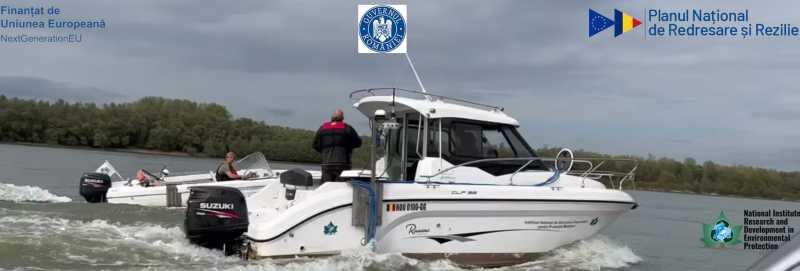
A real-time monitoring network was also deployed across roughly 1,500 km of the Lower Danube, tracking environmental parameters and tagged wild sturgeon equipped with ultrasonic transmitters. INCDPM developed technology for tagging and releasing sturgeon with such transmitters, enabling real-time supervision, and acquired specialised equipment for maintaining the integrated monitoring system.
The project also delivered custom software applications using artificial intelligence to process environmental data and track tagged sturgeon, as well as to manage the resulting databases.
According to INCDPM, the project's goal was to create a resilient reform in environmental protection and biodiversity conservation, laying the groundwork for improved cooperation between fishing communities and responsible authorities.
The infrastructure supports the EU's 'zero tolerance for illegal fishing' objective under the European Green Deal, while helping restore wild sturgeon populations so that authorities may one day reassess the possibility of reopening controlled fishing - but only if conservation status becomes favourable.
The system provides a scientific basis for future decisions on sustainable species management, using digital and AI-based technologies to analyse and interpret data. It also strengthens cooperation among institutions responsible for environmental protection and anti-poaching, including the Romanian Police, Gendarmerie, National Environmental Guard, Coast Guard and the National Agency for Fisheries and Aquaculture.
The newly created infrastructure can supply data on Danube water pollution, hydrodynamic parameters, riverbed morphology, extreme-event forecasting, climate-change impacts, sturgeon migration, hydrotechnical construction impacts and nature-based solutions.
INCDPM says the project is 'innovative and unique worldwide', integrating telecommunications, acoustic telemetry and artificial intelligence into a unified, complex monitoring system designed to support viable biodiversity-protection solutions. AGERPRES (RO - writing by: Mariana Nica; EN - writing by: Simona Klodnischi)
- Category: English
- Date: 2026-09-01 21:22:41
- Foto: incdpm.org