
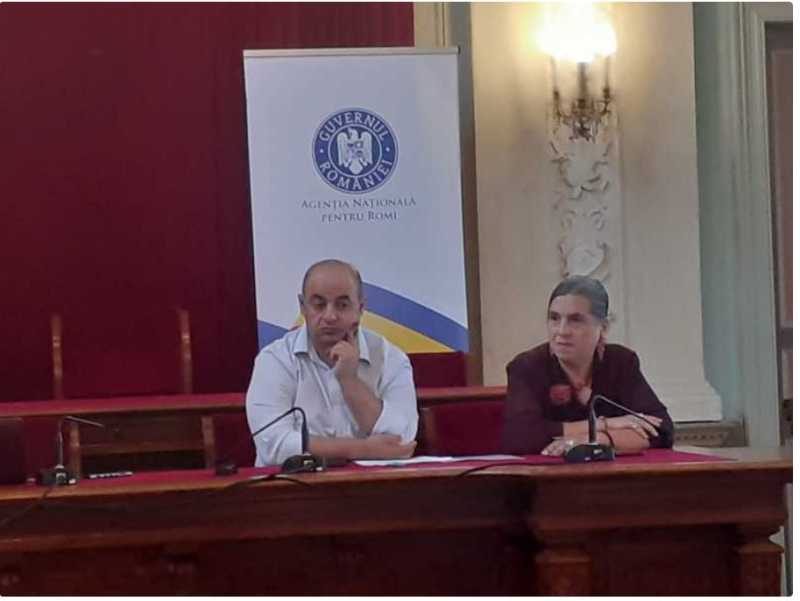
Representatives of Romania's Roma community, gathered at the ProEtnica Intercultural Festival in Sighisoara, voiced frustration that the Museum of Roma Culture and History exists only on paper and urged authorities to finally implement the law establishing it.
The conference - organised by the National Agency for Roma - focused on Roma slavery and the need for historical reconciliation, highlighting what speakers described as major gaps in public recognition and education.
Mihai Neacsu, director of the National Roma Culture Centre, said reconciliation must consider 'what and how much is studied' about minorities, slavery and the Holocaust, noting that while some steps have been taken, 'there is always room for more, both from Roma and from authorities.'
He pointed out that several proposals remain stalled, including the museum project, despite Parliament having adopted the law.
Sociologist Adrian-Nicolae Furtuna stressed that Roma slavery, which lasted nearly five centuries on Romania's current territory, and the Roma Holocaust remain insufficiently known, warning that 'the lack of a correct collective memory perpetuates prejudice and systemic racism.'
'To understand reconciliation, we first need to know what happened,' Furtuna added.
Lecturer Delia Grigore said anti-discrimination laws exist but 'racism continues,' adding that extremist symbols and attitudes still appear publicly. 'What do we actually want? We want reparations. (...) We have a law, and yet neither slavery nor the Holocaust is recognised at the level they should be,' she said.
Grigore appealed to authorities to act: 'In July 2026 there were three years since Parliament adopted the law establishing the Museum of Roma Culture and History, thanks to the efforts of then-MP Catalin Manea of the Roma Party, and we kept hoping this museum would be created. More than that, even before the law appeared, we mobilised on the content side. The National Agency for Roma contracted a working group of specialists — historians, sociologists, linguists, Roma and non-Roma cultural experts — and we joined and worked in this group for about half a year. (...) The concept was completed and submitted to the Government, before the law even existed, and it is posted on the Agency's website. So when you have a concept, a complex, detailed vision, when you have a law adopted by Parliament, and three years later not even the smallest step has been taken, no space allocated. We are very disappointed that not even this has happened, especially since all or most minorities here have a public museum, and we have only a virtual one. (...) A physical public museum does not exist. We are disappointed.'
She urged the Government, Parliament and the Ministry of Culture to ensure the law is applied: 'We have a law, and it's a pity to live in a state that becomes anomic - with good laws that are not enforced.'
Iulian Paraschiv, head of the National Roma Agency, said ProEtnica showcases Romania's multicultural richness and stressed that Roma remain 'the most unpopular minority in Romania and Europe.' He called the museum 'a long-standing goal' and said authorities are still searching for a suitable space.
Paraschiv noted that experts helped develop the museum concept, which aims to present Roma history and contributions. He said few people know about the Roma Holocaust or the centuries of slavery, and that ignorance fuels stereotypes: 'In Romania and across Europe, Roma are still viewed as 'those who don't want to work', as 'those who don't want to send their children to school', as 'those who have brought shame on Romania'.'
To change such perceptions, he added, the National Agency for Roma is organising events and developing strategic frameworks that address these issues. 'Roma are part of the Romanian nation, whether some like it or not,' Iulian Paraschiv said, adding that deeper historical understanding is needed 'to relate correctly to the present and build our common future.'
He also announced that an educational guide on Roma history, including the Holocaust, will soon be distributed in schools to help combat racism and stereotypes.
The event, held at Sighisoara City Hall, brought together representatives of national minorities, local authorities, teachers, human-rights activists, community leaders, social-policy experts, journalists and young people. AGERPRES (RO - writing by: Catalina Matei; EN - writing by: Simona Klodnischi)
- Category: English
- Date: 2026-08-28 18:14:05
- Foto: Catalina MATEI / AGERPRES