
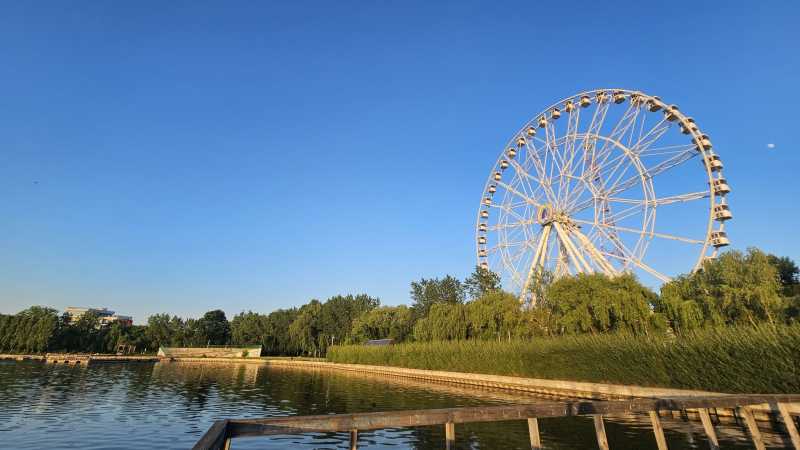
Music from Armenia, France, the Republic of Moldova, Romania, Türkiye, Poland, Serbia and the Arab cultural space will will be heard from Friday to Sunday on the shores of Lake Tei, at the 13th edition of the Balkanik Festival.
According to a release of the organisers sent to AGERPRES, the festival transforms Tei Park into a space dedicated to world music, where Bucharest's lautari music (a class of musicians whose music is known as lautareasca music and who are historically associated with ensembles and bands that perform at weddings, celebrations and other social events) meets Balkan brass bands, Anatolian psychedelia, Armenian songs and Middle Eastern sounds. This year's edition will also feature, for the first time, the musical traditions of the Huni Kuin community from the Brazilian Amazon.
Ladaniva, Zdob si Zdub, Taraf de Caliu, Baba Zula, Bubliczki, Shiran & Bakal, Cumbus Cemaat and Kristijan Azirovic Orkestar will take to the stage, alongside the special project 'Romica Puceanu Reimagined.' Ceremonial songs brought from the Amazon by Txana Iba Huni Kuin will be performed, along with jam sessions in which musicians are invited to join in with their own instruments and voices.
Around the stages, the festival continues with contemporary art, installations, video mapping, talks, dozens of independent creators and craftspeople, workshops, international cuisine, tarot and coffee-cup readings, relaxation areas and activities on Lake Tei.
Under the theme 'The Sounds of Heritage. The Rhythm of Now,' Balkanik regards heritage as something that moves between people, generations and geographies and changes its form precisely because it remains alive.
The festival starts on Friday at 18:00 with a brass band procession by Kristijan Azirovic Orkestar, which will set off from Obor towards Tei Park. At 18:30, the Serbian musicians will open the programme on the Lake Stage.
At 20:30, Shiran & Bakal will bring together Arab musical memory and contemporary production. With Yemeni and Iraqi roots, the project builds a sound from Arabic songs, rhythm, bass and electronics that views tradition as a living material in a constant state of transformation.
At 21:30, the first evening belongs to one of the most beloved bands in Romania at the moment: Ladaniva. The French-Armenian duo formed around Jacqueline Baghdasaryan and Louis Thomas effortlessly and infectiously moves between Armenian folk, Balkan sounds, jazz, reggae and contemporary pop. After their own version of the song 'Saraiman' from Romica Puceanu's repertoire, won over Romanian audiences, Ladaniva comes to Balkanik for one of the central concerts of this year's edition.
On Saturday, from 17:30, the Balkanik stage will host the premiere of 'Romica Puceanu Reimagined,' an original project created for the 13th edition.
Thirty years after Romica Puceanu's death and on the eve of the centenary of her birth, Balkanik proposes a return to the repertoire of one of the great voices of Romanian urban lautaresti music. The project brings together for the first time on the same stage Corina Sirghi, Madalina Paval, Paulina, Raluca Radu and Ioana Tatarusanu, alongside Valeriu Borcos - electronics, Lucaz Molinaz - percussion and Nelu Raducanu - cimbalom, in a line-up complemented by musicians from the contemporary lautari scene.
Romica Puceanu's songs will be reinterpreted through the voices and musical languages of a new generation, from approaches close to the lautareasca tradition to combinations with electronics and percussion.
From 19:30, Baba Zula will bring to Bucharest Turkish alternative music inspired by the sounds of Istanbul, while from 21:30 Taraf de Caliu will close the programme on the Lake Stage.
On Sunday, the main programme starts at 17:30 with Bubliczki, a Polish band made up of seven musicians, which describes its style as 'turbo folk'. Drawing on Kashubian culture and language, the group combines klezmer harmonies, Balkan brass and folk elements.
At 19:30, Cumbus Cemaat will bring to Bucharest the spirit of Istanbul's musical gatherings: songs and rhythms that move between Anatolia, the Balkans and the Near East, improvisation and music in which the boundary between the stage and the audience quickly becomes irrelevant. The edition will conclude with Zdob si Zdub taking to the stage at 21:30.
A second musical area is the Poienita Stage, where Andrei Constantinescu will perform a DJ set on Friday from 16:00. On Saturday, the programme starts at 14:00 with Andrei Rautz & Cheia Do and continues from 16:00 with Lula Baluba. On Sunday, from 14:00, Raj & Pietrosel will provide the afternoon programme.
Also on Sunday, from 16:00, the festival will host a Lautaresc Jam Session, with several musicians having already confirmed their participation. The Balkanik Festival encourages musicians in the audience to bring their instruments - or their voices - and join the jam. Thus, the lautareasca music returns to one of the settings through which it has always been passed on: direct encounters between musicians, repertoire passed from one to another, listening and improvisation.
After the concerts end, Balkanik After Dark takes over, moving the festival to two different spaces for two nights with distinct personalities.
On 28 August, from 23:30, Kottarashky & Sando bring Balkan sound collages and live accordion by the Bulgarian project into the night. From 1:00, the party continues with Daniel Mitulescu & Radio Barba - DJ set.
On 29 August, from 23:30, on the terrace, Ligia Kesisian feat. Lucaz Molinaz, accompanied by violin and accordion, continues the night with a world music DJ set featuring live interventions. Inside, Valerius (K.not.K) takes over the decks for a dance set at the same time.
In the context of the Brancusi150 project, Balkanik is bringing to the festival site the project 'Forme care tac/ Forme care lumineaza - Constantin Brancusi la Balkanik Festival' which translates several of the fundamental principles of the Brancusian universe - the essentialisation of form, verticality, duration, silence and light - into the language of contemporary art. The monumental installation Pasarea (Bird), which does not touch the ground, created by set designer and artist Raluca Pavel, functions as a sculptural object by day, while after dark it is transformed through the video mapping created by Adistu, accompanied by a sound composition. Alongside it, the performative intervention Masa Tacerii (The Table of Silence) proposes a collective moment of listening and presence, briefly suspending the rhythm of the festival.
This year's edition takes place across approximately 16,000 square metres of green space, on the banks of Lake Tei, and includes, alongside concerts, a craft fair, international gastronomy, contemporary art, activities on the lake, video mapping, talks, workshops, relaxation areas and DJ sets.
Children aged up to and including 9 enter free of charge when accompanied by adults. Children aged between 10 and 15 benefit from a 50% discount on passes and tickets.
The Balkanik Festival - Home of World Music #13 is organised by the Metropolis Cultural Association.
AGERPRES National News Agency is a media partner of the event. AGERPRES (RO - writing by: Petronius Craiu; EN - writing by: Rodica State)
- Category: English
- Date: 2026-08-27 11:45:45
- Foto: BalKaniK Festival / Facebook