
AGERPRES special correspondent Nicoleta Gherasi reports: The technical component is overwhelmingly dominant at the CIGRE 2026 Paris Session, while Romanian engineers continue to rank among the sector's leading specialists, CIGRE Romania President Ciprian Diaconu said on Wednesday.
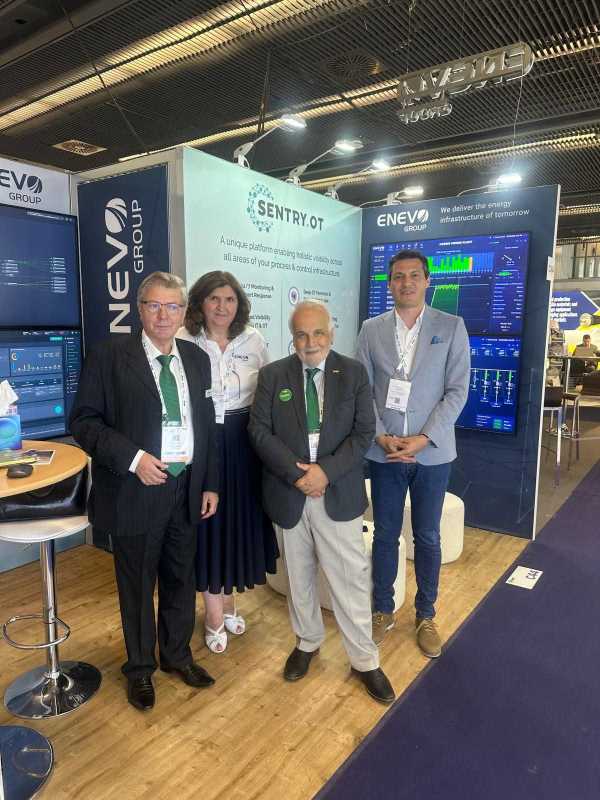
'One new element is the very large number of participants compared with two years ago. This year there are at least 5,400 paying delegates, plus at least 1,500 exhibitors and visitors. The exhibition has grown by around 25% compared with two years ago, while the prestige and recognition of CIGRE International are also increasing. (...) The technical side is 99.9% predominant over any other aspects. Technologies from every area of the power sector are here. (...) You may have seen at one of the stands the first 400-kilovolt vacuum circuit breaker, with vacuum technology once considered economically prohibitive. (...) There are also many developments in communications and IT. Our colleagues at Enevo are presenting something very interesting in cybersecurity. (...) It seems to me that what our colleagues from Romania have developed is far ahead of what others have done. So Romanian engineers continue to be somewhere at the top,' Diaconu said.
Among the main topics at this year's event, he highlighted artificial intelligence and its potential to support the energy industry.
'Its gradual, day-by-day penetration into the energy industry seems to me to be very welcome and well founded. And if, for many people, AI is just ChatGPT, it is important for many more to understand that AI is a tool that can help those in the energy industry. There are now hundreds of thousands of electricity companies operating in the same area, and they all need to communicate with one another, protect themselves against cyberattacks and optimise their operations economically. So, in my view, this is a very, very important contribution,' he said.
Another major topic at the Paris session is what Diaconu described as the need to correct a historic mistake in energy systems: the so-called 'unbundling', or separation of companies.
'Another important issue discussed here is: let's fix a historic mistake made in energy systems, not only in Europe but across much of the world, when the famous unbundling took place, separating companies. I also took part in, and had to contribute to, separating transmission from distribution. Now CIGRE is saying: but we are actually connected, we are all in the wire business. We have the same concerns. Technologies from transmission have moved into distribution, technologies from distribution are moving towards transmission, and the grid is no longer unidirectional, from transmission to distribution. There are now many flows going from distribution towards transmission, and engineers need to observe all this, formalise the concepts and find solutions,' Diaconu said.
He also highlighted CIGRE's growing efforts to fund research and educational projects through a dedicated foundation, stating that the association has established a foundation to fund eligible research and educational projects, attracting support from sponsors who recognize its key role in the energy sector. As Diaconu put it, while younger generations may see Wi-Fi as essential, electricity remains the foundation of modern life.
At the 2026 Paris Session, Romanian energy specialist Bogdan Leu was elected International NGN President of CIGRE for 2026-2028, while Transelectrica specialist Radu Opreanu presented a paper on 'Dynamic formation of power system areas for continuous inertia estimation.'
'CIGRE Paris Session is the world's largest conference dedicated to power systems, bringing together every two years companies providing solutions and showcasing their latest innovative projects. (...) I presented a paper on inertia estimation in power systems. For this research, I used data from Romania's National Energy Dispatch Centre (DEN). Inertia is like an invisible actor in the transmission grid that compensates for power imbalances in the first moments after they occur. In my article I focused on a specific step in the inertia-estimation process: how to divide system regions for local inertia assessment. (...) This would help the DEN dispatchers gain a clearer view of inertia in certain areas and prepare frequency-regulation capacities that can compensate for a possible power imbalance,' Opreanu explained.
Around 15,000 experts from 100 countries are attending the August 23-28 CIGRE 2026 Paris Session, which focuses on the challenges of electrification, including AI and data centres, large-scale power outages, grid-forming technologies, electricity markets, flexibility mechanisms, cybersecurity and infrastructure planning.
Romanian company Enevo Group is showcasing its expertise in EPC and cybersecurity for energy infrastructure, including live demonstrations of its SentryOT cybersecurity platform. AGERPRES (RO - writing by: Oana Tilica; EN - writing by: Simona Klodnischi)
- Category: English
- Date: 2026-08-26 20:34:48
- Foto: CIGRE Romania / Facebook