
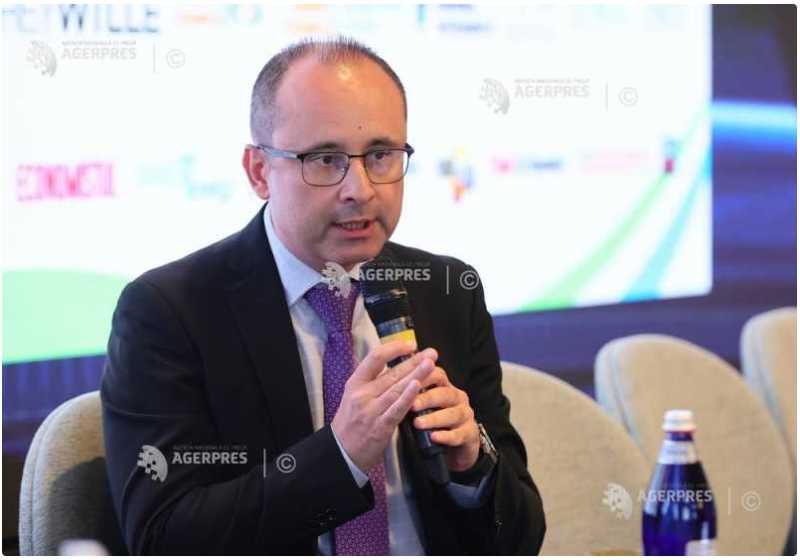
Romania is in a much better position than other European countries regarding natural gas supplies for the upcoming period, and its gas storage level is above the European Union average, Cristian Busoi, State Secretary at the Ministry of Energy, stated in a post published on his social media page on Tuesday.
'As a country with significant domestic production—currently boasting the highest natural gas output in the EU, a position set to be further strengthened when the Neptun Deep project begins extraction in 2027—Romania is in a much better position than other European nations regarding natural gas supplies for the period ahead. First, under Emergency Ordinance no. 12/2026, the population is protected. There is a regulated mechanism requiring producers to supply specific volumes of domestically produced gas at a price of 110 lei/MWh to suppliers serving household consumers and to thermal energy producers. The volumes for suppliers serving household consumers and for thermal energy producers have already been contracted, primarily through the efforts of Romgaz. Second, Romania ranks above the European average in terms of gas storage levels and is required, under both national and European frameworks, to maintain stocks amounting to at least 90% of its storage capacity,' Busoi stated on Facebook.
According to the official, under the new European rules, there is no longer an obligation to reach a minimum storage capacity level of 90% by November 1; instead, this level must be achieved at any point between October 1 and December 1, 2026.
'Furthermore, a Member State may lower the target by up to 10 percentage points (effectively to 80%) in the event of difficulties in filling storage facilities, and the European Commission may grant an additional 5 percentage points of flexibility if unfavorable market conditions persist. I am well-acquainted with this situation because, during my tenure as Chair of the ITRE Committee, I served as the European Parliament's rapporteur for the regulation on natural gas storage. Given the potential for increased gas consumption—driven by the integration of new generation capacities at Mintia, Iernut (the new power plant), Constanta, and Arad (NRRP projects), as well as the connection of numerous household consumers via the Anghel Saligny program—a recommendation was issued during the last 'Gas Task Force' meeting in August. All companies with storage obligations were urged to accelerate their pace and exceed the statutory minimum requirement,' the State Secretary emphasized.
He also noted that forecasts and concerns regarding the coming winter were discussed at length during the most recent EU Energy Council meeting, held in Luxembourg in June 2026, 'and we will certainly revisit the topic at the Dublin Council in September, organized by the Irish Presidency of the EU Council.'
According to data published by Busoi, on Tuesday, August 25, the European benchmark for exchange-traded natural gas (TTF) stood at around €68/MWh—approximately 16% above the level recorded in July and roughly double the figure for 2025.
According to the Ministry of Energy representative, the main causes of this situation are: the conflict with Iran and the disruption of traffic through the Strait of Hormuz, which affected LNG exports from the Gulf—particularly the availability of gas from Qatar; intense competition for LNG—especially supplies from the US—between the EU and Southeast Asian countries; high market prices that made purchasing and storing gas for winter less attractive; and the very hot summer combined with the partial or total shutdown of certain nuclear power facilities, leading to increased gas consumption for electricity generation.
'The European Union has rightly chosen to reduce and gradually phase out natural gas imports from Russia through a set of European measures, including those associated with REPowerEU. Despite these international and European challenges—which are beyond the Romanian Government's control—Romania will navigate this situation more easily thanks to proactive measures adopted by the government led by Mr. Ilie Bolojan, as well as domestic natural gas production and support measures for the population,' emphasized Cristian Busoi. AGERPRES (RO - writing by: Daniel Badea;EN - writing by: Catalin Cristian Trandafir)
- Category: English
- Date: 2026-08-25 15:52:30
- Foto: Silviu MATEI / AGERPRES Photo