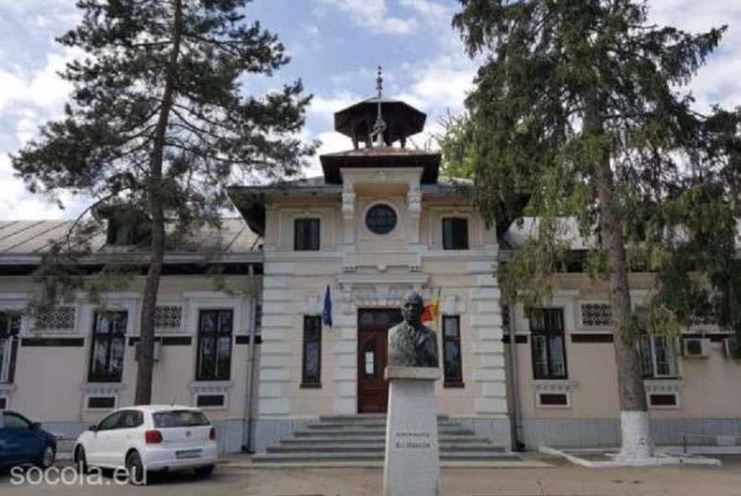

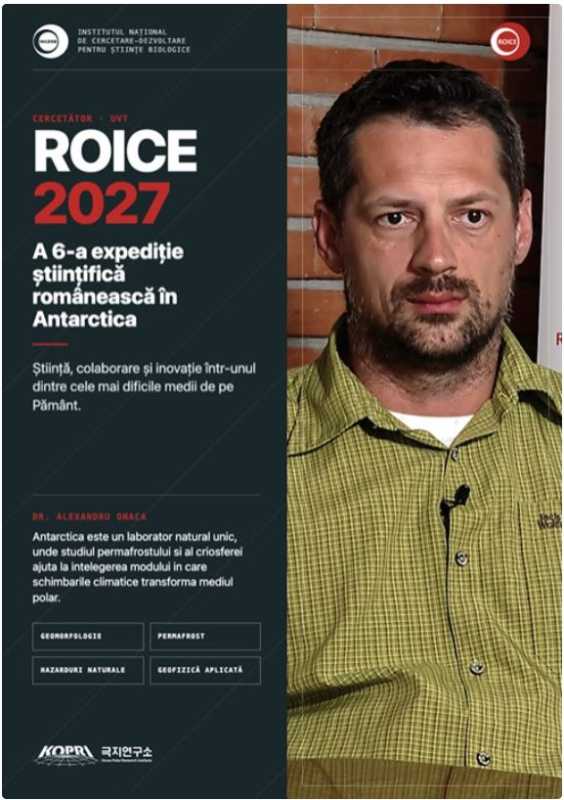
The West University of Timisoara (UVT) will take part for the first time in a scientific expedition to Antarctica in December, through its Department of Geography, represented by Associate Professor Alexandru Onaca, UVT Vice-Rector Madalin Bunoiu told AGERPRES on Monday.
According to him, the university's participation in the expedition represents, beyond visibility and prestige, a scientific milestone and confirmation of the Timisoara university's standing in Romania's research community, all the more so as this is not an isolated initiative, but part of a Romanian polar research programme coordinated by the National Research and Development Institute for Biological Sciences (INCDSB), through its Department of Antarctic Research.
'We are a comprehensive university, and our ambition is to be present wherever relevant, competitive research connected to the major themes of contemporary science is being conducted. Taking part in a scientific expedition to Antarctica fits very well into this approach. For UVT, joining this community and working alongside a national research institute and the other partner universities is also important from the perspective of how we see the development of research in Romania: major scientific questions can no longer be addressed institution by institution, separately, but through complementarity, shared infrastructure and networks of expertise. Antarctica is one of the most spectacular natural laboratories available to us. It is an isolated and extreme environment where we can study natural processes that are difficult or impossible to observe in other parts of the planet: glacier and permafrost dynamics, climate change, biodiversity and the adaptation of organisms to extreme conditions, and the interaction between the atmosphere, water, ice and ecosystems. The history of ROICE shows precisely this diversity: Romanian expeditions have addressed microbial biodiversity, human adaptation, polar ecology and environmental pollutants over time,' physicist Madalin Bunoiu said.
According to the vice-rector, the expedition also highlights the role of fundamental research, with major scientific advances often emerging over time, while research in isolated and extreme environments is a test of scientific and institutional maturity.
'You cannot improvise in Antarctica. You need highly trained researchers, robust methodologies, appropriate equipment, extraordinary logistics and, above all, the ability to work across disciplines and in cooperation with other institutions. (...). The cooperation developed with the Korea Polar Research Institute (KOPRI) and the possibility of conducting research at the King Sejong Antarctic Station are the result of this institutional framework. Therefore, for UVT, our presence here through our colleague Alexandru Onaca is not simply an institutional box-ticking exercise, but shows that the expertise built at our university can contribute, as part of a national programme coordinated by INCDSB and international scientific cooperation, to research conducted in one of the most challenging and relevant natural environments on the planet,' Madalin Bunoiu stressed.
The Antarctic expedition highlights the complexity of scientific research: the expedition is its most visible and spectacular part, but only one stage of the process.
For several weeks in Antarctica, measurements and observations will be carried out, samples will be collected and data will be gathered.
After returning to Romania, another, much more laborious stage will begin: the analysis and processing of the data, comparing them with previous results, and the formulation and testing of hypotheses. This process can take months and, in many cases, even years.
'For UVT, the main objective will be precisely to make scientific use of this information. We want the data obtained by Alexandru Onaca during the ROICE expedition to generate relevant scientific results, publications in major international journals, new research collaborations and projects, as well as topics for students, master's students and doctoral students. At the same time, we must be aware that fundamental research does not guarantee spectacular discoveries on demand. Sometimes we confirm what we already knew, sometimes we correct an interpretation, and sometimes an apparently minor observation opens up an entirely new avenue. The value of such an expedition is measured not only in the weeks spent in Antarctica, but above all in the knowledge we manage to build in the years that follow, based on the data brought back from there. I believe the most important message is this: a strong university must be present not only where answers exist, but especially where science is still formulating the major questions,' UVT Vice-Rector Madalin Bunoiu concluded. AGERPRES (RO - writing by: Otilia Halunga; EN - writing by: Simona Iacob)
- Category: English
- Date: 2026-08-24 14:59:53
- Foto: Universitatea de Vest din Timișoara (UVT)