
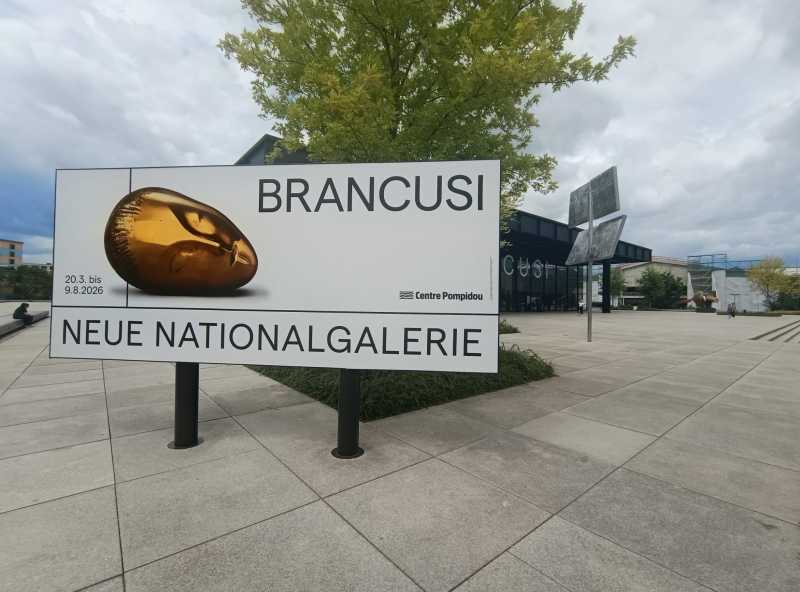
A major retrospective dedicated to Romanian sculptor Constantin Brancusi, organised to mark the 150th anniversary of his birth and hosted by Berlin's Neue Nationalgalerie, offers visitors a rare opportunity to discover the work and creative universe of one of the artists who revolutionised modern sculpture.
Organised in collaboration with the Centre Pompidou in Paris, the exhibition brings together more than 150 sculptures, drawings, photographs, films and rare archival documents and is the first Brancusi retrospective of such scale to be staged in Germany in more than half a century, according to information published on the museum's website.
The works on display come from the Centre Pompidou and numerous international public and private collections. A highlight of the exhibition is a partial reconstruction of Brancusi's legendary Paris studio, presented outside France for the first time, allowing visitors to experience not only his sculptures but also the environment in which they were conceived.
Housed in the light-filled glass pavilion of the Neue Nationalgalerie, designed by Ludwig Mies van der Rohe, the exhibition unfolds in an open space that allows visitors to approach the sculptures from multiple angles and appreciate the dialogue between the works and their surroundings.
The retrospective opens with Sleeping Muse, whose refined, simplified form introduces visitors to Brancusi's artistic language and his lifelong search for the essence of form rather than its outward appearance.
Among the exhibition's centrepieces are The Beginning of the World (The Egg), Princess X, Miss Pogany, several versions of The Kiss, Maiastra, Bird in Space, Endless Column, as well as animal-inspired sculptures such as Seal, Turtle and Rooster. A dedicated space is reserved for Leda, displayed on a rotating metal disc that enhances the impression of graceful movement, recalling a swan gliding across water.
Throughout the exhibition, visitors linger in front of the sculptures, often returning to the same works several times, listening to the audio guide and attempting to understand the essence Brancusi sought to capture through radically simplified forms.
Parents explain the sculptures to their children, students sketch the works on paper, while art lovers quietly contemplate masterpieces that have shaped the history of twentieth-century sculpture.
One of the strongest attractions is Bird in Space, whose polished surface and soaring form continue to fascinate audiences more than a century after its creation. The sculpture embodies one of Brancusi's defining ideas: representing not the physical appearance of a bird but the very concept of flight.
The exhibition also offers an exceptional insight into Brancusi's creative process through the reconstruction of his Paris workshop. Beyond a wooden doorway inspired by traditional architecture from Romania's Oltenia region, visitors discover the artist's tools and the way he arranged his sculptures, treating the studio itself as an integral work of art in which the pieces appeared to communicate with one another.
Photographs taken by Brancusi himself, sketches, films and archival documents further enrich the exhibition, while a video projection shows the sculptor, dressed in his characteristic simple clothes, at work in his studio.
The exhibition has attracted an international audience, with conversations in German, English, French, Spanish and Romanian echoing throughout the gallery.
Among the visitors are Romanians living abroad who travelled specifically to Berlin to see the retrospective.
Nancy Nemes, who has lived in Germany for many years and has visited Brancusi exhibitions around the world, described the sculptor as 'a universal genius given to the world by Romania. And shaped, of course, in France.'
She praised the quality of the exhibition's curation and the remarkable effort to assemble masterpieces from museums and collections around the world while offering visitors new perspectives on works that have become icons of modern art.
According to Nemes, Brancusi's ability to innovate remains a source of inspiration not only for artists but also for everyday life and professional activity.
She also pointed out the symbolic significance of staging the exhibition in the Neue Nationalgalerie, a landmark building located close to the former Berlin Wall, in an area deeply associated with Europe's twentieth-century history.
Asked what Brancusi represents to her personally, she replied with a smile: 'He could have been my lover.'
She continued: 'The truth is that he inspires you to love. He inspires you not only to love the beauty of his art, but also to think creatively and allow your own love to find expression.'
Standing near the series of Bird sculptures, Béa Beste, whose father, Romanian art historian and architect Richard Bordenache, knew Brancusi personally, said the sculptor's work was characterised by a courageous reduction of form to its essential elements.
'My father knew Brancusi. My father was a professor of art history and architecture in Bucharest, Richard Bordenache, and apparently he knew him. They were not friends or anything, but I know they met. He told me a great deal about him. My father was fascinated by this modernism, by reduction to the essence. He also worked with Le Corbusier. For me it is a very special aesthetic because it is very courageous. (...) For me it is courage, the courage to leave behind what is superfluous and retain only the essence,' Beste told AGERPRES.
She believes Brancusi's sculptures also speak about the freedom to think differently, to innovate and to move beyond established conventions.
Another Romanian visitor, Anca Liana Dunica, travelled to Berlin to allow her son to discover the work of Romania's greatest sculptor.
'The exhibition is beautiful and fascinating, and it's a pity that it's here and not in Romania,' she said.
She added that young people should rediscover genuine cultural values and stressed the importance of education in helping future generations appreciate Brancusi's legacy.
Maria, who travelled from Oradea specifically to see the exhibition, said her fascination with Brancusi began after seeing a holographic projection of the artist on the facade of the Royal Palace in Bucharest.
She said that learning more about Brancusi's life had transformed the way she viewed his work, describing him as a creator deeply rooted in Romanian rural culture whose artistic vision ultimately reached universal significance.
Visitors' impressions are also reflected in the exhibition's guest book.
'Dear Constantin, thank you very much! An Oltenian,' wrote one Romanian visitor.
Another thanked the artist 'for the grace of being able to see and perceive, of returning to my soul, to the essence,' while a visitor from Germany described Brancusi as 'one of the greatest artists in the history of the world.'
The exhibition has proved a remarkable success. In May, the Neue Nationalgalerie announced that it had welcomed its 100,000th visitor. By the time the retrospective closes on Aug. 9, attendance is expected to exceed 300,000, which would make it the museum's most visited exhibition since 2012.
The event is held under the High Patronage of German President Frank-Walter Steinmeier, French President Emmanuel Macron and Romanian President Nicusor Dan. AGERPRES (RO - writing by: Gina Stefan; EN - writing by: Simona Iacob)
- Category: English
- Date: 2026-08-04 12:28:22
- Foto: Foto: GINA ŞTEFAN/AGERPRES