
A Romanian researcher is taking part in the refurbishment of the CMS (Compact Muon Solenoid) experiment and the construction of a component at the heart of the particle detector built for the Large Hadron Collider (LHC) at CERN. The detector functions as a gigantic 3D camera capable of capturing up to 40 million collisions per second, with the aim of studying fundamental phenomena in physics, including the Higgs boson and dark matter.
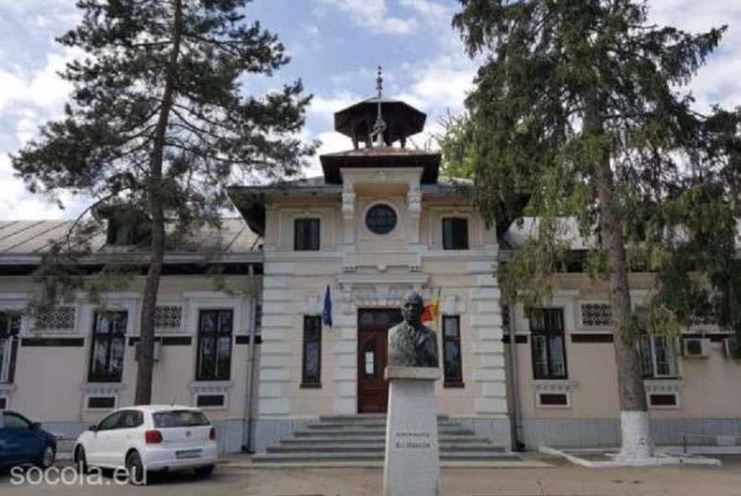
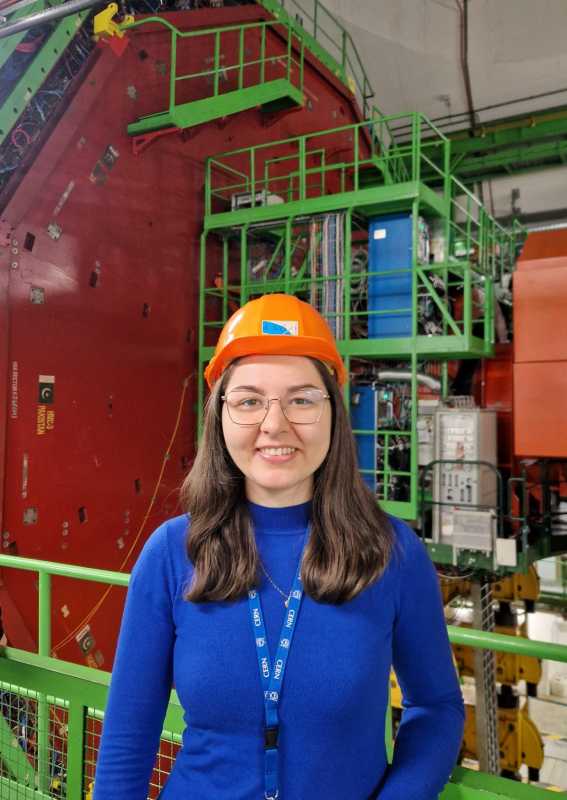
Cristina Alexe studied at B.P. Hasdeu National College in Buzau, where she developed a passion for physics and environmental science. She later chose to continue her studies at the University of Manchester in the United Kingdom, enrolling on an integrated Bachelor's and Master's degree in Theoretical Physics. In 2022, she began work on her PhD thesis in particle physics at the Scuola Normale Superiore di Pisa in Italy, funded by European grants. This marked her entry into the world of researchers at the European Organization for Nuclear Research (CERN), who are striving to understand how the Universe came into being and the forces that govern matter.
'I analyse data and interpret it to uncover information about the Universe. More specifically, together with an international team of researchers, I measured the mass of the fundamental particle known as the W boson, the particle responsible for mediating the weak nuclear force. Measuring its mass with such high precision allows us to test the best theoretical explanations of how the world smaller than an atomic nucleus works, as described mathematically by the Standard Model. Our result confirmed that the Standard Model is indeed correct regarding the mass of the W boson. It is remarkable that we can draw such conclusions given that our measurement has an uncertainty on the order of 10/26 kg - that is, 0.000...1 with 25 zeros after the decimal point!' Cristina Andreea Alexe told AGERPRES.
At the end of June, CERN shut down the Large Hadron Collider to begin a major scheduled upgrade. The shutdown is necessary to install new technology that will enhance the capabilities of the world's most advanced proton accelerator.
The young researcher is part of a team of more than 6,000 scientists and, while the LHC is offline, she will contribute to the upgrade of CERN's CMS experiment to prepare it for the future High-Luminosity Large Hadron Collider (HL-LHC) era.
'My contribution will focus on upgrading the CMS experiment so that it can cope with an unprecedented volume of data and withstand the high levels of radiation it will be exposed to. I will take part in building a component at the heart of the detector, where particles leave behind a trail of electrical signals as they pass through, and I will also help develop the algorithms that will enable us to reconstruct the particles' trajectories through the detector accurately. The projects we work on here are extraordinarily complex and require thousands of people. There are more than 6,000 of us working on the CMS experiment alone. The very fact that an institution such as CERN exists, and that so many people from so many different countries come together to achieve something important, gives me hope that good can prevail in an increasingly troubled world. The aim of the HL-LHC upgrade is to increase the number of proton collisions. The more collision data we have, the greater the chances of observing extremely rare new phenomena. At present, each collision involves two bunches of around 60 protons; we want to increase that number to between 140 and 200. Other ambitious aspects of the project involve electronic engineering - we will be using cables capable of carrying record-breaking electrical currents - as well as advanced vacuum technologies,' Cristina Alexe explained.
Through the modernisation of the LHC and the refurbishment of the CMS experiment at CERN, the particle physics PhD researcher hopes to obtain answers about dark matter, as well as further information about the Higgs boson, the elementary particle responsible for giving mass to all other particles in the Universe. Often referred to as the 'God particle', it is the quantum of the Higgs field, an invisible field that permeates all of space and interacts with particles to endow them with mass. The results are expected to support the work of scientists worldwide and add to the many discoveries that CERN has already made available to the global scientific community. AGERPRES (RO - writing by: Florin Zafiu; EN - writing by: Cristina Zaharia)
- Category: English
- Date: 2026-07-21 09:51:29
- Foto: Cristina Alexe