
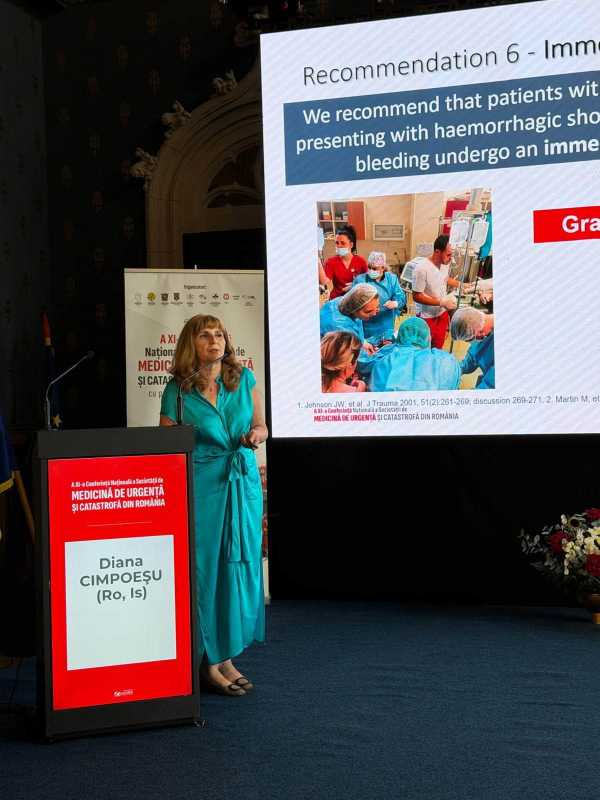
Emergency medicine in Romania is on a par with European standards, but emergency rooms remain overcrowded because many patients seek treatment for conditions that could be managed by family doctors or outpatient clinics, head of the Iasi Emergency Reception Unit-Mobile Service for Emergency, Reanimation and Extrication (UPU-SMURD), Professor Dr. Diana Cimpoesu told AGERPRES on the sidelines of a scientific event dedicated to emergency medicine.
According to her, the professional standards of Romanian emergency physicians are recognised internationally, while the experience of SMURD teams in helicopter rescue missions and mass casualty incidents is highly regarded at European congresses.
'In emergency medicine we are on a par with all European countries. Everything we present at scientific events is very well received. What matters now is to improve communication and visibility and to train the younger generation as we were trained: sound science, solid theoretical knowledge and practical skills aimed at saving people in critical situations,' said Diana Cimpoesu, coordinator of the Iasi UPU-SMURD unit and SMURD coordinator for north-eastern Romania.
She stressed that emergency medicine is one of the most demanding medical specialties and that those choosing it must be prepared for an intense workload and situations that are physically and emotionally challenging.
'The specialty is attractive because of its diversity and high level of performance, but it is also one that demands a great deal. Emergency medicine is not an ordinary specialty. It requires physical effort, scientific work and both emotional and physical resilience because you constantly face very serious situations,' Cimpoesu said.
According to her, emergency medicine requires permanent availability, including during periods when others are on holiday or spending festive occasions with family and friends.
'You have to be willing and able to cope with prolonged shifts, interventions on public holidays or during heatwaves and spending weekends in hospital. You also have to accept that your annual leave may be changed because of extreme heat requiring more pre-hospital and hospital emergency teams, or because many more patients attend emergency departments during holiday periods,' she explained.
Despite these sacrifices, she said the professional rewards are considerable.
'It is a fascinating and highly rewarding specialty. There is immense satisfaction in restarting a heart that has stopped or saving someone in a coma or in shock, then seeing them walking, talking and thanking you days or weeks later. You have to accept the more difficult side of the profession,' Cimpoesu said.
She added that coping with the pressure requires both the support of colleagues and the understanding of family members.
'You need support, first of all from your team and from effective team management, but every emergency physician also needs support from their family. One family is the one at the hospital, the other is the one at home. The latter must understand and provide support. You do not always have the understanding of both families. Sometimes it is difficult and you have to make other choices,' she said.
Cimpoesu said continuous professional training is essential to ensure that patients in Romania receive the same standard of care as those treated in leading European healthcare systems.
'In emergency medicine, as in any other medical specialty, it is important to know what is new and what matters. We have to learn the latest guidelines and constantly practise our practical skills,' she said.
She mentioned that patients have increasingly high expectations and that the healthcare system must meet those expectations.
'People want to be treated in Romania in the same way they are treated in France, Belgium or the United Kingdom,' Cimpoesu said.
Asked what should be done to reduce overcrowding in emergency departments, she said the solution begins with efficient family medicine services and outpatient clinics, combined with better public education.
'First of all, the other doors have to be open. If people know that the family doctor in their community is available, competent and approachable, they will go there for non-urgent conditions. I know many family doctors who can manage minor emergencies or non-urgent cases. The problem arises when those doors are closed, when people are sent from one place to another without finding a solution. That is when they end up in the emergency department,' Cimpoesu said.
She also pointed out that emergency services remain extremely busy despite the summer holiday season.
'There are a great many cases. Even in summer we see many patients with infections and many oncology patients. Outpatient services need to be available and patients need to know about them. Some simply do not know where to go, while others choose not to use them. For those unwilling to do so, public information campaigns in the media may help,' she said.
'Of course, a little civic responsibility is needed as well,' Cimpoesu added.
She said patients also share responsibility for the overcrowding of emergency departments.
'If you occupy a trolley, laboratory services, radiology or CT facilities for a non-urgent condition by claiming over the phone that it has just happened, even though you know your back pain has been there for a year and you could have arranged investigations or at least seen a doctor during that time, you are depriving genuinely critical patients of those resources,' she explained.
According to Cimpoesu, every unjustified visit to an emergency department consumes resources that could save the life of a patient in a critical condition.
'If you abuse the system, other people suffer and then complain about waiting times. They are waiting because everyone expects everything from a system that is clearly overstretched. Improving the situation requires action on both sides. Patients need to understand that they can use other healthcare services, while those services must be available, accessible and well known,' she concluded. AGERPRES (RO - writing by: Daniela Malache; EN - writing by: Adina Panaitescu)
- Category: English
- Date: 2026-07-04 15:29:47
- Foto: Carmen Diana Cimpoesu/Facebook.com