
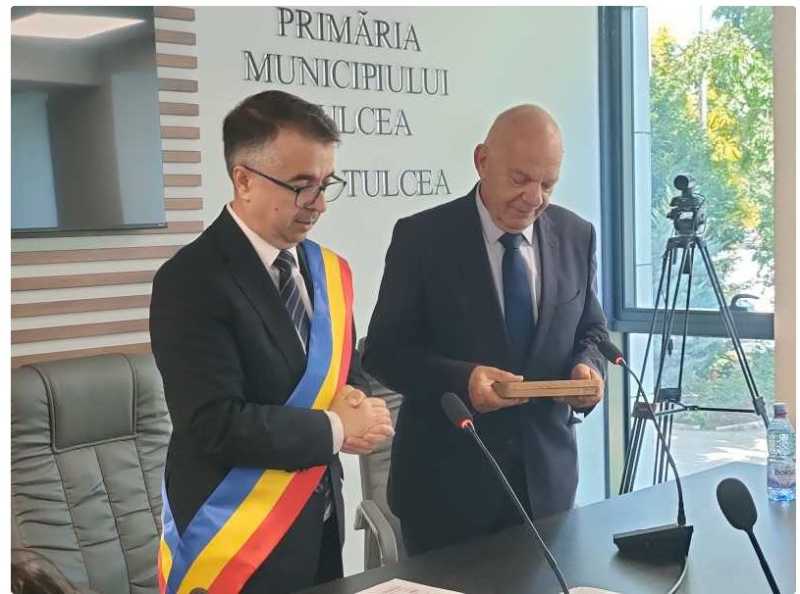
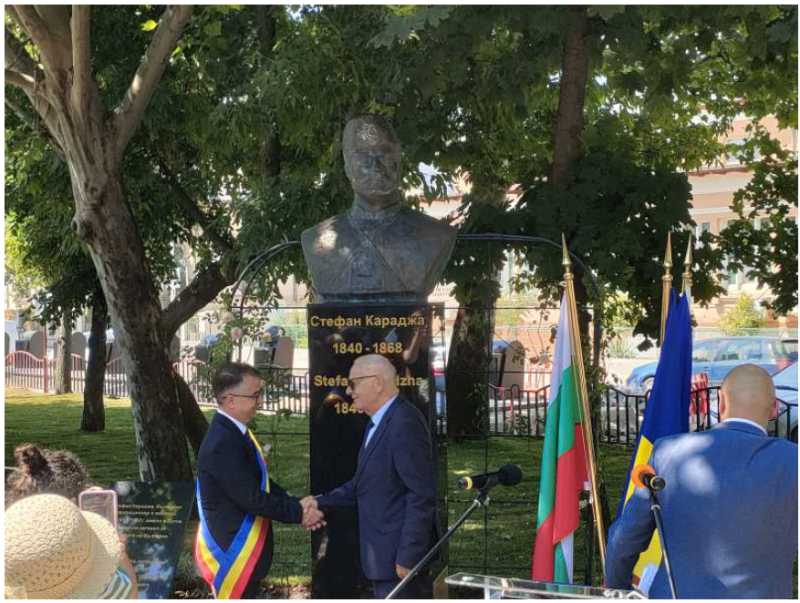
Bulgarian Ambassador to Romania Radko Vlaykov received on Tuesday the Key of Tulcea, in recognition of his contribution to strengthening bilateral relations, and together with Tulcea Mayor Stefan Ilie unveiled the commemorative monument dedicated to Stefan Karadzha, one of Bulgaria's national heroes.
The key-handover ceremony took place at Tulcea City Hall, in the presence of an official delegation including mayors from Bulgaria and representatives of Romania's Ministry of Foreign Affairs.
'Through you, I, as a history teacher, as well as many specialists from the 'Gavrila Simion' Eco-Museum Research Institute have learned a great deal about Tulcea's history, and because our shared history helps consolidate relations between our countries, and since this is all the merit of Your Excellency, I hand you the Key of Tulcea,' Mayor Stefan Ilie said.
In his turn, the Bulgarian Ambassador to Romania expressed his feelings: 'I am excited. Since my first day here, I have felt at home in Tulcea. Now I also have the key, so this is my home too. Thank you very much.'
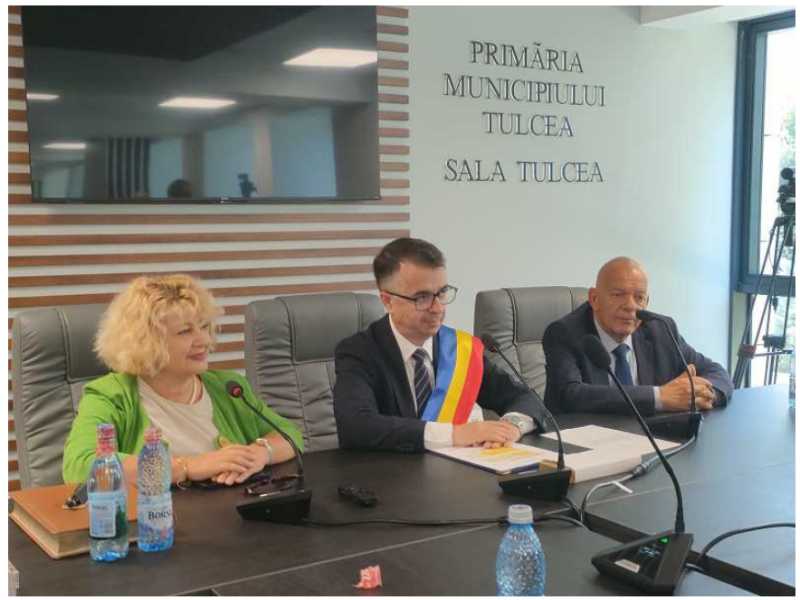
During the meeting hosted by the Tulcea City Hall, Romania's Ambassador to Bulgaria Brandusa Ioana Predescu underlined the importance of cooperation built also at local level: 'For us, building relations and efficient cooperation alongside local authorities elected and appointed at the level of counties, provinces, cities in the countries where we represent our states is as important as working with the central government, with members of Parliament, and sometimes perhaps more important.'
The Romanian diplomat also expressed hope that poet and journalist Mihai Eminescu will have a monument in the Bulgarian capital too.
The meeting was followed by the unveiling of the monument dedicated to Stefan Karadzha - an emblematic figure of the Bulgarian national revival movement - in the city's St. George Park. Director with the Romanian Foreign Affairs Ministry Mihail Harbic highlighted the relevance of bilateral cooperation: 'Today, as in the past, Romania and Bulgaria are facing the challenges of history. The two countries continue to develop fruitful cooperation in numerous areas, strengthening their ties of friendship and partnership at bilateral and regional levels, as well as within the EU and NATO. In an increasingly difficult geopolitical context, with a war started by the Russian Federation more than four years ago and still in full swing in our immediate neighborhood, this cooperation is more relevant than ever. Here, in this city, where the war across the border has very concrete repercussions, close collaboration in the face of threats to the security of our countries is even more evident and relevant.'
Harbic cited some ongoing joint initiatives, including the Mine Action Group coordinated by Turkey and the Black Sea Maritime Security Hub.
During the unveiling ceremony, Bulgarian Ambassador Radko Vlaykov mentioned that the monument in Tulcea is a replica of the one in Ruse, inaugurated in 1968.
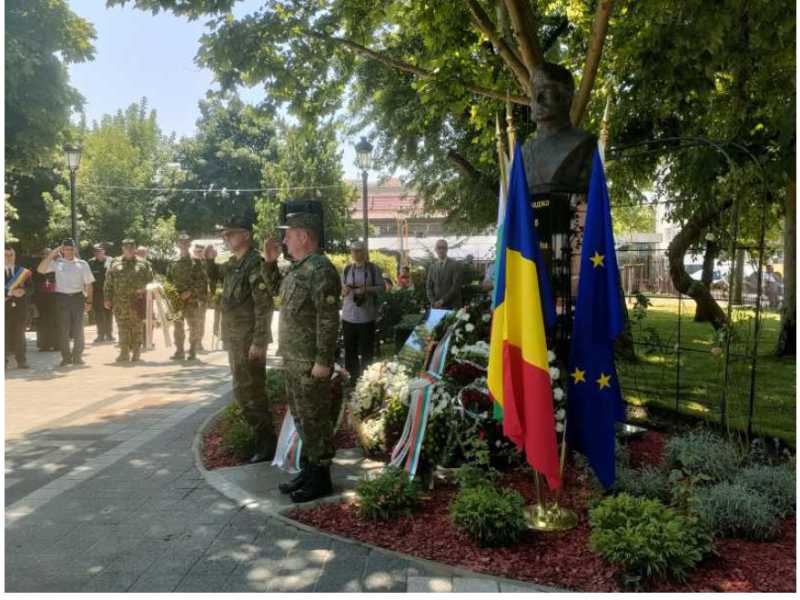
'Only together can we honor the memory of the historical figures of our two peoples, and only together can we build a path to the future,' Ambassador Vlaykov said.
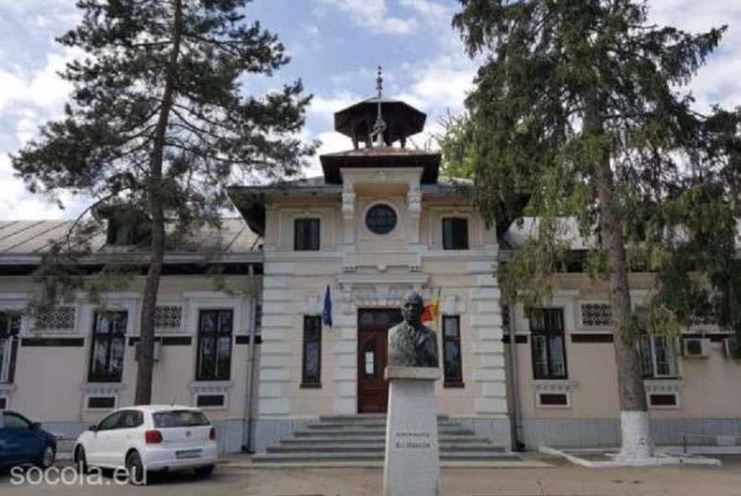
After laying wreaths at the new monument, the guests visited the nearby St. George Church, also known as the Clock Church or Bulgarian Church, where Ambassador Vlaykov met representative of the Eco-Museum Research Institute Aurel Stanica. Stanica presented newly discovered archival documents on Tulcea's Bulgarian community and asked for support to translate the material into Romanian.
'I can commit that in a very short time we will find someone to translate this book,' Vlaykov replied.
Also, Tulcea Mayor Stefan Ilie, pledged to cover the fee of the historian who will translate the work recommended by the representative of the institute.
The visit to the place of worship, which will celebrate next year its 170th anniversary, was followed by a wreath-laying ceremony at the bust of Gheorghi Rakovski, ideologist of the Bulgarian national liberation movement.
According to Tulcea City Hall, the Karadzha monument was created by Bulgarian sculptors Georgi Petkov Radulov and Daniel Kanchev Ivanov.
Stefan Karadzha (1840 - 1868) is a central figure of Bulgaria's 19th-century national emancipation movement. Born in Ichme (today Stefan Karadzhovo), he lived in Tulcea between 1854 and 1862, a formative period in which he studied and embraced the ideals of freedom and national identity. His revolutionary activity is closely linked to Romania, where he carried out much of his work and where many Bulgarian militants organized actions against Ottoman rule.
The Tulcea monument is the result of a partnership between the Municipality of Tulcea and the Embassy of Bulgaria in Romania. The Embassy initiated and financed the design, execution and installation, while the municipality handled administrative procedures and will maintain the ensemble. AGERPRES (RO - writing by: Luisiana Bigea; EN - writing by: Simona Klodnischi)