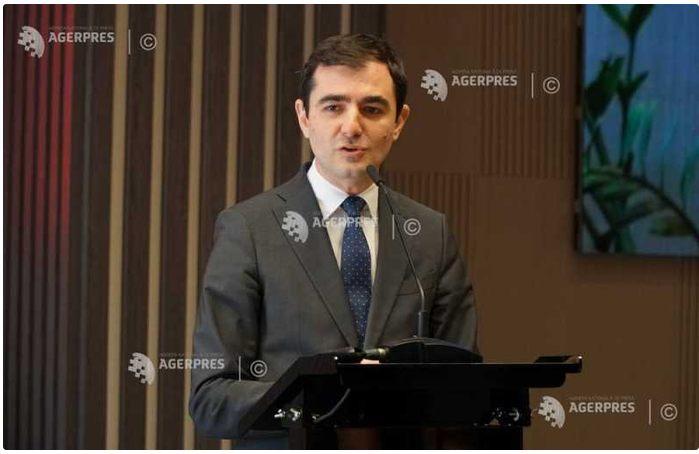


All the ministers I have nominated meet all the requirements of competence, ethics and integrity to implement the governing agenda and to contribute to Romania's reform, Prime Minister-designate Siegfried Muresan said on Tuesday in an interview to AGERPRES.
Muresan presented the main measures he will take if his government wins the confidence of the parliament on Wednesday - budget revision, passing the state budget law and reform of state-owned companies - explaining that foreign investors are looking very carefully at these aspects that can contribute to reducing uncertainties related to the national economy amidst an unstable geopolitical environment.
Regarding the decision of the Social Democratic Party (PSD) not to vote for his ministerial picks, Muresan reproached the Social Democrats for prolonging the political crisis and asked them to show responsibility and put the country before party.
AGERPRES: Mr Prime Minister-designate, the government you propose will go for a vote of a joint plenary session of Parliament on Wednesday. PSD has already announced that it will not vote for the Executive proposed by you, and the Alliance for the Union of Romanians (AUR) has the same position. At this moment, how many votes do you rely on in the investiture vote?
Siegfried Muresan: The government I am nominating is the first transparent, legitimate attempt to solve the political crisis and to install a pro-European, reforming, stable government, since the no-confidence motion that led to the fall of the government led by Prime Minister Ilie Bolojan, at the beginning of May. The first two attempts to form the government were made around a candidate from an extra-parliamentary party, who started with zero votes, and the second attempt was made around a candidate from the National Liberal Party (PNL) against the will of our party. Now we have for the first time a nomination transparently supported by three parties. The National Liberal Party, the Save Romania Union (USR) and the Hungarian Democratic Union of Romania (UDMR) already nominated me at the end of June. These three political parties together have 170 seats in the Romanian Parliament. In addition, in the last few days I had a series of very good discussions with the group of national minorities, which will announce its voting intention tomorrow. I am very optimistic after the discussions I had with them, including yesterday, and out of respect for them I let them announce how they will vote, but I am very confident in terms of the support of the lawmakers of the national minorities and especially in terms of my cooperation with them in the long term.
I have also had a series of discussions with the non-attached lawmakers and with the lawmakers from the smaller parliamentary groups. We are currently at between 170 and 233 votes. We will continue discussions.
I have seen the position of the Social Democratic Party. By yesterday's decision not to vote for the government, the Social Democratic Party chose to prolong the political crisis in Romania and, if it votes against a pro-European government, I am convinced that the PSD will not succeed in convincing anyone in Romania that it is practically pro-European. So, until tomorrow I will continue discussions with the Social Democratic Party, I think it still has a chance to reconsider its position in its entirety or at least for a part of its members. I am not asking the Social Democratic Party to understand that our reformist government agenda is good for Romania, but I am asking it to understand that the crisis it generated must be solved and to give a sign of responsibility towards the country, to put the country before party for the first time and to support the investiture of this government with a number of parliamentarians necessary to reach 233 votes.
AGERPRES: On Monday afternoon, hearings of the proposed ministerial picks for the Muresan Cabinet began in the parliamentary standing committees. Of the six picks already heard in the committees - only two received a positive opinion, the other four receiving negative opinions. Are you replacing the picks or are you going with the same formula in the joint plenary to ask for the investiture vote?
Siegfried Muresan: All my ministerial picks meet all the conditions of competence, ethics and integrity to implement the governing agenda and to contribute to the reform of Romania and each of them is very well prepared to hold the portfolio I have allocated to them. That was seen yesterday at the hearings, there were no questions to which the ministers could not answer. The ministers were supported en bloc by PNL, USR and UDMR lawmakers in all specialist committees. At the same time, the AUR lawmakers were absent from work, turned their backs on the Romanian Parliament, and PSD abstained in the case of Deputy Prime Minister Barna Tanczos of UDMR and in the case of the independent finance minister backed by the National Liberal Party. They voted present in these two cases and voted against the competent ministers from PNL and USR. The PSD vote was a political vote, it was a remote-controlled vote, it was not a vote based on the results of the hearing.
In fact, PSD has at this time kept looking for pretexts and has not been interested in a serious debate, not even on the governing agenda. Had they treated our governing agenda seriously, it would have seen that over 60 of the 370 concrete measures are in line with the ten ideas that the Social Democratic Party adopted at their conference a few weeks ago in Sinaia, when they set out their expectations for the new government. So, in short, PSD has no objective reasons to vote against this government. Voting against will be purely purely on subjective grounds. In the governing agenda there are many ideas that are in the field of social policies and that take into account PSD's requests. In fact, even yesterday, at the hearings, we saw a political behaviour of PSD, not an objective evaluation of the ministers I put forth.
AGERPRES: What were the criteria against which you selected the ministers?
Siegfried Muresan: As I said from the beginning, first I draught the governing agenda and after I finalised the government agenda, I looked for the ministers who best correspond to the portfolios. As such, the criteria were to be flawless nominations from the point of view of competence and integrity. These two criteria were the main criteria, after which we discussed the composition of the government, the portfolios and the nominations, of course, with the leaderships of the three parties, which each adopted unanimous decisions to support the ministers. What I am trying to say is that each of the ministerial picks has extremely strong support from their own party and general support from the coalition partners.
In addition, I picked an independent minister for an independent justice at the Ministry of Justice. I suggested to the three parties - and I appreciate the fact that they accepted - to have a minister who comes from the magistracy, a former judge with a long and impeccable career in the judiciary, a former esteemed member of the Supreme Council of Magistracy (CSM) and also with a remarkable academic career, including at the Babe-Bolyai University. So, I picked an independent nomination for the Ministry of Justice.
AGERPRES: Given that the defence pick received a negative opinion on Monday in the standing parliamentary committees, can you tell us whether or not you have consulted in advance President Nicusor Dan in your conversation on Friday on the defence portfolio, and also the foreign affairs portfolio?
Siegfried Muresan: Both the Minister of Foreign Affairs (Oana Toiu) and the Deputy Prime Minister (Radu) Miruta, the defence minister, did a remarkable and exceptional job in the Romanian Government last year. The foreign minister led a foreign policy based on principles, based on values, a foreign policy designed to strengthen Romania's role in the European Union and the strategic partnership with the United States of America, in a visible, transparent, institutional way, through repeated contacts with American officials. But I believe that she has done her job impeccably and I think that to Romanian diplomacy it would be very good for her to continue in this position. I am absolutely convinced that, together with Minister Toiu, given that I myself will be very attentive to foreign policy and to strengthening Romania's partnerships,t we will also succeed in modernising Romania's diplomacy in the coming years.
As far as Deputy Prime Minister Miruta is concerned, his results are also undeniable. The security risks to Romania are significant, we know them. He understood them very well as the defence minister and played an essential role in developing Romania's plan to access the EUR 16 billion from the European defence programme SAFE, a programme already approved by the European Commission and from which we received pre-financing of over EUR 2 billion. So, Minister Miruta has actual, remarkable results in an essential field. The protection of the people will be one of our priorities in government and that is why his nomination was fully deserved and we will continue all the steps to equip our troops and increase the security started by him in his first term.
AGERPRES: If the government you are nominating wins the confidence of Parliament on Wednesday, what will be the first three measures you will take to stabilise the economy in the short term, also taking into account the difficult international geopolitical context, marked by uncertainties in the immediate vicinity of Romania, and also in the Middle East?
Siegfried Muresan: The first thing I will do is budget revision. There are ministers who, in fact, pulled out of the government at the behest of their own party, PSD, who have not provided enough funds for this year. The Ministry of Health is an example. Former Minister (Alexandru) Rogobete failed miserably to come up with a responsible budget for the Ministry of Health for this year. We see the negative consequences. We see that there is a lack of money in hospitals. This budget revision is urgent, it will be one of our first measures, one of the main priorities, in the first weeks in office.
After that, immediately after the revision, we will start working on the state budget law for 2027. We will stop the waste of public money, we will be responsible and as soon as we have a little fiscal room, we will try to come up with certain relaxation measures for the people, who have borne the brunt this year.
After two years in which pensions and public pay did not increase, I believe that an indexation of pensions and pay is justified and we will assess exactly how much room we have for this. Both measures, the budget revision and the passage of the state budget law - by the way, on schedule, before the end of December - are things that investors are looking at very closely.
There are many people who would like to invest in Romania, but they want to have certainty, they want to have political stability. I am convinced that if the government I picked is sworn in, we will also have a series of favourable decisions from investors in the coming weeks. Investors are waiting for certainties and waiting for the end to the ongoing political crisis.
The third measure concerns the reform of state-owned companies. Here, Deputy Prime Minister Oana Gheorghiu has started a very good job of transparency. State-owned companies need efficient management; they need to attract the European funds they have at their disposal. In the energy sector, for example, there are companies that had hundreds of millions of euros made available but were not able to absorb them. We will have to absorb these funds to improve the energy infrastructure and storage facilities. If we do that, we will be able to reduce the price of electricity for people and the losses that these state-owned companies make. My goal is for these state-owned companies to produce quality services for the people, at the best possible price and, if possible, to produce profit for the Romanian state. They are now 'black holes' that produce losses for the Romanian state. Besides the fact that they produce quality services at too high prices, they quickly need restructuring, transparency and efficient management.
AGERPRES: What deadline are you setting for the passage of the uniform public pay law, mentioned as a priority by President Nicusor Dan?
Siegfried Muresan: It is a priority to me and the more active the President of Romania plays the part of a mediator and the more he indicates possible solutions, the better. I consider the unitary pay law justified. I consider its constant sabotage by the PSD irresponsible. The uniform pay law brings transparency, equity in the public system, things that people have been waiting for a long time. I know that negotiations will be difficult and that is why I cannot set an actual deadline, but it will be a priority and, the more active and decisive the role of the President in this area, the better. I am ready to work closely together on this subject.
AGERPRES: You have said that your governing agenda also includes proposals from the Social Democratic Party and shows that, if PSD votes for the Government, it will vote for it on objective criteria, and if it votes against, it will do so strictly on subjective criteria. Can you argue this point of view?
Siegfried Muresan: I surely do. There are a lot of social measures in our government agenda, and I don't think that many people in Romania think that, on private planes to Monaco, Mykonos or Nice, PSD politicians think a lot about pensions and salaries. We must end a little bit with the duplicity of the Social Democratic Party. We have all the energy measures, the concrete projects from Mintia, from Iernut, which are also mentioned by PSD. After that reindustrialisation, we have the measures for economic development and the reindustrialisation of Romania, which are also mentioned by PSD.
We will aid with capital the successful Romanian companies that have the potential to expand in the region. We will help the Romanian capital and especially the Romanian companies that have established themselves, but which lack the capital to become regional players, they will be helped by us. PSD also talks about a fair collection and budgetary discipline. Obviously, we want to reform the National Tax Administration Agency (ANAF), reunify ANAF with the customs service, fiscal and budgetary predictability, reduce waste, take up firm deficit targets, 6% this year, below 3% in 2030.
PSD is also talking about state reform. And there our agenda is extremely ambitious - reducing the number of seats in Parliament against the results of the last census, maximum three secretaries of state per ministry, mergers of institutions from the central administration, where possible.
In the category of work, income, cohesion and demography, I propose the establishment of a so-called account of the future, for each child that is born, in the first year of life, in which parents can save for the future of the child advantageously.
I suggest the indexation of pensions and public sector pay as soon as possible. I propose a new law on social housing and a one-stop shop for all citizens, that is, the issuance of passports, identity cards, driving licenses, car registrations - to do all at one counter.
We also have a series of joint planks on education, agriculture and infrastructure and strategic investments among the ideas of PSD and our governing agenda.
AGERPRES: PSD Chairman Sorin Grindeanu says that PSD cannot vote for a prime minister who is 'totally disconnected' from Romania and criticises your governing agenda by saying that 'it does not contain any public or poverty alleviation measures, given that over 5 million Romanians are at risk of poverty or social exclusion.' What is your reaction to these criticisms?
Siegfried Muresan: On private jets to Monaco, Mr Grindeanu is certainly much more disconnected from reality than I am when I ride the subway through Bucharest.
AGERPRES: How will you secure parliamentary support for the state budget for 2027 and for the reforms in the government agenda?
Siegfried Muresan: That is a very important question. We currently have a transparent support that we can rely on under any conditions from the three parliamentary groups - PNL, USR and UDMR - 170 votes. I am absolutely convinced that, if we pass the vote, we will be able to have a fair collaboration in the Romanian Parliament with at least some of the PSD lawmakers. There are many PSD MPs who are not happy with the way Sorin Grindeanu leads the party. They see that PSD has fallen from 23% to 13%. Of course, they will tell you publicly that PSD is a big and powerful party, as it has always been, but in reality they have enough experience to see that PSD is weaker than ever today and is led by a party chairman whose confidence ratings are well below the PSD's low ratings anyway. I am absolutely convinced that, if the Government passes, Sorin Grindeanu's days at the helm of PSD will be numbered and the other members of the PSD leadership will make a real assessment of the situation in which the PSD finds itself. So, after the government passes, I am convinced that more things will be re-established on the political stages. I hope we will enter a stage of stability, at least in the medium term. AGERPRES (RO - editing by: Tudor Martalogu; EN - writing by: Corneliu-Aurelian Colceriu)
- Category: English
- Date: 2026-09-29 14:54:54
- Foto: Grigore POPESCU / AGERPRES Photo