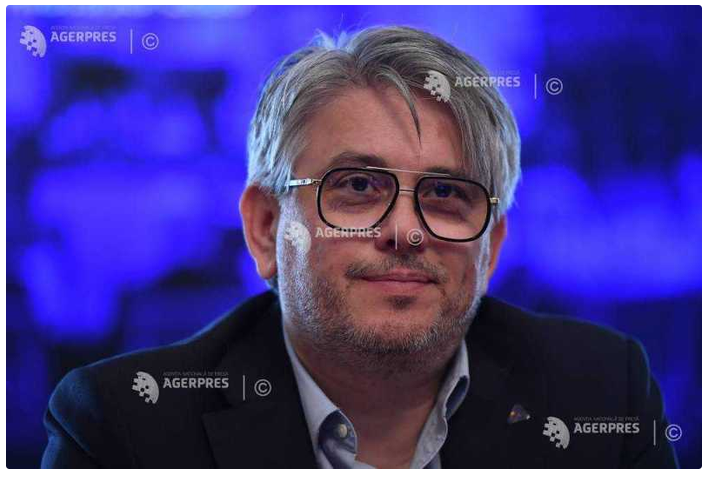
Economic and Social Councils and similar institutions across the Francophone world are genuine platforms for stability and crisis prevention, President of Romania's Economic and Social Council (CES) Sterica Fudulea said on Tuesday at the Francophone Social Dialogue Forum, dedicated to the role of representative social and civic dialogue partners in social, economic and cultural diplomacy.
'We are living in a global context marked by uncertainty, geopolitical tensions and profound socio-economic challenges. In this complex landscape, we must recognize a fundamental truth: there can be no lasting peace without social justice, economic prosperity and inclusive dialogue. Peace does not simply mean the absence of armed conflict, but the existence of strong institutions, an atmosphere of trust and genuine social cohesion. In this equation, Economic and Social Councils and similar institutions across the Francophone world are genuine platforms for stability and crisis prevention. Economic and Social Councils bring governments, employers, trade unions and non-governmental organizations to the same table,' Sterica Fudulea said at the event, organized by CES at Victoria Palace of Government.
By facilitating institutionalized dialogue, national Economic and Social Councils enable the early identification of social and economic tensions, which often fuel instability and political crises, while providing negotiated and balanced solutions before such tensions escalate, the CES president said.
He also highlighted the international dimension of the work of Economic and Social Councils, which complements official diplomacy.
'The international dimension of the work of Economic and Social Councils, as reflected in events such as the one we have the honour of hosting today, plays a complementary role to official diplomacy conducted by the political leaders of the countries we represent. It is a complement intended to strengthen their efforts in international cooperation and peacebuilding. Beyond the dialogue among senior officials from the foreign ministries, such events strengthen ties between employers' organizations, trade unions and civil society organizations in our countries. (...) We can therefore speak of comprehensive diplomacy, which would not be possible without our contribution,' Fudulea said.
He also underscored the role of NGOs in developing cultural diplomacy.
'Through NGOs and civil society representatives within the Economic and Social Councils, cultural diplomacy becomes a tool for promoting tolerance, mutual respect and democratic values. The French language and the values of La Francophonie provide us with a common space of understanding, where cultural diversity becomes a source of solidarity rather than division,' the CES head declared.
Romania, he added, is unfortunately being forced to understand, in the most worrying way, the urgency of identifying solutions to restore and strengthen peace, given the war in Ukraine.
'This war is also an invitation to reflect in practical terms on a history that, unfortunately, is repeating itself before our eyes and which concretely illustrates the thesis that peace is not merely the absence of conflict, and that the origins of wars are often rooted in pre-existing socio-economic conditions such as poverty, inequality, lack of access to education, healthcare and decent jobs, environmental problems, or the inability to build truly democratic and inclusive institutions that guarantee the rights and interests of all social actors and involve everyone equally in the development of public policies,' Fudulea pointed out.
He noted that, in light of the diplomats' almost impossible mission of bringing the war to an end, Economic and Social Councils are invited to reflect on their role in the early identification and addressing of deep-rooted socio-economic causes that often lead to democratic failure and, at times, even to war.
'Let us not forget: peace cannot be decreed; peace is built. I believe the time has come for the voice of Economic and Social Councils to be heard more strongly in the peace architecture of the Francophone world. Our cooperation networks must become active pillars of preventive diplomacy. I invite you to invest in social dialogue, strengthen the role of social partners and NGOs, and transform the Francophone space into an exemplary model in which peace, economic development and social justice go hand in hand,' Fudulea said.
In his turn, President of the Union of Francophone Economic and Social Councils and Similar Institutions (UCESIF) Eugene Aka Aouele stressed that La Francophonie is defined 'not only by geography or by aspects of a language, but by a community of values, a willingness to engage in dialogue and an ability to turn our differences into a space for understanding and cooperation.'
'The theme that brings us together today as partners in social dialogue and civil society in social, economic and cultural diplomacy fully reflects this vocation. It invites us to ask ourselves questions about the role this must play in relations between peoples, in a profoundly transformed international context. We are faced with multiple crises, persistent geopolitical tensions, rapid economic and technological changes, as well as a particular social context. In such an environment, diplomacy cannot be limited to its traditional channels. Diplomacy must also be enriched by the voice of society and the expertise of consultative forums that foster contacts between peoples. This is where the Economic and Social Council acquires its full significance,' the UCESIF president said, according to a translation provided by the organizers.
By its very nature, he added, the Economic and Social Council sits at the intersection of society and public decision-making, where aspirations meet institutional interests, thereby helping to inform public policies, with the aim of turning dialogue into understanding, understanding into convergence, and convergence into proposals capable of serving the general interest.
'In this spirit, economic, cultural and social diplomacy should not be understood as three isolated areas, but rather as three complementary dimensions of a single field through which societies can draw closer to one another, foster understanding and promote shared values,' the UCESIF president went on to remark.
Luca Niculescu, Secretary of State with the Ministry of Foreign Affairs and Romania's national coordinator for the country's OECD accession process, stressed that today diplomacy 'is no longer conducted only between diplomats, but is also built between entrepreneurs and trade unions, between universities, associations, researchers, artists and local communities,' according to a translation provided by the organizers.
He noted that social dialogue, in a world where balances of power are changing rapidly, is not only an institutional mechanism but also a way of building trust and a form of diplomacy.
Niculescu also highlighted the strength of La Francophonie in promoting dialogue and fostering trust.
'We need to move from a Francophonie that we love to a Francophonie that we build with. And we are already doing this,' Niculescu stressed.
In conclusion, he said that Romania would attend the Francophonie Summit in Phnom Penh, Cambodia, in November with an ambitious candidacy for the post of Secretary General of the International Organisation of La Francophonie (OIF), represented by former Prime Minister and former European Commissioner Dacian Ciolos, through which it aims to promote a more effective Francophonie, closer to citizens and offering 'more opportunities for young people and women.' AGERPRES (RO - writing by: Daniel Florea; EN - writing by: Simona Klodnischi)
- Category: English
- Date: 2026-09-29 18:11:07
- Foto: Grigore POPESCU / AGERPRES Photo