
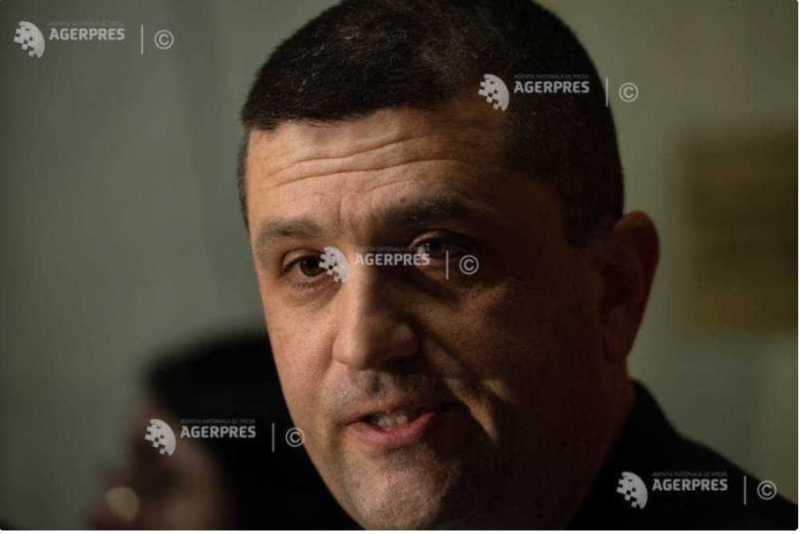
Acting Transport Minister Radu Miruta said on Thursday in Buzau that Romania's rail system is currently 'twice as bad' as it was a decade ago, blaming the decline on the absence of a coherent, long-term maintenance plan for railway infrastructure.
'Compared with the last ten years, the situation now is twice as bad as it was then. This also shows the level of concern of the Romanian state and the speed at which things have been done on railway infrastructure. This is where we are,' Miruta said. He noted that while new trains have begun to be commissioned, much of the rolling stock remains old, and infrastructure problems continue to generate delays.
Video credit: Florin Zafiu / AGERPRES
'There are issues on the rail infrastructure because speed restrictions mean trains must roll at very low speeds, which generate delays. Speeds are low because you cannot safely cross a bridge or a rail segment whose foundation is not in order, whose joints are not properly calibrated, whose alignment between rails is poor. These things happened because there was no coherent plan to maintain railway infrastructure,' the minister said.
Miruta argued that the newly adopted rail infrastructure development strategy will help reduce delays and address salary-related problems affecting railway employees. 'The pace must increase. The strategy adopted yesterday by the government has as zero priority the reduction of the number of kilometres that generate very large delays in passenger and freight transport. For this, funds must be correctly allocated. There must be a measurement unit for those who manage this money. There must be clear deadlines and accountability,' he stressed.
'In my view, the way things work in Romania can no longer be to hold a director's position and then see what happens. You are a director and you are assessed every four months - not only on what you do, but on whether what you said you would do is actually happening. Otherwise, you stay in office four years, then another political layer comes, appoints other people, and says we'll see what happens from there. And that's how we ended up with unacceptable delays in Bucharest's North Station in 2026,' Miruta explained.
He criticised the late approval of the strategy, noting it should have been ready before the previous one expired at the end of 2025. 'A team concerned with continuity prepares the next strategy before the current one expires, just to avoid a gap. Some politicians thought that 2026, when we should have had this strategy, does not start in January but in August,' he said.
Miruta also warned of salary risks: 'The first projection is that the situation of people who were not receiving their salaries must be eliminated. There is a risk that tomorrow people may not be able to collect their salaries.'
To implement the new measures, Miruta said the Ministry has launched a selection process for specialists in state-owned transport companies. 'There is a risk that no money could be allocated to CFR Infrastructure because this strategy was not adopted. Last week we began the procedure to select people for many of the state-owned companies under the Transport Ministry,' he said.
'Romania has many good people, but between the good people and the positions where they should decide, there is sometimes a toxic political class that is not concerned with bringing good people in, but with appointing people who tolerate practices like shoe boxes filled with bribe money and other political arrangements. Romanians are tired of political propaganda and tired of the theatre in which, the day after you leave the ministry, you suddenly start being surprised by things happening in the Ministry you led,' Miruta said.
'No state-owned company changes by itself. It changes when the minister encourages people to use their own minds in the interest of the company. I have seen many contracts, especially in the Transport Ministry, designed not for the Romanian state. And that is a problem that explains why we are where we are today. We must have the courage to stop this - and I have it,' he concluded.
The government has approved the 2026-2030 Rail Infrastructure Development Strategy, which provides the basis for signing CFR's activity and performance contract for the same period. AGERPRES (RO - writing by: Florin Zafiu; EN - writing by: Simona Klodnischi)
- Category: English
- Date: 2026-08-20 17:37:46
- Foto: Cristian Nistor / AGERPRES Photo