

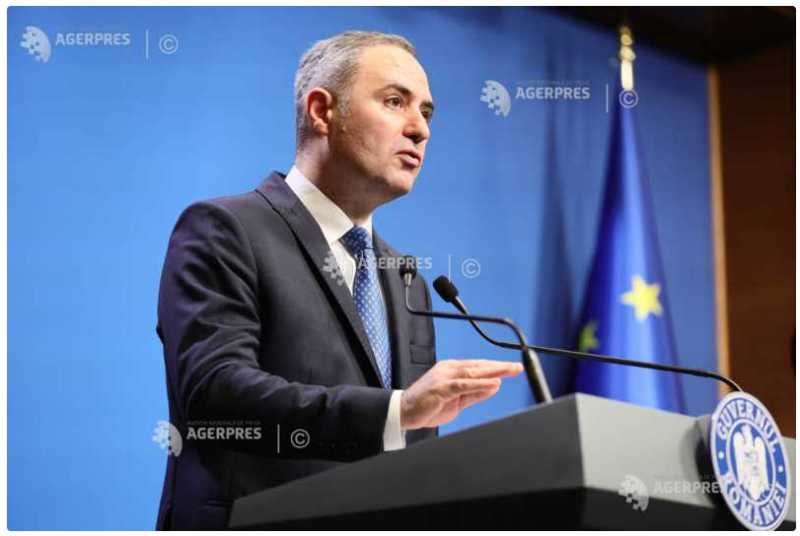
Romania's public debt has exceeded 60% of GDP, and under these circumstances, the Government cannot approve measures that increase total personnel costs or total social assistance spending, Finance Minister Alexandru Nazare stated on Wednesday in a Facebook post.
'With public debt exceeding 60% of GDP, fiscal-budgetary discipline is an obligation, not an option. The Fiscal-Budgetary Responsibility Law prohibits the Government from approving additional expenditures as long as the debt threshold is exceeded. Today, during the Government meeting, I presented an updated overview of the implications of the Fiscal-Budgetary Responsibility Law, given that the latest Eurostat data show Romania's public debt reached 60.1% of GDP at the end of the first quarter of 2026. Exceeding this threshold triggers additional rules for expenditure control and gradual debt reduction; the Ministry of Finance is legally required to inform the Government when statutory thresholds are breached and to outline the implications and necessary measures. In concrete terms, this means Romania faces a very clear limit on new budgetary commitments: as long as debt remains above 60% of GDP, the Government cannot approve measures that increase total personnel costs or total social assistance spending,' Nazare wrote on his social media page.
According to him, any initiative with a budgetary impact must be substantiated and calibrated within the limits of the prevailing fiscal-budgetary framework and the expenditure envelopes established by the fiscal-budgetary strategy, 'with a full assessment of the immediate impact, the annualized effects, and the medium-term risks.'
'This approach must serve as the reference framework, including for finalizing the new wage law as well as for other initiatives impacting permanent expenditures,' states Nazare.
Thus, given that public debt remains above the threshold of 60% of GDP, the provisions of the Fiscal-Budgetary Responsibility Law impose additional constraints, including regarding the increase in total personnel expenditure.
In his view, any priorities or reallocations between different priorities must be carried out within the established fiscal-budgetary envelopes, without generating additional pressure on the deficit and public debt trajectory.
'Therefore, in discussions regarding the new wage law—as well as other initiatives during this period—we must have a complete and realistic picture of the measures we can afford and the potential risks involved; any new measures adopted must be framed within the current fiscal-budgetary parameters. At present, the Fiscal-Budgetary Responsibility Law no longer permits further increases in total personnel expenditure,' he added.
At the same time, Nazare pointed out that Romania remains subject to the excessive deficit procedure, and the fiscal consolidation plan agreed upon with the European Commission entails clear limits on expenditure growth.
'Romania must, therefore, continue to demonstrate that it can keep its public finances under control. Current estimates indicate that public debt could reach 61.8% of GDP in 2026, 63.3% in 2027, and 63.9% in 2028, subsequently embarking on a gradual downward trajectory—though only provided the path of budget deficit reduction is maintained. That is precisely why the decisions we make today have an impact over several years, not just on the following year's budget. Romania already has an adjustment trajectory agreed upon at the European level. For 2026, the ESA deficit is projected at 6% of GDP, following a figure of 7.9% in 2025 and the record high of 9.3% in 2024,' the Finance Minister emphasized.
According to the minister, Romania has narrowly passed recent sovereign rating tests, and this necessitates 'prudence, discipline, and consistency in every decision with a budgetary impact.'
'Budget execution results to date show that this correction has begun to take effect. In the first half of the year, the cash deficit narrowed to approximately 42 billion lei—down from 70 billion lei during the same period in 2025—while the primary deficit shrank by nearly 74%. Revenues rose by about 32 billion lei, whereas total expenditures remained under control, despite rising interest costs. These results played a direct role in safeguarding the investment-grade rating. Over the past few months, working alongside the Ministry of Finance team and in coordination with the National Bank of Romania (BNR), I have led an intensive technical dialogue with international rating agencies, presenting budget execution data, consolidation measures, reforms, and the trajectory Romania has committed to. Our goal was to prevent the loss of the investment-grade rating; however, the rating agencies are sending a clear signal: Romania must continue fiscal consolidation and demonstrate its ability to avoid the bottlenecks and policy slippages that would undermine the credibility of its public finances,' Alexandru Nazare explained in his post.
Against this backdrop, the Minister of Finance conveyed that his message within the Government remains one of 'prudence and rigor' when analyzing any decision with a budgetary impact.
'We must choose very carefully which permanent commitments we undertake in the coming period. A derogation from fiscal-budgetary rules is not a mere formality: it can call into question the country's credibility and stability and expose Romania to additional risks during a volatile period,' he added.
Nazare further pointed out that Romania must meet the NRRP milestones within the committed timeframes and address the legitimate needs of the economy and society.
'It is imperative that we meet the PNRR milestones within the committed timeframes and address the legitimate needs of the economy and society. However, all government-level decisions must be adopted in a way that does not destabilize the budget or the trajectory for rebalancing public finances. Romania cannot revert to accumulating imbalances and cannot afford unfunded budgetary promises,' emphasized the head of the Finance Ministry.
Last but not least, Nazare noted that all this information matters to every Romanian, because reducing the deficit and stabilizing the debt means, over time, less money spent on interest and more funds available for investments, public services, and development.
It means a state that borrows at lower cost, greater stability for the economy, and increased predictability for families and companies. 'If we maintain this course, the benefits will be visible to us all. It means a Romania capable of funding its schools, hospitals, and infrastructure on a sounder basis, supporting investment, and becoming more resilient in the face of crises. Fiscal consolidation is not an end in itself. The goal is to rebuild the fiscal space that will allow us, in the coming years, to implement public policies and make investments without passing the bill on to future generations,' the Minister of Finance further wrote on his social media page. AGERPRES (RO - writing by: Mariana Nica; EN - writing by: Catalin Cristian Trandafir)
- Category: English
- Date: 2026-08-19 19:58:21
- Foto: Silviu MATEI / AGERPRES Photo