
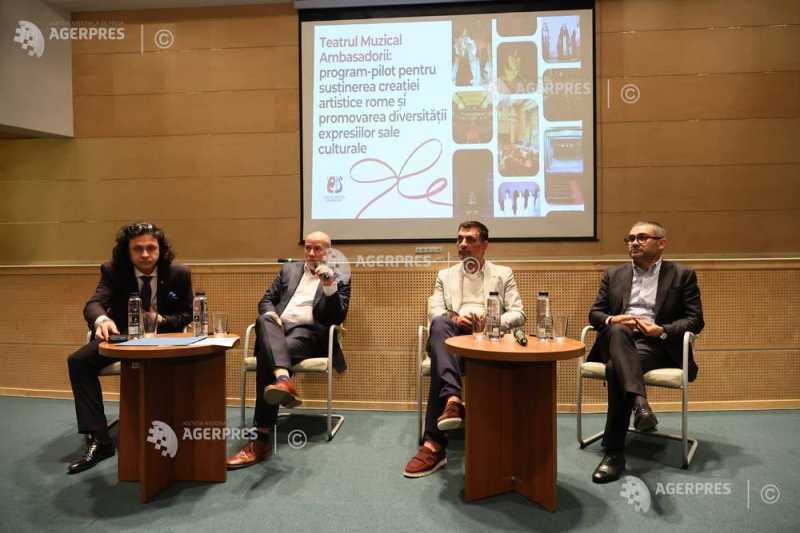
Culture Minister Andras Istvan Demeter announced on Tuesday evening at the ministry's headquarters the launch of a pilot programme aimed at supporting and promoting Roma culture, a project to be carried out by the 'Ambasadorii' (Ambassadors, ed. n.) Musical Theatre.
'We are now in an interesting situation, we are facing challenges that we keep postponing for various reasons, which are becoming more or less objective, primarily because of a lack of will, including political will, and not least because of a lack of resources. These include certain components of the national strategy for Roma, including the objective, which has a 2027 deadline, of having a public performing arts institution addressing the Roma community in general and showcasing everything that contemporary creation encompasses, the performing arts, visual arts, obviously in theatrical languages, music and everything related to this immense journey that is an integral part of culture in Romania,' the Culture Minister said.
'At present, in the context we all know and experience every day, I have no chance of saying that I will propose, or that anyone will accept a proposal to create a public performing arts institution now under the auspices of the Ministry of Culture, a ministry that is unable to manage its existing institutions,' he added.
'I spoke to interim director general Catalin Petrescu and we thought of two or three possible moves. One would be to create a pilot programme,' the minister said.
The pilot programme proposes the participation and representation of Roma artists in the theatre's casts and production teams; promoting, through dedicated artistic productions, Roma cultural and identity heritage, genealogical and family memory and the contribution of Roma communities to the development of Romanian society and culture; organising workshops, conferences, open-stage sessions and other activities for artistic exploration and development as part of the preparation of artistic productions; and incorporating research relevant to Roma history, culture and heritage into the development of the theatre's artistic productions and programmes.
The programme also proposes training specialists in the performing arts and practical development of skills covering the entire theatre ecosystem, as well as exploring and contemporarily reinterpreting Roma cultural heritage; and inviting companies and productions by Roma artists or dedicated to Roma experiences, cultures and creative work, from Romania and abroad.
Andras Istvan Demeter said that discussions were currently under way for the Lipscani Theatre to become the 'Ambasadorii' Musical Theatre.
'It is a long road ahead. The discussions are quite advanced, we have a chance, but ultimately we depend on our authorities and on a certain amount of support. We will also have to attract funding, but you cannot build such a project without finding a venue. You cannot develop a theatre, whatever kind of theatre it is, that can grow and build an audience without having a place of its own for the artists, performers and audience. Without that, it does not exist; the idea remains purely theoretical,' the minister said.
He brought to mind that he had visited the Lipscani Theatre several times this summer. 'It is fortunate that it is not a building marked as being at seismic risk. It is in very good condition, most of the interior spaces have been renovated and refurbished, it has study rooms, ballet rooms, rehearsal rooms, choir rooms, in other words it has all the infrastructure needed. The only thing missing is perhaps the carpet in the auditorium (...) but if you get the lighting right in the auditorium, you do not notice its absence. What matters is that the stage is functional. It has very good storage facilities, everything underneath the stage and auditorium has been cleared out, which very few theatres in Bucharest can say they have. But we still need to establish the legal arrangement between Cartel Alfa, which owns the venue, and us, the Ministry of Culture. (...) But we are looking for solutions and we will find them,' Andras Istvan Demeter said.
Catalin Petrescu, interim director of the 'Ambasadorii' Musical Theatre, said the programme would bring Roma and Romanian artists together in joint productions.
'I believe it can be done. This does not mean that we are abandoning everything we have done so far and will do something completely different. No, we are moving forward with our projects and we will also have this pilot project. (...) We should not somehow think that, right, we are forgetting everything we have done so far and radically changing our position,' Catalin Petrescu said.
The programme will bring Roma and Romanian artists together in joint productions, support the training of young talent and the development of theatre-related professions and create space for projects inspired by Roma culture, as well as for research, preservation and promotion of Roma cultural heritage. At the same time, it represents a first practical exercise in gaining the experience needed to develop, in the future, an independent institution dedicated to Roma theatre, the organisers said.
Those attending the event included Social Democrat MP Petre Florin Manole, former Labour Minister Daniel Jinga, director of the Bucharest National Opera Madalin Voicu, Undersecretary of State at the Ministry of Culture Iulian Paraschiv, president of the National Agency for Roma, as well as actors, directors and set designers. AGERPRES (RO - writing by: Petronius Craiu; EN - writing by: Adina Panaitescu)
Photos: (c) SILVIU MATEI / AGERPRES FOTO
Display count: 261