
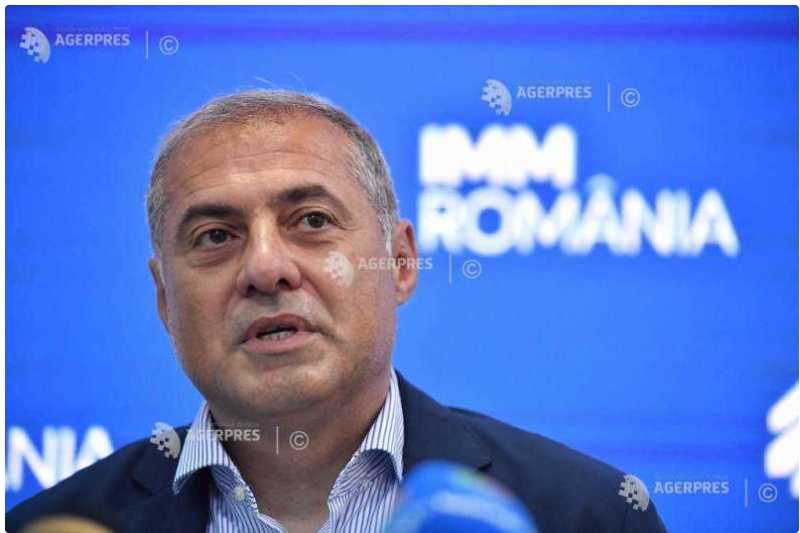
The main lesson Romania has learned from its National Recovery and Resilience Plan (PNRR) is that the state should programme European funds based on the economy's real needs; otherwise, we will end up with another failed programme, IMM Romania President Florin Jianu said at a conference on Tuesday.
'The main lesson we have learned, or that the state should learn, is that if we programme European funds without taking into account the real needs of the economy, sustained coordination capacity and realistic planning around a few major objectives, while trying not to do everything for everyone, we will once again have a failed programme, as the PNRR appears to be,' Jianu said.
IMM Romania has analysed PNRR implementation in four areas 'which are both the most visible and the most important': road infrastructure, motorways, rail infrastructure, energy and digitalisation.
The analysis examines implementation just weeks before the August 31 deadline for completing the PNRR, at a time when the Romanian authorities and the European Commission are negotiating the final adjustments to the project portfolio.
According to the analysis, the motorway component is one of the most visible parts of the PNRR, but also one of those most affected by the 2025 renegotiation with the European Commission. Of the 429 km of new motorways initially planned along four corridors - A7 Moldova, A8 Unirii, A3 Transylvania and A1 Lugoj-Deva - two entire motorways, A8 and A3, were removed from funding, while the total length was cut by more than 40%.
Jianu also noted that rail infrastructure followed a different trajectory from motorways. The reduction was not achieved by cutting the length of a single corridor, but by selectively removing entire sections from larger projects. The Cluj-Napoca-Oradea corridor was retained in full, although the physical completion targets for its final sections were renegotiated downwards, while only one third of the full Caransebes-Timisoara-Arad corridor remains active. Overall, the rail component lost approximately 33% of the length initially planned across the two major corridors.
The energy sector, meanwhile, was among those most affected by the renegotiation in structural, rather than merely financial, terms. IMM Romania noted that, unlike transport, where the cuts were mainly proportional, the energy renegotiation included the complete removal of battery production, with a budget of 150 million euros, as well as the unilateral suspension of contracts for green hydrogen and photovoltaic panel manufacturing.
According to IMM Romania specialists, Component C7 (Digital Transformation) is the most granular of all the components analysed, comprising 20 separate measures coordinated by different institutions (MEDAT, MS, MJ, MMFTSS, MAI, ANFP, ANAP and MIPE). Overall implementation remains low, at below 22% of the budget, with a recurring pattern: major strategic projects, including the government cloud, application migration, eHealth, electronic identity and cybersecurity, have significantly lower financial implementation rates than smaller-scale projects.
In conclusion, the positive impact of the PNRR consists in the construction of approximately 257 km of motorway, a major investment in an area where funding exclusively from national sources is difficult to sustain, and the modernisation of approximately 220 km of railway, helping to develop an efficient alternative to road transport for passengers and freight.
The main shortcomings identified by IMM Romania include abandoning the battery production component, limiting an opportunity to develop national energy storage capacity; removing the photovoltaic panel production component, reducing the opportunity to develop a national value chain in renewable energy; cutting the original motorway target from approximately 429 km to 257 km; and reducing the railway target from approximately 328 km to 220 km.
As regards the digitalisation of SMEs, the direct impact on small and medium-sized enterprises has been more limited, with investments focused predominantly on public-sector digitalisation projects.
The employers' confederation notes that, from the drafting stage, the PNRR had shortcomings regarding consultation and the genuine involvement of social partners, and that proposals put forward by IMM Romania were not reflected in the final version of the plan.
IMM Romania had proposed allocating 5.1 billion euros to support SMEs, but the final version of the PNRR earmarked approximately 1.3 billion euros for the business sector.
IMM Romania also proposed granting 5,000-euro vouchers to 100,000 SMEs, but this approach was not adopted as proposed.
Measures to support entrepreneurship and innovation included programmes such as 'Romania Tech Nation', aimed at supporting 20,000 digital start-ups, and the EQUITY programme, designed to facilitate access to capital for innovative SMEs, start-ups and scale-ups.
However, the implementation of the SME digitalisation scheme, providing grants of between 20,000 and 100,000 euros, has proved difficult, IMM Romania notes. AGERPRES (RO - writing by: Cristian Anghelache; EN - writing by: Simona Iacob)
- Category: English
- Date: 2026-08-18 16:39:44
- Foto: Grigore POPESCU / AGERPRES Photo