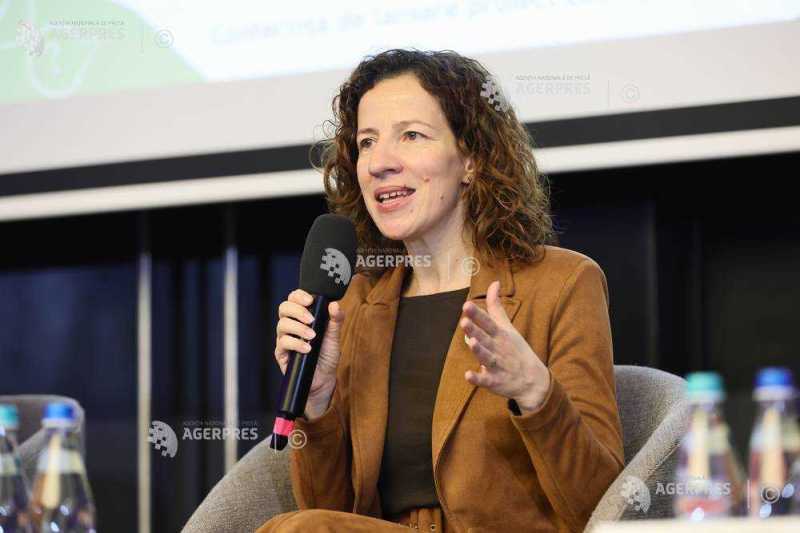
More than 36 million Europeans participated in projects and programmes funded through the European Social Fund Plus (ESF +) and Erasmus+ in 2025 and 2026, almost 8% of the European Union's (EU) total population, Executive Vice-President of the European Commission for Social Rights and Skills, Quality Jobs and Preparedness Roxana Minzatu said on Thursday.
'What has 2026 been like so far? The months have been intense. In the portfolio I manage, two of the main instruments through which Europe directly invests in people are the European Social Fund Plus and Erasmus+. In 2025 and 2026, more than 36 million Europeans participated in projects and programmes funded through the two funds. Almost 8% of the EU's total population. Approximately 450,000 projects and programmes are under way,' the European Commissioner said in a brief half-year review posted on Facebook.
According to Roxana Minzatu, by the end of 2026, more than 100 billion euro is expected to have been implemented through the European Social Fund Plus, out of its total budget for the 2021-2027 multiannual financial framework.
'This is money that goes directly towards funding social services, inclusion measures, education systems and training programmes, unemployment programmes and access to the labour market. Approximately 65% of this European contribution goes to less developed regions, while more than half of the reported participations are by people under 30,' the European Commissioner explained.
As regards Erasmus+ programme, by the end of the year, around 22 billion euro of the total 27 billion euro in funds is expected to have been committed. In 2025 alone, more than 1.7 million Europeans benefited from Erasmus, including pupils, teachers, young people and athletes.
In addition to managing major financial instruments, 2026 has also marked important political steps, the Executive Vice-President for Social Rights and Skills, Quality Jobs and Preparedness said.
For the first time in EU history, the EU Anti-Poverty Strategy has been adopted.
'It is not just about support for vulnerable people. It proposes prevention measures. A major focus is access to jobs. Especially for the 50 million Europeans outside the labour market who could work. To this end, we have also launched the legal process, provided for by the Treaties, of consulting the social partners on the advisability of developing a European legal instrument on activating people outside the European labour market,' the European Commissioner said.
Moreover, the European Child Guarantee has been strengthened, proposing a European card for vulnerable children covered by the Guarantee, while also including the safety of vulnerable children, both online and offline.
In this context, Executive Vice-President Minzatu also referred to an 'important upgrade to the annual European Semester process.' Thus, education, skills and human capital are now at the centre of coordinating budgetary, fiscal and social policies between the EU and national levels.
'We are putting the Union of Skills into practice: We have approved the first projects piloting the European Skills Guarantee. The idea is simple: if a factory is undergoing restructuring, we should intervene before people become unemployed. What is the most effective way to help these people retain their employee status while also keeping a good job? We have selected six pilot projects from across the EU for funding to see in practice what works and what does not. Romania is participating in two of these six pilot projects,' the quoted source said.
According to Roxana Minzatu, the rules for traineeships at the European Commission (Blue Book traineeships) have also been changed so that, as of 2026, graduates of vocational and technical education can also become trainees at the Commission.
At the same time, after almost ten years of negotiations, the modernisation of EU rules coordinating social security for millions of mobile workers across Europe has been unblocked.
'Beyond the technical language of Regulation 883, there is a simple idea: if you go to work in one or more other EU Member States, your social rights and insurance coverage come with you in a fair and equitable way. The truth is that Europe is undergoing huge changes: building an autonomous European industrial base with minimal vulnerabilities, energy security and eliminating imports which create vulnerabilities, demographic change towards a longer-lived continent, climate change and artificial intelligence,' the European Commissioner said.
Roxana Minzatu added that these are not changes that cannot be stopped. 'But we can choose whether we simply react to them or prepare in advance. We can intervene after a factory closes or prepare people beforehand. We can compensate for the next energy bill, offer subsidies or invest intelligently in production, storage, grids and interconnections. We can view the effects of a continental drought that dramatically reduces the Danube's flow as a crisis of 2026 or we can develop structural preparedness measures for how we manage water and energy,' she underscored.
The second half of the year will focus on important files: fair labour mobility, vocational and technical education, a new vision for education, how to ensure quality jobs in new contexts, a new European strategy for sport and more.
'And, beyond portfolio, negotiations continue on the future 2028-2034 European budget. The Commission has proposed 2 trillion euro to address unprecedented needs. Member States and the European Parliament are now negotiating. Cuts to these allocations could pose major risks to our common future. One thing is clear: Europe cannot reduce its competitiveness gap or become stronger without investing, intelligently but as a priority, in people - in their training, their resilience and the services that empower them. That is, in fact, what my work at the European Commission is all about,' Roxana Minzatu concluded. AGERPRES (RO - writing by: Cristian Anghelache; EN - writing by: Rodica State)
- Category: English
- Date: 2026-08-13 12:03:30
- Foto: SILVIU MATEI / AGERPRES PHOTO