Rural libraries in Dambovita county are redefining their role in the community by integrating artificial intelligence (AI) and new technologies, transforming themselves from simple book-lending spaces into modern centres of education, inclusion and digital access for all categories of public.
Libraries are increasingly integrating AI into activities with the public, particularly when working with children, where digital tools are used to stimulate creativity and interest in learning.
Foto: (c) CORNELIA DUMITRU / AGERPRES PHOTO
'For example, we use AI to learn how to tell stories on any subject. We make extensive use of these digital tools because if we do not keep up with the children, who are familiar with them, we risk losing touch with them,' librarian in Persinari commune Ionela Petrisor told AGERPRES.
According to her, AI-based applications are used practically during workshops, from generating texts and poems to creating posters or audio materials.
'We give them an idea and AI helps us create a story or a poem. We also use programmes that turn texts into audio, which makes the information more appealing to children,' the librarian explained.
At the same time, children are taught to use these tools responsibly.
'They know how to use AI, including for their homework, but we explain to them that they should not rely 100% on the information provided because there may be errors. It is a useful tool for ideas and creativity, but not always for reliable information,' she added.
Librarian Ionela Petrisor also explains how using AI has helped children become more attentive.
'Let me give you an example: as a tool, Natural Reader AI. Rather than me reading, if we have a documentary, say, from Wikipedia, if I were to read it or present it, it could be a little boring. When I use the digital tool, it is more fascinating. Or I tell them: 'go in, find a source on the internet and put it into this application' and everyone can hear it, there is no need for everyone to be pressing buttons. Then, we create stories and poems, we give an idea and use artificial intelligence to help us create them. I teach them how to make a promotional poster and we use, for example, Canva [an image editor]. There are so many tools that we use here. We also had CODE Kids and we simply access these tools and learn how to make moving little robots, a cartoon... The child draws and when they see their own drawing projected on the screen, it is something else. We use small things, at the children's level of knowledge,' librarian Ionela Petrisor explained.
Foto: (c) CORNELIA DUMITRU / AGERPRES PHOTO
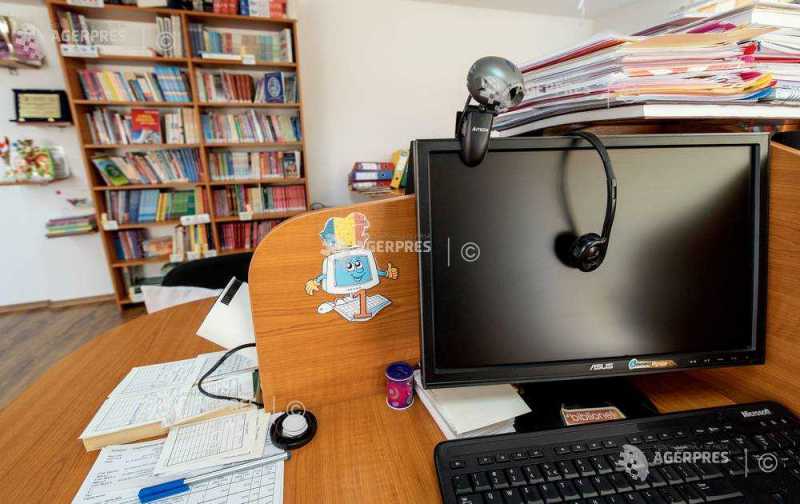
She has been a librarian since 2008 and says that the first part of her work entailed lending books. She explains that in 2010 the introduction of the Biblionet programme brought about 'a boom, a transformation', with the library being equipped with computers, a printer and a video projector.
One project she is proud of is a library for the Roma children, carried out with the help of the Communities of the Future Foundation.
'Even though there are no declared Roma in the locality, we know they are there, they have their own street. Five libraries from across the country were selected in 2022. It does not mean that we work only with Roma, but with everyone, and make books about the Roma culture available to them (...). The project is continuing. I have just returned from Valencia, where I went as part of this project, on the subject of storytelling, the art of telling stories of any kind, with inclusion as the theme, and we somehow use artificial intelligence to learn how to tell stories on any subject,' Ionela Petrisor added.
At several libraries in Dambovita, including the one in Persinari, a project funded through the National Recovery and Resilience Plan (PNRR) was carried out, providing free basic digital skills courses for citizens.
'We also had older people and I started with my grandmother, who came for my sake. She is 87 and was the oldest course participant. And I wanted to see what she thought. Initially, she told me: 'What, I don't know this stuff!'. Going from a button phone that she had to sitting in front of a laptop seemed extraordinary to her. When we opened it to speak via video with someone who did not live in our country, she was amazed at how they could see her from there. Well yes, I said, that's how we see each other, that's how technology works,' the librarian from Persinari said.
The experience of using technology and AI in the library has also been strengthened through participation in Erasmus projects held in several European countries, where modern methods of integrating AI into non-formal education were explored.
Foto: (c) CORNELIA DUMITRU / AGERPRES PHOTO
'For me, artificial intelligence seems like a super assistant because it helps me a lot in the work I do. Of course, you need to know what to put into it. I took part in an Erasmus project with the County Library, together with several colleagues. We were curious about how AI could be implemented in our daily work,' Cateluta Barbu, a librarian in the Dambovita commune of Raciu, told AGERPRES.
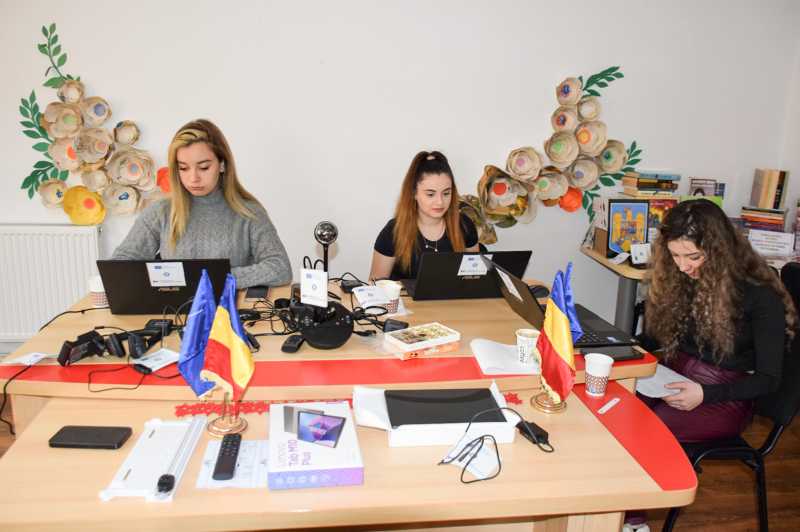
Photo: Cateluta Barbu, librarian in Reciu
She says that, with the help of AI, she creates images for posts on the library's Facebook page, stories, as well as decorative elements for activities with children.
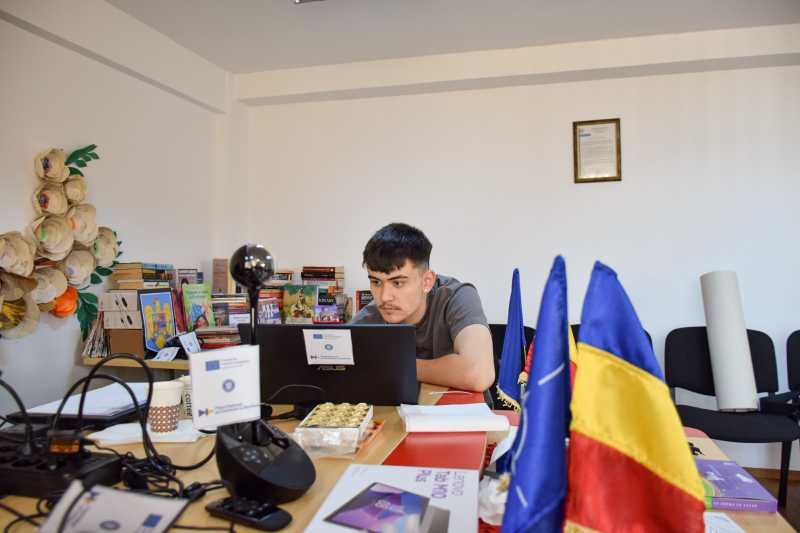
Photo: Cateluta Barbu, librarian in Reciu
'I even make bookmarks. Before, I worked in Publisher and searched for images, going on various websites where you had to pay for photos. Now, with AI, if I say what I would like the bookmark to contain, it helps me and I create the image. I also used AI for the decorations at the cultural centre, where we hold activities. I ask it for ideas, give it a specific task and it helps me recreate what I have in mind. I am now working on a new book donation and I have 13 books for which I don't have the prices. I didn't sit down and look up each price separately, I gave it a task to search online, at the respective publisher, for the cover price of each book. So, it helps me with that too. I use the free version of ChatGPT. I found out about it at the methodological meetings held with Mr Vladu Andreescu from the County Library, I think two years ago,' librarian Cateluta Barbu said.
Foto: (c) CORNELIA DUMITRU / AGERPRES PHOTO
She also says that on Europe Day she did not have a story adapted to the age of kindergarten children, so with the help of AI she created 'The Story of the Little Stars.'
'The same applies to the Green School. I always try to make the book the main attraction in an activity. And in addition to the book, we also do something practical. But I use AI more on the creative side, to create material that attracts the public to the library,' Cateluta Barbu also said.
Librarian Violeta Dumitrescu from Ocnita also says that the work she does is extremely varied, but she has the energy and enjoys her job, even though she is approaching retirement age. She took part in the Erasmus programme and applies everything she learned on the courses in her day-to-day work.
Foto: (c) CORNELIA DUMITRU / AGERPRES PHOTO
'I attended this course through Erasmus, in Istanbul. I can search, for example, for book recommendations, for similar books, I do my own research too. But people come to the library, for example, a woman asked me, she has a problem, she wants to retire. I told her that I didn't know much either about what she wanted to find out, it was beyond me, but I said, come on, let's try and research it like this: let's also ask artificial intelligence. And it was largely accurate, because the woman in question did not have the financial resources to see a lawyer. We use AI and we also teach users to try it, within limits, or to find a balance, as I always say, with technology,' librarian Violeta Dumitrescu said.
She is very proud that, with the help of technology, she also managed to create a logo for the library.
Foto: (c) CORNELIA DUMITRU / AGERPRES PHOTO
'We created the library's logo: 'the book and the computer, the future together'. In other words, we use technology too,' Violeta Dumitrescu says, showing how she displayed the logo on the library's Facebook page, as well as on informational materials.
Foto: (c) CORNELIA DUMITRU / AGERPRES PHOTO
The transformation of libraries in Dambovita shows that these institutions remain relevant in a digitalised society, rapidly adapting to the needs of the community. The use of AI does not replace the book or the role of the library, but helps it provide new things: more engaging learning methods, greater creativity and a better connection between people. From children creating stories with the help of technology to older people learning to use the internet, the library is becoming a place for everyone. AGERPRES (RO - writing by: Cornelia Dumitru; EN - writing by: Rodica State)
- Category: English
- Date: 2026-08-12 12:07:03
- Foto: CORNELIA DUMITRU / AGERPRES PHOTO