
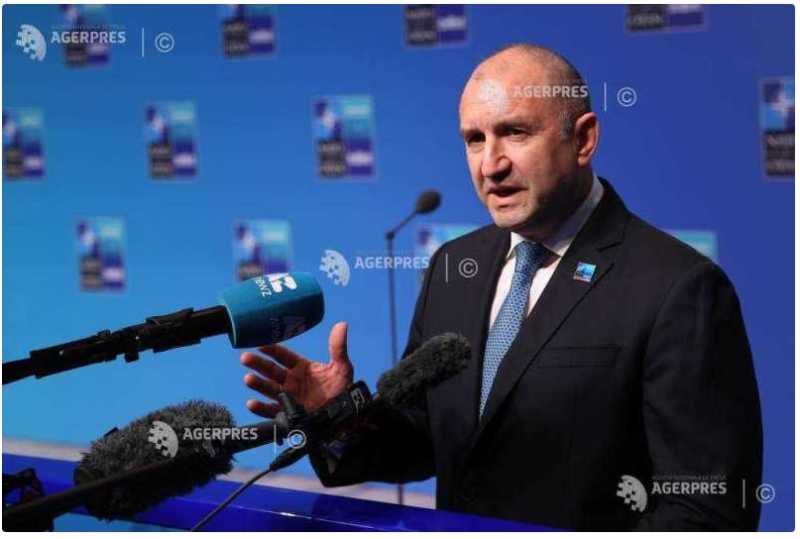
Bulgaria's Prime Minister Rumen Radev said at a briefing following a meeting of the Security Council under the Council of Ministers that at 08:10hrs on Saturday morning, a drone entered Bulgarian airspace from the north, and exploded approximately 100 metres inside Bulgarian territory, acording to the BTA Bulgarian National News Agency.
The incident occurred in the immediate vicinity of the former Kardam border checkpoint between Bulgaria and Romania, and about 1,000 metres from Bulgaria's compressor station on the Trans-Balkan gas pipeline route, Radev added. According to the prime minister, the drone crashed in a sunflower field.
The area has been cordoned off. There were no casualties reported and no damage to infrastructure, Radev said.
'Sound from the drone was detected by Romania's Border Police, followed by a loud explosion heard by the [Bulgarian] border patrol from General Toshevo, which is stationed in the area,' said Radev. The location of the drone explosion was immediately identified, and teams from the Border Police, National Police and the Defence Ministry are currently at the site to determine the type of drone involved.
He stressed that the drone in question had not been detected in Romanian or Bulgarian airspace. 'We have also received no information from the Combined Air Operations Centre in Torrejon [Spain], which monitors the airspace across southern Europe,' Radev added.
Following the incident, he said, Border Police personnel and equipment used to detect and counter drones would be redeployed from the Turkish border to the Romanian border.
Radev also commented on the three Shahed drones shot down in Romania two weeks ago, assuring reporters that Bulgaria had responded immediately and that the Defence Ministry had strengthened radar coverage in the region.
Early next week, a meeting of the North Atlantic Council will be held, where Poland will provide information on the incident involving ballistic missiles on its territory, Romania will brief allies on the drones detected over its territory, and Bulgaria will raise the issue of the drone that exploded on Bulgarian territory, Radev said.
Asked whether the drone was civilian or military, Radev said there was photographic material available, but because the drone had been damaged in the explosion, it was not possible to determine its type. 'This is not a toy drone, it is a larger drone,' he explained.
Asked whether the incident was a deliberate attack and whether the drone had been carrying anything, he replied that this could not be established at this stage. He added that the drone had been carrying a substantial amount of explosive material, enough to produce an explosion that could be heard from a considerable distance.
Radev explained that the drone had not been detected in either Bulgarian or Romanian airspace because such drones are difficult to detect due to their small size. 'When flying at low altitude,' he said, 'it is not possible to ensure sufficiently dense radar coverage.'
There is currently information about only one drone.
Radev also said that the procedure for procuring modern digital three-dimensional radars has been delayed, but the Defence Ministry is doing everything possible to speed up their delivery. AGERPRES (RO - writing by: Mariana Ionescu; EN - editing by: Corneliu-Aurelian Colceriu)
- Category: English
- Date: 2026-08-08 14:51:28
- Foto: NECATI SAVAS / EPA