

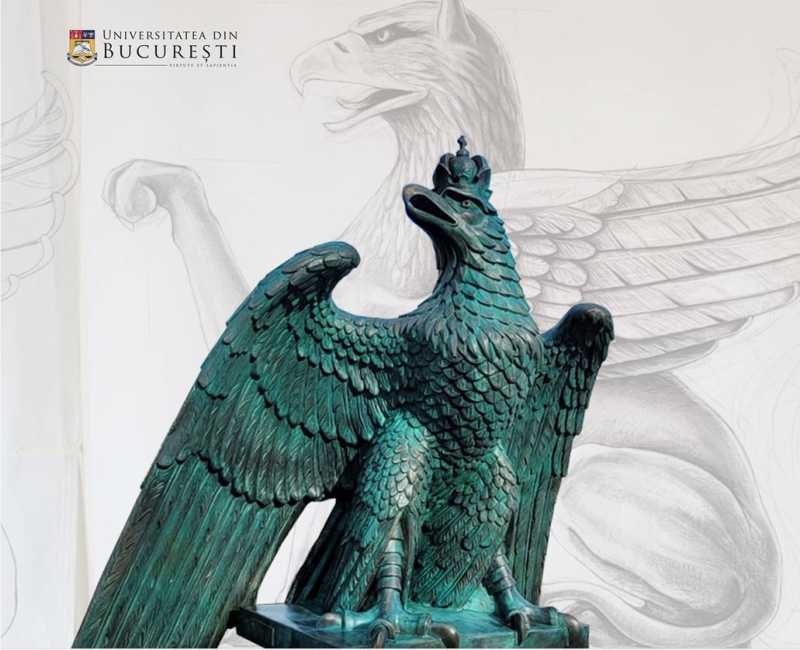
The University of Bucharest (UB) on Saturday will relocate an eagle and two griffin sculpture to the pediment of its building in the centre of the capital city. The sculptural ensemble was almost entirely destroyed in the WWII bombings of 1944.
According to UB, the installation of the three sculptures marks the beginning of a project of complete restoration of the original pediment of the University Palace. The works will continue in the next two years, until the complete reconstruction of the ensemble designed by architect Alexandru Orascu and made by sculptor Karl Storck between 1862 and 1869.
The original pediment of the neoclassical Palace of the University of Bucharest, was called 'Minerva protecting the arts and sciences', being inspired by the Glyptotheque in Munich. The artistic composition was conceived by Theodor Aman, and the bas-relief, carved in Rusciuc stone by Karl Storck and his collaborators depicted the goddess Minerva crowning the sciences and arts, surrounded by allegories of academic disciplines and fine arts.
Above the pediment, on the acroterion, there is the ensemble formed by the crowned eagle and the two griffins, a symbol of the state's protection of knowledge and of the university institution. It was almost entirely destroyed in the bombings of 1944. During the post-war reconstruction, the facade of the central body was simplified, and the sculptural elements that defined the image of the University Palace for almost a century disappeared.
According to UB, the ensemble to be mounted is made of bronze and consists of an eagle weighing about one tonne and two griffins weighing about 300 kilograms each, which makes the entire assembly weigh 1.6 tonnes. The work, valued at approximately RON 2 million, is made by sculptor Alexandru Siminic, together with his collaborators, Teodor and Stefan Siminic, using the traditional technique of lost-wax casting of bronze, chased and patinated, and is based on the original creation of sculptor Karl Storck.
The restoration of the pediment is part of an extensive project of consolidation, restoration and modernisation of the University Palace in Bucharest, the largest education building in Romania covering over 45,000 square metres, and one of the most important monuments of the architectural heritage in Romania. The investment is financed under the National Programme for Structures of Public or Social Interest carried out by the National Investment Company (CNI) under the authority of the Ministry of Development, Public Works and Administration.
'The return of the eagle and the two griffins to the University Palace in Bucharest represents, first of all, an act of historical recovery of a symbol that marked the identity of the university and of the Romanian capital for 75 years, until its destruction in WWII. That is why this moment is charged today with the significance of the reintegration of historical memory after the most destructive attack on Bucharest, as a gesture of reconstruction and respect for the past. The restoration of the heritage of our university and of the symbolic building of the University Palace of Bucharest, with government support, is a necessary gesture of homage to the past that built the present and which must be the basis for building the future,' says Marian Preda, rector of the University of Bucharest. AGERPRES (RO - editing by: Roberto Stan; EN - writing by: Corneliu-Aurelian Colceriu)
University Palace's eagle and two griffins to be relocated to its pediment
Conţinutul website-ului www.agerpres.ro este destinat exclusiv informării publice. Toate informaţiile publicate pe acest site de către AGERPRES sunt protejate de dispoziţiile legale incidente. Sunt interzise copierea, reproducerea, recompilarea, modificarea, precum şi orice modalitate de exploatare a conţinutului acestui website. Informaţiile transmise pe www.agerpres.ro pot fi preluate, în conformitate cu legislaţia aplicabilă, în limita a 500 de semne. Detalii în secţiunea Condiţii de utilizare. Dacă sunteţi interesaţi de preluarea ştirilor AGERPRES, vă rugăm să contactaţi Direcţia Marketing - marketing@agerpres.ro.
Alte știri din categorie

President Dan says Foreign Ministry investigating Orlivka school case
President Nicusor Dan said on Friday that Romania's Foreign Ministry has opened an investigation into the case of the school in Orlivka, Odesa region, where a Year 1 class taught in Romanian was closed. Speaking at a news conference held after the Carpathian Integration Initiative 'Carpathian 8' Summit, he said that 'remarkable progress has bee

Bolojan: We will try, within our possibilities and depending on our electoral weight, to form a Government
President of the National Liberal Party (PNL) Ilie Bolojan said on Friday that, although Siegfried Muresan's nomination for prime minister came three months late, the party would deal with the situation 'responsibly' and seek to form a Government based on its electoral weight. 'Yesterday, about 30 minutes beforehand, I learned from the piece of

Siegfried Muresan: We will start work on a government programme; beginning of next week - discussion with MPs
Prime Minister-designate Siegfried Muresan announced on Friday that he was starting work on the government programme together with the National Liberal Party (PNL), Save Romania Union (USR) and the Hungarian Democratic Union of Romania (UDMR), mentioning that he would present the priorities at the beginning of next week and, based on these, would hold an "extremely tran

CCIR's Daraban: The diaspora is not a sentimental issue but a chapter in the national economy
The experience gained by Romanians in the diaspora in competitive markets must be transformed into investment, jobs and exports, believes Mihai Daraban, President of the Chamber of Commerce and Industry of Romania (CCIR). According to a press release from the organisation sent to AGERPRES, the institution is strengthening its partnership with ROUNIT - Reunited
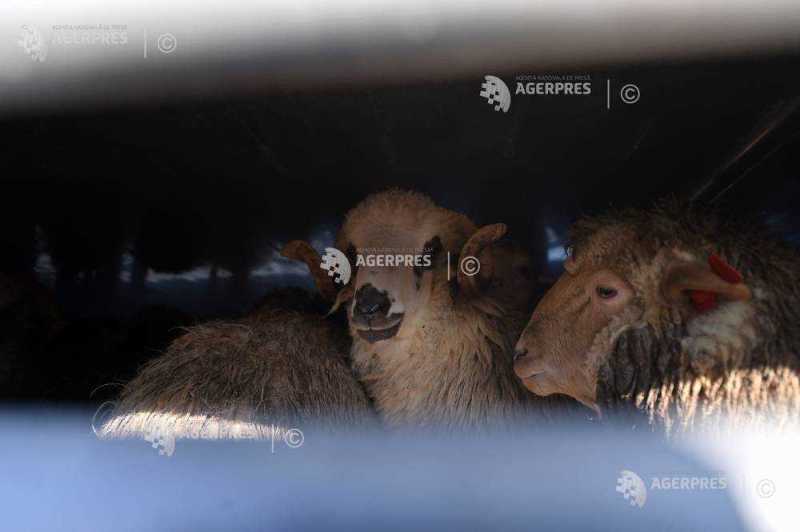
European Commission approves ANSVSA's Action Plan to unblock sheep and goat exports
The Action Plan of the National Veterinary Sanitary and Food Safety Authority (ANSVSA) for unblocking exports of sheep and goats has been approved by the European Commission, allowing exports of carcasses and products to resume under the differentiated vaccination scheme. According to an ANSVSA release sent to AGERPRES on Friday, the approved solution protects
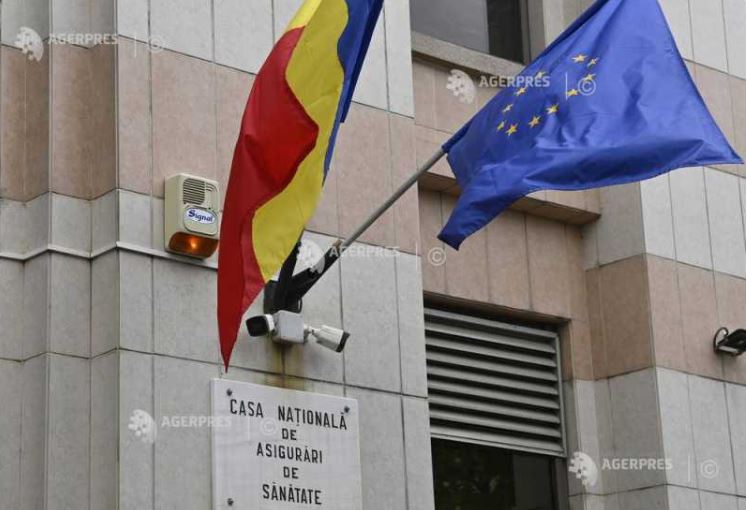
Health Insurance House launches project on cross-border exchange of medical images, laboratory results, discharge reports
The National Health Insurance House (CNAS) announced on Friday the launch of the European project 'Romanian Medical Images, Laboratory Results and Discharge Reports' (RO-MI-LR-DR), for the cross-border exchange of medical images, laboratory results and discharge reports. The project is funded through the EU4Health programme, with the European Health an
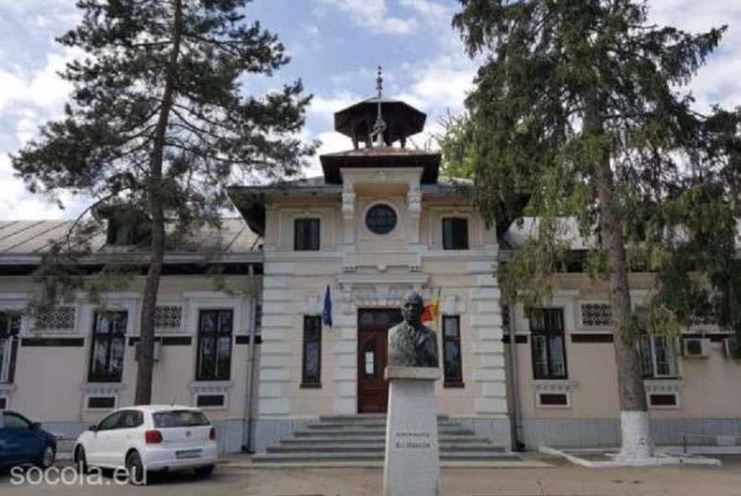
'Socola' Institute of Psychiatry in Iasi to hold new memory testing campaign at weekend
The 'Socola' Institute of Psychiatry in Iasi has announced that it will hold the third edition of its 'Memory Testing Campaign' on Saturday and Sunday, a campaign addressing people of all ages and aimed to identify individual risk factors that may predispose people to memory disorders, while also providing participants with specialist counselling.
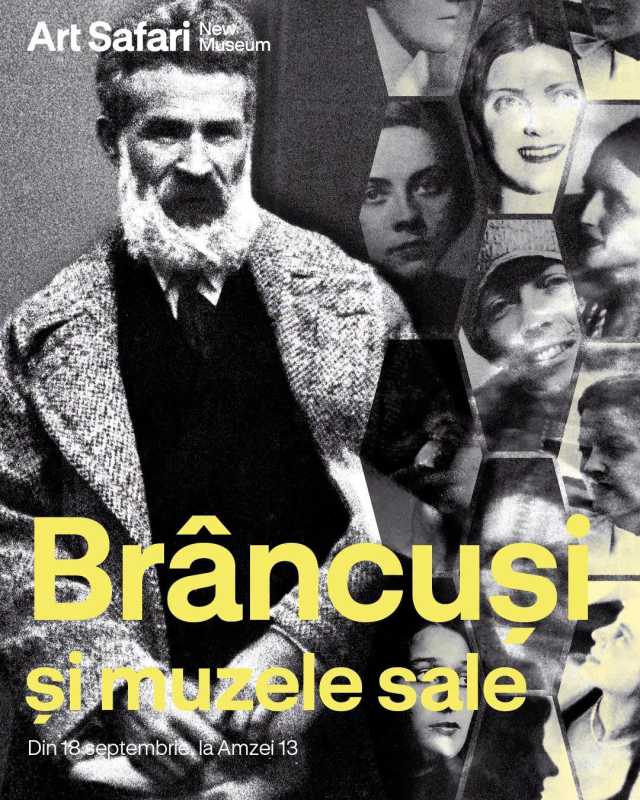
'Brancusi and His Muses' exhibition opens at Art Safari
'Brancusi and His Muses', the largest exhibition dedicated to the great sculptor to be held in Romania during Brancusi Year, opened on Thursday evening at the Art Safari New Museum. Curator Doina Lemny said she wanted the initiative to be different, allowing the public to enter the artist's studio atmosphere. 'It is true that Brancusi's wor