
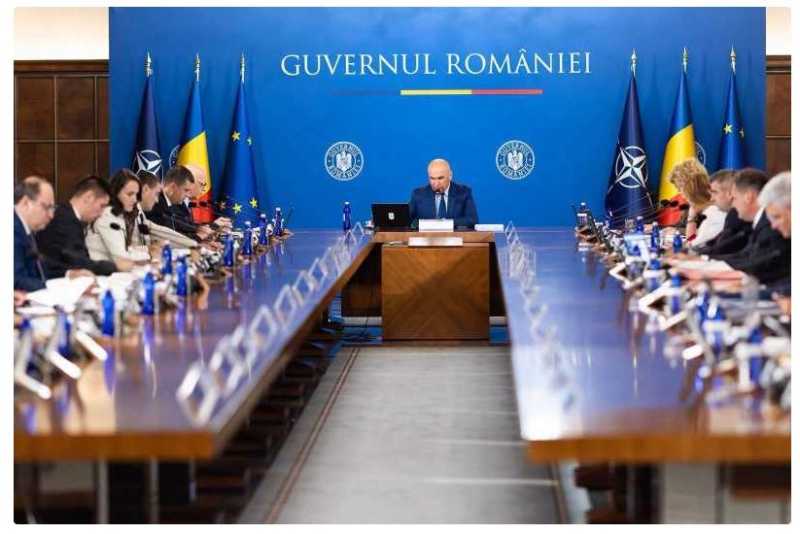
The Government approved on Thursday a decision endorsing Romania's Risk-Preparedness Plan for the Electricity Sector, a framework document outlining national measures for preventing, preparing for, managing and mitigating the effects of potential electricity-supply crises, as well as steps required to restore the safe functioning of the National Power System.
According to the Executive, the plan - drawn up by the Ministry of Energy under EU Regulation 2019/941 - does not declare an electricity crisis and does not automatically introduce consumption limits or cross-border restrictions. It sets out the institutional responsibilities and the sequence of measures that may be applied only if the evolution of the National Power System requires it. Any tiered limitation of consumption for final customers included in the Normative on Restrictions would require a separate Government decision, under Article 5(6) of Law 123/2012.
The Government stressed that tiered limitation does not automatically target households or all industrial consumers, but only final customers covered by the Normative, following procedures set in current legislation. The plan and accompanying documents confirm the distinct nature of any future consumption-limitation decision.
The document analyzes nine national risk scenarios that could affect electricity-supply security: cyberattack on grid assets; cold wave; extreme winter weather; fossil-fuel supply crisis; strikes or protests; pandemic; drought; earthquake; military conflict or war.
For each scenario, the plan details conditions of occurrence, possible evolution, effects on electricity production, transmission and distribution, national prevention and intervention measures, and regional/bilateral coordination mechanisms with neighboring transmission-system operators.
It also defines the roles of the Ministry of Energy, National Electricity Transmission Company Transelectrica, distribution operators, electricity producers, the National Energy Regulatory Authority (ANRE) and other authorities involved in managing the National Power System. The plan sets information flows, crisis-coordination procedures, defense and restoration measures, and periodic testing of relevant equipment and dispatch centers.
In the drought scenario, the plan foresees, gradually and in the established order, the following measures:
- Safeguard measures under ANRE Order 142/2014;
- Loading operating units to maximum available power and, if needed, using reserve units;
- Reducing dispatchable consumption declared as loading offers on the balancing market;
- Returning units from repair ahead of schedule, safely and where technically possible
- Increasing grid-equipment availability including rescheduling outages;
- Operating distribution networks at the lower end of the admissible voltage band;
- Requesting emergency electricity from neighboring TSOs within interconnection limits;
- Reducing or cancelling interconnection capacity and notified export flows if previous measures prove insufficient
The Government notes that market-impacting measures, especially non-market ones, are used only after market-based options are exhausted or proven insufficient. They must be necessary, proportionate, non-discriminatory and time-limited. The plan's objective is to strengthen the resilience of the National Power System, maintain supply continuity as far as possible, reduce the duration and scale of any interruptions, and ensure rapid and safe system restoration.
The plan aligns with national emergency-management mechanisms and with defense and restoration plans for the National Power System, contributing to Romania's electricity-supply security. AGERPRES (RO - writing by: Catalina Matei; EN - writing by: Simona Klodnischi)
- Category: English
- Date: 2026-08-06 17:37:40
- Foto: Guvernul României / Facebook