
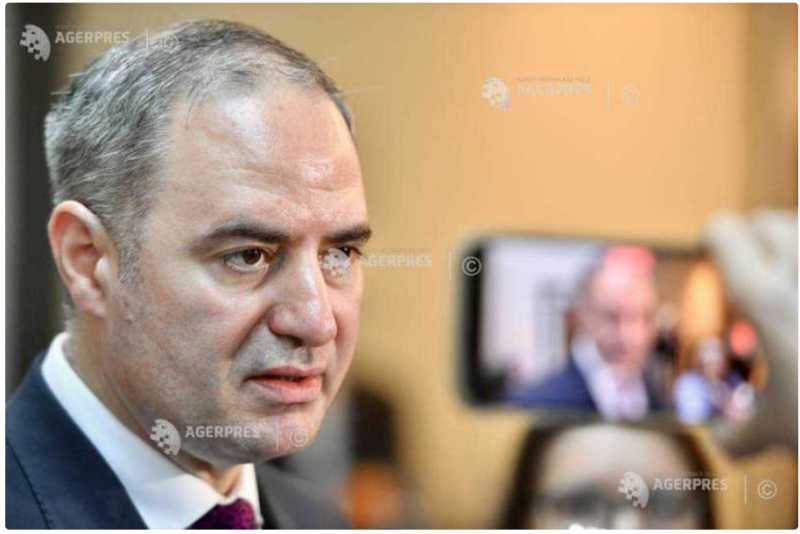
Romania needs a new engine for development as the National Recovery and Resilience Plan nears completion, and the operationalization of the Interministerial Committee on Public-Private Partnership Projects (CI3P) represents a major step forward, according to interim Finance Minister Alexandru Nazare.
'Romania needs a new engine for development. As the NRRP nears completion and the current European funding cycle gradually enters its final stage, we must be more creative and competitive, and mobilize new sources of funding for strategic projects. Therefore, the operationalization of the Interministerial Committee on Public-Private Partnership Projects (CI3P)—established via a decision recently signed by Prime Minister Ilie Bolojan at the proposal of the Ministry of Finance—marks a major step forward. Public-private partnerships have been a priority focus for me since 2024, when I began advocating that Romania must prepare in advance for the next phase of public investment and make more effective use of this mechanism, which has been successfully employed in numerous European countries,' the minister wrote on his Facebook page on Wednesday.
According to him, the new structure—coordinated by the Ministry of Finance—brings together nine ministries and the General Secretariat of the Government to ensure a unified approach to the selection, preparation, and monitoring of PPP projects. CI3P is complemented by another essential instrument set to be launched—introduced via the economic support package in February: the '2026-2028 Program - National Facility for Project Preparation and Technical Assistance for PPPs,' with an allocation of up to 25 million euros.
Through this instrument, we will be able to gradually prepare a national portfolio of mature, well-founded projects that are attractive to investors. Thus, the Government and the ministries set the direction via CI3P, while the Facility—through its implementing bodies, the Ministry of Finance and the Investment and Development Bank—is tasked with transforming good ideas into mature, bankable projects.
'A PPP does not mean free money, nor does it entail the non-transparent shifting of obligations into the future. Projects should be selected only if they demonstrate economic efficiency compared to traditional public procurement, budgetary affordability, and a genuine allocation of risks to the partner best equipped to manage them. That is precisely why Romania needs professional preparation and coordination at the level of the Ministry of Finance,' Nazare explained.
The head of the Finance Ministry emphasized that the role of the CI3P is to identify strategic projects that can be developed through PPPs, ensure the coherence of the legislative framework, facilitate inter-institutional collaboration, promote modern financing and co-financing mechanisms, and build a national investment portfolio ready to attract private capital. Furthermore, the CI3P will facilitate dialogue with the European Commission and international financial institutions.
'A PPP does not merely mean additional financial resources; it entails access to expertise, technology, innovation, and high-performance management, as well as whole-life-cycle cost assessment and more efficient risk allocation. Greece, Croatia, Poland, and Turkey have utilized public-private partnerships for transport infrastructure, hospitals, schools, energy, and environmental projects. European data reveal a market that has mobilized investments totaling hundreds of billions of euros over the past three decades. The goal for the next five years is for Romania to build and progressively implement a substantial portfolio of PPP projects capable of mobilizing billions of euros in private investment annually. These projects can partially offset the decline in investment flows associated with the conclusion of the NRRP, support economic activity, and help maintain high investment levels. Their tangible impact will depend on the projects selected, the pace of preparation, and the timeline for their implementation. We must enter a new phase of development—one in which the state is no longer merely a financier but becomes a credible partner that prepares robust projects, establishes clear rules, and offers predictability to investors,' noted Alexandru Nazare. AGERPRES (RO - writing by: Nicoleta Gherasi; EN - writing by: Catalin Cristian Trandafir)
- Category: English
- Date: 2026-08-05 19:09:56
- Foto: Cristian NISTOR / AGERPRES Photo