
The authorities in Ocnele Mari, together with the parishes in the area and the Association of Former Political Detainees in Romania, paid tribute on Friday to the victims of the communist regime who passed through the local penitentiary, a place considered a landmark of repression in post-war Romania.
Currently, only a door from one of the cells remains from the Ocnele Mari penitentiary, the building having been simply wiped off the face of the earth by the brine released from the salt mine that collapsed in the locality a few decades ago. The memory of those who passed through this prison is, however, alive, preserved by the local community which every year organizes in July the memorial dedicated to these people who paid with their freedom and even with their lives for their ancestral faith and values.
'The former Ocnele Mari penitentiary represents one of the painful pages of our history. Within its walls, people were imprisoned whose only fault was that they chose to preserve their faith, dignity and convictions. Many never left here. They left behind families, dreams and broken destinies, but they left us a priceless legacy, an example of courage and dignity. As mayor of the city of Ocnele Mari, I believe that we have not only the obligation to administer the present, but also the duty to keep the memory of the past alive. A community that forgets its history risks losing its identity. That is why this Memorial is a pledge that we will not let oblivion cover the suffering of those who suffered here. Today we do not only commemorate some names from 'In the history books, we commemorate people who loved this country, who believed in God and freedom and who paid with their lives for these values,' said the mayor Remus Sasu in his opening speech.
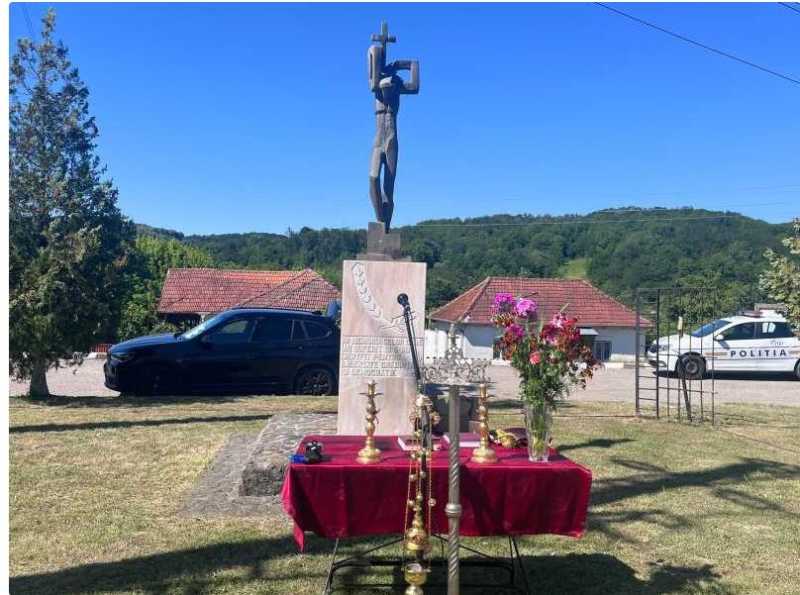
The commemorative event takes place at a monument erected in 2009 in Ocnita, just a few hundred meters from the place where the penitentiary was. For more than 15 years, dozens of people have gathered in front of it to pay homage to those who suffered as a result of detention through religious services and wreath-laying.
'Somewhere above these houses, in a valley, there used to be the Ocnele Mari prison, somewhat famous after the war years for the fact that those dangerous bandits were brought here by the Romanian security and imprisoned for a period of training, after which they were to be sent, one by one, to Pitesti, where it was the most terrible place. Even Solzhenitsyn said that what happened in Pitesti in the 1950s almost beats all the misfortunes that were recorded in Russia. Many of them were young. We didn't have very many deaths in this prison because they stayed here for short periods,' explained to AGERPRES the president of the Valcea branch of the Association of Former Political Detainees, Nicolae Stanculescu, organizer of this memorial together with the city hall.
The commemorative plaques at the base of the Ocnita monument list the names of over 260 people who were allegedly imprisoned there for political reasons. Another 28 are listed as having died in prison and buried in the Bozeasca cemetery, in mass graves. In reality, however, the exact number of those who ended up in this prison during the communist regime is not known.
'We have a directory of former political prisoners throughout the country and there I searched for days in a row for those names where Ocnele Mari prison was written and I listed them all here, but as for the exact number of people who passed through here, you should know that even the state archives know little. At that time, there was a flood of people entering prison, brought by security and thrown into various prisons in the country, Ocnele Mari being a benchmark for the harshness of detention and the sorting, then, according to their criteria, and sending to really large prisons, that is, those where they served another seven, eight, ten, twelve years of imprisonment. My message is that every year we must be present here, at the religious service, because this is what these martyrs need, as much as they could suffer,' Nicolae Stanculescu said.
Important names from the country's intellectual elite passed through here for 're-education'. Among the most famous prisoners are Petre Tutea, Petre Pandrea and the poet Vasile Militaru, who died here, after 18 days of detention, isolated in the penitentiary's infirmary cell, without any medical help. In fact, the idea of this memorial was precisely to evoke the personality of Vasile Militaru, considered a symbol of spiritual resistance in the face of repression.
'Vasile Militaru had a history that people from the local area remember more. At the age of 77, he was arrested in Bucharest, everything was confiscated, that is, all his work and he was a brilliant guy at the time, and he was brought to prison and after a few weeks, at the age of 77, in a prison like this, you can't really have any pretensions to living. But there are many personalities who have passed through here,' the representative of the former political prisoners also said.
The director of the Valcea County Directorate for Culture, historian Florin Epure, even speaks of an 'underground academy' at the Ocnele Mari penitentiary, which functioned as a form of intellectual resistance.
'I discover other personalities who passed through here every day in my research. Not all the names of those who passed through here are written on this monument either. The important thing is that here an elite of 60 peaks, as Petre Pandrea called them, held conferences in an, as they called it, underground academy. They lectured from memory on various topics to over 1,000 prisoners, who were morally and spiritually nourished by what they told them, because they were academics, they were writers, university professors, doctors. So, from all fields, they also maintained their dignity, solidarity among themselves, in order to survive. Ocnele Mari Penitentiary was a place like the others - in Aiud, in Sighet, Gherla, Ramnicu Sarat, the Pitesti phenomenon. They wanted a re-education, they say that a new man was being created, but of In fact, the aim was to liquidate these opponents of the communist regime. And you can imagine how many destinies were destroyed, of the families of those who died here, of those who lost their health here, because after a few years of detention they died of various diseases - tuberculosis, jaundice and other diseases acquired from starvation, from the forced labor to which they were subjected and from torture, from beatings. I say that this penitentiary seems to have been erased, demolished by the will of God, but I believe that it should have remained precisely to remind those who come, the generations to come, that these things should never happen again', added Florin Epure, for AGERPRES.
The former Ocnele Mari prison operated between 1838 and 1948 in the premises of the old salt mines, as a place of forced labor for common law prisoners, and during the communist period it became an extermination camp for political prisoners. AGERPRES (RO - writing by: Ramona Dinca; EN - writing by: Bogdan Gabaroi)
- Category: English
- Date: 2026-07-10 23:26:17
- Foto: Ramona DINCA / AGERPRES