

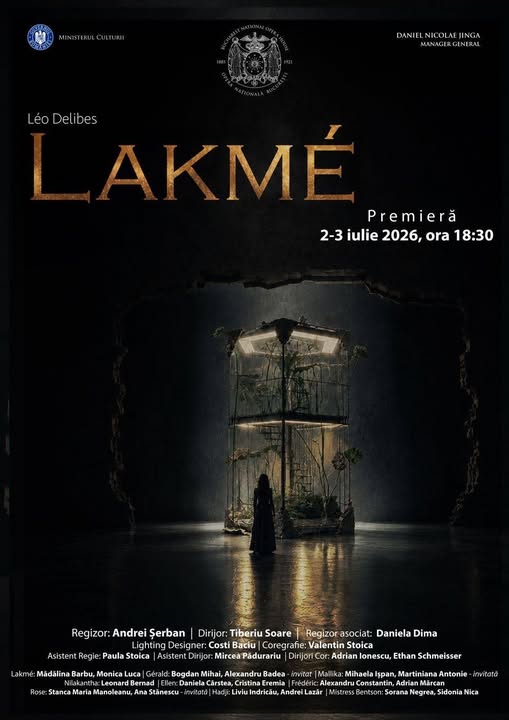
The opera performance 'Lakme' by Leo Delibes, directed by Andrei Serban and under the musical direction of maestro Tiberiu Soare, will be staged for the first time at the Bucharest National Opera House (ONB) on July 2 and 3.
Director Serban expands the meaning of 'Lakme', placing it in the gallery of great impossible loves, alongside masterpieces such as 'Romeo and Juliet', 'Aida' or 'Madama Butterfly'. From this perspective, the story of colonial India becomes a universal parable of how political boundaries and fanaticism destroy human destinies. The keystone in deciphering this tragedy remains the music, especially the famous 'Flower Duet' and 'The Bell Song ' functioning as a territory of absolute reconciliation.
'I was nine years old, I guess, when I listened with my father to 'Lakme' on a record with the great Russian bass Chaliapin as Nilakantha before and after the October Revolution - I imagine that the subject had not created problems for either the Tsars or the Communists. It seems that the opera was also in the repertoire in Bucharest in the '50s, in a period of harsh Stalinist censorship, with the libretto translated into Romanian, 'to understand the people', although, when the rhythms are fast, the words are not understood in any language. According to the communist ideology, the Indians represented the oppressed proletariat, and the British colonialists - the bourgeois-landowner class as the enemy,' according to Serban.
He said that 'Lakme' has been absent from the stage of the National Opera for more than half a century.'
'It is true that it is rarely performed in the world, first of all because it is not easy to find sopranos and tenors who meet the requirements of an extremely complex vocal score. Today, when the post-communist ideology is back in fashion in all the arts, the splendid music of the opera, the simple, beautiful story, with a tragic ending, conquers the hearts, and not the concepts, of whatever nature they may be. Our show focuses on the love affair between two beings from different cultures in times of war. It is absolutely natural to compare the context of the work with the moment we live in today's world, in which different religious beliefs intertwine with power struggles and in which love is annihilated. Lakme is not only a young woman who discovers life by falling in love, but also a being who believes in the power of hope and forgiveness in a world of violence. Her final sacrifice has a value that goes beyond the individual gesture of the lover who refuses life without her lover. He comes from a foreign civilisation shrouded in mystery, which reminds us of the universality of faith, hope and love,' added Serban.
The cast consists of Lakme - Madalina Barbu, Monica Luca; Gerald - Bogdan Mihai, Alexandru Badea (guest); Nilakantha - Leonard Bernard; Frederic - Alexandru Constantin, Adrian Marcan; Mallika - Mihaela Ispan, Martiniana Antonie (guest); Miss Ellen - Daniela Carstea, Cristina Eremia; Hadji - Liviu Indricau, Andrei Lazar; Mistress Bentson - Sorana Negrea, Sidonia Nica; Miss Rose - Stanca Maria Manoleanu, Anna Stanescu (guest); Lakme's double - Maria Gogonea; Lakme's sisters - Andrada Corlat, Serin Jemaa, Alexandra Sarbei, Alexandra Stroe.
Tickets can be purchased on the http://tickets.operanb.ro/ and at the Ticket Office of the Bucharest National Opera House.
The AGERPRES National News Agency is a media partner of the event. AGERPRES (RO - editing by: Petronius Craiu; EN - writing by: Corneliu-Aurelian Colceriu)
Leo Delibes's 'Lakme' directed by Andrei Serban to premiere at ONB on July 2, 3
Conţinutul website-ului www.agerpres.ro este destinat exclusiv informării publice. Toate informaţiile publicate pe acest site de către AGERPRES sunt protejate de dispoziţiile legale incidente. Sunt interzise copierea, reproducerea, recompilarea, modificarea, precum şi orice modalitate de exploatare a conţinutului acestui website. Informaţiile transmise pe www.agerpres.ro pot fi preluate, în conformitate cu legislaţia aplicabilă, în limita a 500 de semne. Detalii în secţiunea Condiţii de utilizare. Dacă sunteţi interesaţi de preluarea ştirilor AGERPRES, vă rugăm să contactaţi Direcţia Marketing - marketing@agerpres.ro.
Alte știri din categorie

President Dan says Foreign Ministry investigating Orlivka school case
President Nicusor Dan said on Friday that Romania's Foreign Ministry has opened an investigation into the case of the school in Orlivka, Odesa region, where a Year 1 class taught in Romanian was closed. Speaking at a news conference held after the Carpathian Integration Initiative 'Carpathian 8' Summit, he said that 'remarkable progress has bee

Bolojan: We will try, within our possibilities and depending on our electoral weight, to form a Government
President of the National Liberal Party (PNL) Ilie Bolojan said on Friday that, although Siegfried Muresan's nomination for prime minister came three months late, the party would deal with the situation 'responsibly' and seek to form a Government based on its electoral weight. 'Yesterday, about 30 minutes beforehand, I learned from the piece of

Siegfried Muresan: We will start work on a government programme; beginning of next week - discussion with MPs
Prime Minister-designate Siegfried Muresan announced on Friday that he was starting work on the government programme together with the National Liberal Party (PNL), Save Romania Union (USR) and the Hungarian Democratic Union of Romania (UDMR), mentioning that he would present the priorities at the beginning of next week and, based on these, would hold an "extremely tran

CCIR's Daraban: The diaspora is not a sentimental issue but a chapter in the national economy
The experience gained by Romanians in the diaspora in competitive markets must be transformed into investment, jobs and exports, believes Mihai Daraban, President of the Chamber of Commerce and Industry of Romania (CCIR). According to a press release from the organisation sent to AGERPRES, the institution is strengthening its partnership with ROUNIT - Reunited
European Commission approves ANSVSA's Action Plan to unblock sheep and goat exports
The Action Plan of the National Veterinary Sanitary and Food Safety Authority (ANSVSA) for unblocking exports of sheep and goats has been approved by the European Commission, allowing exports of carcasses and products to resume under the differentiated vaccination scheme. According to an ANSVSA release sent to AGERPRES on Friday, the approved solution protects
Health Insurance House launches project on cross-border exchange of medical images, laboratory results, discharge reports
The National Health Insurance House (CNAS) announced on Friday the launch of the European project 'Romanian Medical Images, Laboratory Results and Discharge Reports' (RO-MI-LR-DR), for the cross-border exchange of medical images, laboratory results and discharge reports. The project is funded through the EU4Health programme, with the European Health an
'Socola' Institute of Psychiatry in Iasi to hold new memory testing campaign at weekend
The 'Socola' Institute of Psychiatry in Iasi has announced that it will hold the third edition of its 'Memory Testing Campaign' on Saturday and Sunday, a campaign addressing people of all ages and aimed to identify individual risk factors that may predispose people to memory disorders, while also providing participants with specialist counselling.
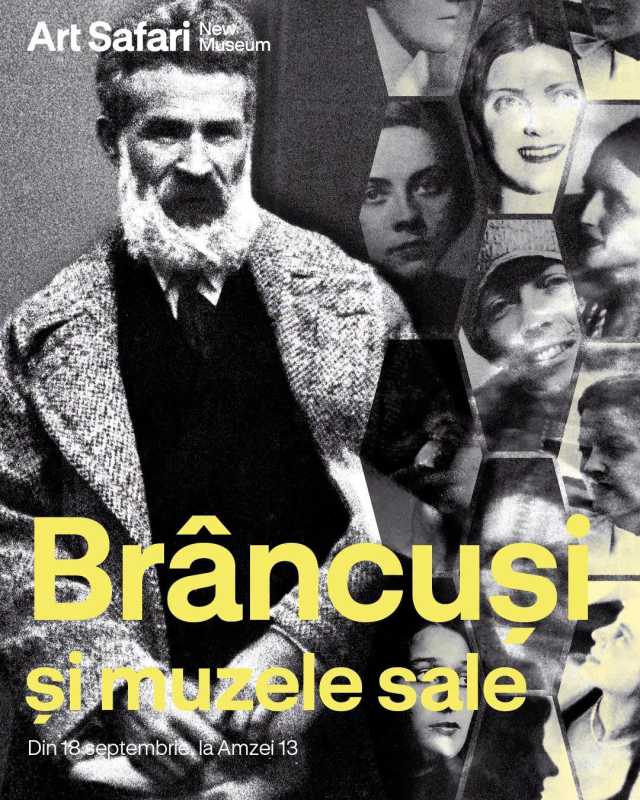
'Brancusi and His Muses' exhibition opens at Art Safari
'Brancusi and His Muses', the largest exhibition dedicated to the great sculptor to be held in Romania during Brancusi Year, opened on Thursday evening at the Art Safari New Museum. Curator Doina Lemny said she wanted the initiative to be different, allowing the public to enter the artist's studio atmosphere. 'It is true that Brancusi's wor