
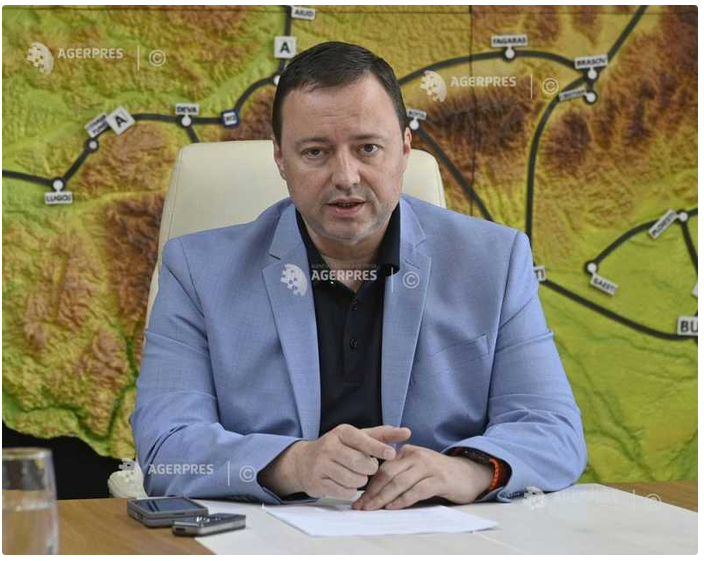
Traffic on the new road bridge over the Tisza River, linking Sighetu Marmatiei (Romania) and Bila Tserkva (Ukraine), was opened on Thursday to passenger vehicles with a maximum authorised mass of up to 3.5 tonnes, Director General of the National Company for Road Infrastructure Administration (CNAIR) Cristian Pistol announced.
'Today, we opened traffic on the road bridge over the Tisza River, which will link Sighetu Marmatiei (Romania) with Bila Tserkva (Ukraine). This new bridge has been symbolically named Maramures-Transcarpathia. It is an important project for cross-border infrastructure and connectivity in northern Romania, carried out in partnership with the Maramures County Council. The new road link between Romania and Ukraine also provides a modern connection to European infrastructure,' Cristian Pistol wrote on his Facebook page.
According to him, the project route is approximately 1.2 kilometres long on Romanian territory and includes the 268.8-metre-long bridge over the Tisza River, as well as the new Sighetu Marmatiei II border control point.
The connection to the existing road infrastructure is made via a roundabout with DN18.
The design and construction contract, worth 135.8 million lei excluding VAT, was signed in July 2022, while the works were financed through the Transport Programme 2021-2027 and carried out by an association of Romanian contractors.
The CNAIR Director General mentioned that traffic is being opened in stages, with vehicles over 3.5 tonnes and buses to be allowed access at a later stage.
'Today, we are carrying out the first stage of the opening, for passenger vehicles with a maximum authorised mass of up to 3.5 tonnes. Subsequently, as the border crossing point becomes fully operational, traffic will also be extended to vehicles over 3.5 tonnes and buses,' Pistol explained.
He underscored the importance of the project for economic development and cross-border connectivity.
'It is an infrastructure project with local, regional and cross-border impact, which contributes to the economic development of the eastern part of the European Union and increases strategic capacity on NATO's Eastern Flank,' the CNAIR Director General also mentioned. AGERPRES (RO - writing by: Nicoleta Banciulea; EN - writing by: Rodica State)
- Category: English
- Date: 2026-10-08 14:56:58
- Foto: Alex TUDOR / AGERPRES Photo